
Medical assistant vs. phlebotomist: Which one should you hire?

Healthcare staffing decisions may be justified due to potential candidate shortages. Given that these challenges focus on job mismatch, when healthcare employers consider phlebotomist vs. medical assistant roles, the question is not which job is better. The question is which job better supports the healthcare employer.
For healthcare recruiters and facilities in the U.S., the medical assistant vs. phlebotomist comparison can help you prevent delays, improve care coordination, and prevent costly turnover. This comparison examines how each job works in the real world of healthcare and where each job adds the most value.
Medical assistants and phlebotomists’ job overview in the United States
Understanding the differences between a phlebotomist vs medical assistant is important because it allows healthcare facilities to identify operational scope, support long-term workforce planning, and align job functions with facility needs.
This clarity also reinforces the differentiation between a medical assistant vs phlebotomist when assigning responsibilities across clinical and diagnostic workflows.
Medical assistants: Broad clinical and administrative support
Medical Assistants can cross over between the clinical and administrative sides of a healthcare facility. Some of their responsibilities include:
- Patient intake and vital sign recording
- EHR (Electronic Health Record) documentation and management
- Appointment scheduling, management, and care follow-up
- Assisting healthcare providers in exams and minor procedures
MAs work in both inpatient and outpatient settings, including physician practices, specialty clinics, and hospitals. The versatility of MAs makes them vital to the operational efficiency of healthcare facilities and the overall patient experience. MAs also help support the diagnostic staff by managing patient visits in a timely and organized manner.
Phlebotomists: Specialists in diagnostic workflows
A Phlebotomist is a specialist in the collection of blood and the handling of specimens. The main effect a phlebotomist has is on the speed and accuracy of lab testing and the speed of diagnosis.
Some of their main responsibilities include:
- Collection of blood samples in a safe and accurate manner
- Proper handling and labeling of specimens
- Preparing patients and explaining the procedure to them
- Lab staff in a timely manner
Phlebotomists are generally employed in hospitals, labs, outpatient clinics, and blood donation centers. Because phlebotomists have been able to communicate directly and quickly with lab staff, providers have been able to make timely diagnoses and set treatment plans.
Operational roles for each position
Healthcare facilities often evaluate both medical assistants and phlebotomists for efficiency in workflow and patient care outcomes.
- Medical assistants help synchronize activities across departments and alleviate clinical bottlenecks.
- Phlebotomists help improve and ensure the reliability of the laboratory and the turnaround time of laboratory tests.
Understanding the differences between a medical assistant and a phlebotomist is important because it allows healthcare facilities to identify the operational scope of the role, ensure long-term workforce planning, and align job functions with the needs of their facility.
Medical assistant vs. phlebotomist: Key role differences
Recruiters like you tend to think about all aspects of their role, not just their title. Most of the decisions related to these roles are based on what is expected to be done within each job category and how it relates to compliance and the operational impact those duties will have on the organization.
Medical Assistants in your facility are responsible for a variety of job duties and also provide patient touchpoints during visits. They have a flexible role and are usually cross-trained to support multiple departments.
Phlebotomists have a more specific responsibility to the Diagnostic Services area and, therefore, less patient contact during their work. They do, however, have a significant impact on the patient’s timeline for obtaining test results, given the accuracy of their work.
Each of these professions is subject to compliance, training, and certification requirements.
- MA training and certification vary by state and facility. Certification is required for certain clinical duties, while others can be obtained through supervised experience.
- Phlebotomists need formal training and certification, as well as strict compliance with laboratory and safety guidelines.
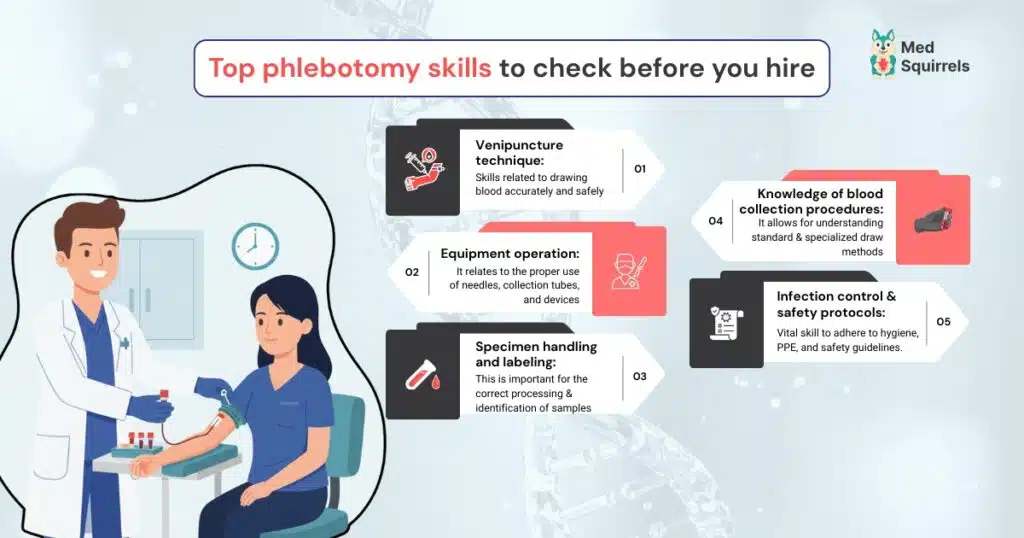
Along with certifications, facilities should verify the required skills when planning to hire phlebotomists and medical assistants. Checking skills during recruiting will benefit your facility, as these skilled professionals can be ready to work on different teams when required, thereby improving patient satisfaction.
A detailed infographic has been added about the key skills that recruiters like you should consider when selecting candidates.
Essential skills to check while staffing phlebotomists
Flexibility across departments and care teams
The work of a medical assistant (MA) can include both clinical and administrative functions, giving MAs the flexibility to support high-volume periods in healthcare. Phlebotomists are highly specialized in their field, focusing primarily on diagnostic workflows.
Impact on throughput and service delivery
Medical assistants are responsible for helping your facility optimize patient flow by handling patient intake, documentation, and coordination. Phlebotomists affect patient throughput by ensuring efficient, accurate specimen collection with a low redraw rate.
Common mistake facilities make: Assuming they can be substituted for each other. It is important to know whether a medical assistant can function as a phlebotomist to make informed decisions.
Workforce demand and availability across the United States
Rising patient demand and high employment levels will affect both roles in unique ways.
Medical Assistant positions continue to be in high demand, especially in outpatient settings, and many facilities track the medical assistant job outlook to predict their long-term availability.
The number of diagnoses growth shows that demand for the phlebotomist workforce is growing, and the shortage is first felt by facilities expanding their lab services, even with a slight increase in testing.
There is a disparity in the availability of positions across different regions.
- There are more potential candidates, but turnover is higher in urban markets
- In the rural areas, the supply is limited
- Outpatient clinics may appreciate more flexibility, whereas hospitals may need more coverage
When the workload is overwhelming and the role is misaligned, you, as a recruite,r must understand that the retention issues will be greater.
Operational impact on healthcare facilities
Staffing decisions also carry financial implications. Facilities evaluating operational efficiency often review medical assistant vs phlebotomist pay to balance labor costs with productivity, coverage needs, and long-term budget stability.
Healthcare facilities or recruiters planning to hire medical assistants or phlebotomists must understand how to offer competitive pay to attract and retain qualified professionals. To support informed compensation planning, a detailed infographic has been added to illustrate current pay structures for both roles.
Top-paying states for phlebotomists and medical assistants

Source: www.bls.gov
How medical assistants impact the workflow process
Medical assistants serve as traffic coordinators. Responsibilities of this position include:
- Assisting with the intake and preparation of a patient’s room
- Decreasing provider downtime
- Coordinating follow-up appointments and chart documentation
Medical assistants’ adaptability helps outpatient facilities accommodate patient demands when they are overstressed.
How phlebotomists support diagnostics
In healthcare facilities, phlebotomists play a vital role in patient interaction and help stabilize the diagnostic process you rely on. This is clearly explained as:
- Assisting with collections during peak hours
- Minimizing capture failures
- Enhancing the turnaround time for labs
When collections at the specimen end slow down, every downstream process is affected.
Aligning clinical roles with patient volume and service mix
Facilities operate optimally when staff roles align with the actual workload, especially when you compare phlebotomist vs medical assistant responsibilities across service lines.
Selecting appropriate roles that match facility requirements
There is rarely a universal answer when selecting the right role for a healthcare facility. The decision depends on the importance of cross-training in allied healthcare settings, the need for flexible skill sets, and how the service mix and patient volume influence the suitability of a phlebotomist versus a medical assistant.
Medical assistants are most impactful when:
- The encounter is in need of both clinical and clerical work
- There is a need for assistance in the room flow from the providers
- Administrative cross-coordination is necessary
Phlebotomists are most effective when:
- There is a high volume of blood collection
- Lab turnaround time impacts treatment options
- There are high compliance standards
Making smart decisions with modern platforms
When deciding between a medical assistant and a phlebotomist, it is not just about filling a position within your facility; it is also about ensuring the individual fits into your operational workflow and patient care model, as well as the volume of patients.
Healthcare facilities that understand the difference between medical assistant vs phlebotomist in roles, patient interaction, and workflow can make better decisions when considering phlebotomist vs medical assistant requirements.
Credentialing is important. Medical assistants and phlebotomists have different certification requirements and regulatory structures in each state of the U.S. If a facility does not account for this during staff onboarding.
It can create difficulties with regard to the limitations on tasks team members can perform, compliance with regulations, and finding last-minute coverage for shift vacancies due to absences that affect your operations.
Credential verification at the start of employment can streamline the process.
Traditional agencies are still preferred by many facilities. Although they may appear to be a great source of convenience, there are numerous challenges associated with agencies:
- High fees associated with placing staff create a burden on long-term staffing budgets
- Limited transparency when it comes to credentialing and aligning roles
- Rigid contracts that are difficult to adapt to customers with high patient volumes
These challenges demonstrate that traditional agencies do not provide the same value and efficiency for facilities that have a continuous focus on sustainable workforce planning.
MedSquirrels’ innovative solutions address these challenges through a simple, affordable staffing approach.
- The Purple Plan works well for healthcare facilities that have already identified a provider and need support with credentialing, payroll, benefits, and compliance.
- The Orange Plan extends support to include full recruitment services, including sourcing, screening, interview scheduling, and onboarding.
- For long-term staffing needs, the Blue Plan is ideal for full-time radiologist placements and also provides end-to-end recruitment services for both clinical and non-clinical roles.
Each plan is designed to keep costs predictable and affordable, allowing facilities to hire within budget while maintaining compliance and role accuracy.
When facilities combine role clarity, certification checks, and the right model, hiring becomes a structured process rather than a reactive scramble. That is how staffing decisions begin to support operational stability, patient care continuity, and long-term workforce confidence.
Facilities can book a demo to see how our platform supports faster decisions. Healthcare professionals can browse open jobs and apply for those jobs that align with their professional goals.
FAQs
Can a medical assistant work as a phlebotomist?
In some settings, a medical assistant may perform phlebotomy tasks if they have received proper training and certification, but this depends on state regulations and facility policies. Along withthe facility’s requirement.
How do medical assistants and phlebotomists impact patient flow differently?
Medical assistants help manage patient intake, documentation, and room flow, while phlebotomists influence patient throughput by ensuring timely and accurate specimen collection.
Which role is better suited for high-volume outpatient clinics?
Outpatient clinics often benefit from having medical assistants handle both patient-facing and administrative responsibilities, especially during peak hours.
What is MedSquirrels, and how does it support healthcare facilities?
MedSquirrels is a modern healthcare staffing platform that supports facilities with recruitment, credentialing, payroll, complianceacross clinical and non-clinical roles.
Is MedSquirrels suitable for facilities with budget constraints?
Yes. MedSquirrels, a healthcare staffing platform, is designed to help facilities hire within budget by offering affordable, transparent staffing plans that scale according to workforce demand rather than locking facilities into long-term agency contracts.

Suresh writes about healthcare staffing and industry insights for MedSquirrels, helping professionals and facilities navigate hiring needs.