
The importance of cross-training in allied healthcare settings

Cross-training in allied healthcare is a strategic approach within facilities to upskill their existing staff beyond their primary roles. This strategy helps the facilities equip professionals with the advanced skills necessary to work across roles.
Cross-team allied healthcare training must be provided under the supervision of experienced professionals working in the concerned domain. It helps facilities optimize their workforce while enhancing allied health professionals’ skills across functional areas.
Cross-training also ensures patient care continues during emergencies or staff absences. In such cases, due to unavailability, turnover, or burnout, facilities often rely on temporary hires from allied health agencies to reduce costs. This blog will help you understand the importance and benefits of cross-training in healthcare.
How can you facilitate the cross-training of allied health professionals?
Allied healthcare training is a strategy that can be implemented based on a range of factors, such as the hospital setting, patient volume, inpatient facilities, and available technologies. Normally, there are two ways in which the facilities cross-train their allied healthcare professionals, such as:
Cross-unit training – In this approach, allied healthcare professionals are proactively trained to work across various functional units in hospital settings, such as critical care, surgical assistance, ventilator support, and telemetry, where skilled resources are scarce and workload demands are high.
Cross-specialization training – This approach will help recruiters like you adapt to evolving staffing demands and trends, while reducing staff burnout and addressing high patient volumes. The staff is cross-trained to work across inpatient and outpatient settings, as well as in specialized areas such as oncology, cardiology, pediatrics, geriatrics, and more.
Strategies for enhancing team-based learning and collaboration
Strategy | Description |
Promote interdisciplinary education | Encourages learning across different healthcare roles to build mutual understanding and collaboration. |
Implement collaborative training programs | Uses workshops, seminars, and team-based activities to strengthen cooperation among professionals. |
Incorporate case studies and problem-solving exercises | Applies practical scenarios and shared problem-solving to enhance teamwork and critical thinking. |
Leverage technology for learning | Utilizes online platforms, webinars, and virtual simulations to facilitate accessible and flexible training. |
Encourage open communication and feedback | Promotes regular meetings, debriefings, and feedback sessions to support continuous improvement. |
source:healthtechacademy
How does the cross-training of allied health professionals benefit facilities?
Address staffing gaps: Staff shortages and increased turnover due to burnout are major concerns in U.S. healthcare facilities. Healthcare staff training across cross-teams enables shift rotations.
These help you attract top allied healthcare talent and allow time off based on workload, as other cross-trained staff provide support. This enhances retention and mitigates staffing challenges, ensuring continuity of patient care.
Increased team collaboration: Cross-training allows existing and newly hired allied health professionals to understand operational challenges across departments. Healthcare staff training and shared knowledge enable collaborative strategies to optimize patient care, streamline operations, and foster a cohesive, happier workforce.
Agile workforce: During periods of high patient volume or emergencies, cross-trained employees can flexibly cover multiple roles, delivering efficient care. This reduces downtime and the need to hire allied health professionals temporarily through recruiters, ensuring essential duties are performed promptly.
Adherence to standards and protocols: Cross-training ensures staff are familiar with hospital policies, standards, and best practices across departments. This consistency reduces errors, improves patient safety, and enhances operational efficiency, fostering long-term patient relationships.
Cost savings on recruitment: Recruitment is a major operational cost, even when using an allied health professional agency. According to the US Bureau of Labor Statistics, healthcare worker dropouts rose from 501,000 to 543,000 in just two months. Cross-training helps hospitals optimize existing staff, reducing the need to hire allied health professionals.
For example, integrating pharmacy and medical assistants improves resource allocation and proactively reduces costs. Understanding burnout also helps recruiters design strategies to maintain staff well-being. A detailed infographic is provided to clarify the key factors contributing to burnout.
Understanding the causes of staffing gaps in healthcare
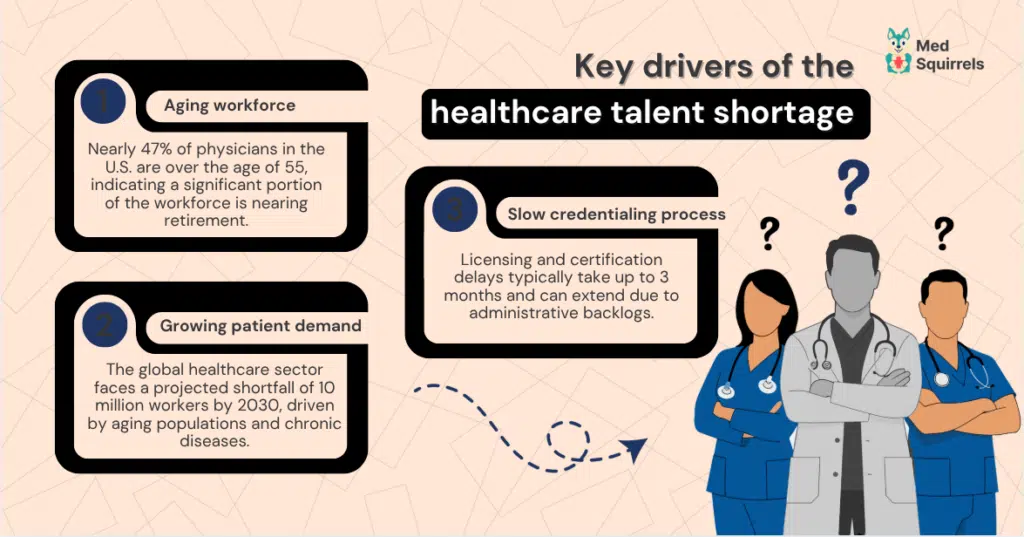
Key things to note while cross-training your existing staff
Even though allied healthcare training in cross teams is an effective strategy for your facility, certain considerations should be kept in mind throughout the process for your existing allied health professionals.
- Identify the functions or departments that require cross-training.
- Determine whether cross-unit or cross-specialization training is essential based on your facility’s needs.
- Define clear career progression paths for your existing staff to avoid misperceptions.
- Establish a supportive environment and provide opportunities to apply the newly learned skills.
- Assess how cross-training has improved the workers’ skill sets before deploying them to that area.
- Take feedback and monitor the progress of the cross-trained staff.
Hire well-trained allied health professionals with the right platform
While allied healthcare training offers many benefits in the evolving patient care sector, understanding the importance of cross-training helps clinics realize that relying solely on existing staff to cut recruitment costs may not be effective.
A significant point to note regarding allied staffing is that when you hire allied health professionals through recruiters, a substantial portion of the workforce’s salary goes to the recruiters, resulting in compensation below market standards.
To avoid allied healthcare staffing challenges, partner with MedSquirrels, where you only pay a flat fee for the service you use, with no markups or additional fees.
MedSquirrels is an all-in-one HR platform with affordable staffing plans that provides healthcare staffing solutions by leveraging technology to optimize your recruiting needs, whether full-time or contract.
These staffing plans are designed to help you meet your recruitment needs, such as for contractual and full-time roles, or to onboard your self-sourced talent in compliance. Recruiters can book a demo to learn how MedSquirrels can be the best allied health recruiter for your facility. Working professionals can also check open jobs and apply for those that match their skills.
FAQs
Why is cross-training important in healthcare?
Allied healthcare training across teams is important in healthcare because it equips staff with diverse skill sets, enabling them to perform a variety of roles as needed. This flexibility ensures smoother operations, reduces reliance on temporary hires, and helps maintain quality patient care during staff shortages or unexpected absences.
What are the benefits of cross-training in allied healthcare?
Cross-training in allied healthcare improves workforce versatility and operational efficiency. It allows allied health professionals to assist across different departments, reduces bottlenecks in patient care, supports better collaboration, and enhances employee engagement by offering skill development opportunities.
How does cross-training help address healthcare staffing challenges?
Cross-training has benefits that help facilities manage staffing challenges by providing a flexible workforce that can adapt to fluctuations in patient demand. It reduces the pressure of recruiting additional staff, minimizes disruptions due to absenteeism, and ensures consistent patient care even during peak periods or emergencies.
Why choose MedSquirrels for allied healthcare staffing?
MedSquirrels provides access to a large pool of pre-screened professionals, including therapists, technicians, and support staff. By combining AI-powered candidate matching with expert recruiter oversight, facilities can quickly fill roles while ensuring high-quality.
How can MedSquirrels assist in overcoming healthcare staffing challenges?
MedSquirrels streamlines recruitment by reducing middlemen, eliminating markups, and providing transparent, flat-fee recruiting solutions. Facilities can maintain workforce flexibility and ensure consistent patient care.

Jani Basha is a Content Specialist with a background in healthcare content development, recruitment, and workforce management. His work focuses on the challenges healthcare facilities face in attracting, staffing, and managing clinical and non-clinical professionals. He develops content on healthcare recruitment, workforce trends, and staffing strategies. His work translates complex workforce topics into practical insights for healthcare recruiters. His work aligns with MedSquirrels’ mission to make healthcare staffing more efficient and cost-effective through technology-driven workforce solutions.