
5 strategies to attract top allied healthcare talent
For most recruiters, allied health staffing has become a vital priority as recruiters face increasing pressure to fill crucial positions beyond doctors and nurses.
Professionals such as radiographers, respiratory therapists, and physical therapists play a vital role in delivering efficient patient care. This requirement is making it increasingly important for facilities to attract qualified talent in a competitive market.
This blog explains proven smart strategies to attract top allied healthcare professionals and address the growing allied health staffing shortage.
Strategy #1: Offer competitive compensation and benefits
Competitive pay is an important factor when attracting certified allied health professionals.
In recent years, wages in allied healthcare staffing have become more aligned with industry standards, reflecting the rising demand for skilled talent.
For example, if you are planning to hire MRI technicians for your clinic in California, you would need to pay approximately $80,850 per year for each MRI technician as per market standards.
In addition to competitive salaries, offering comprehensive benefits such as paid, career-oriented certifications like Advanced Cardiac Life Support (ACLS) can boost employee satisfaction.
Other benefits such as joining bonuses and relocation assistance can make your offer more attractive.
To provide competitive salaries, especially for allied healthcare roles such as medical sonographers, as a recruiter, you must stay informed about recent changes.
So, to keep you informed about salaries, an infographic about states and their compensation is provided to ease your allied health staffing.
Top-paying states for magnetic resonance imaging technologists
States | Hourly pay | Annual pay |
California | $ 55.14 | $ 114,680 |
Alaska | $ 52.80 | $ 111,690 |
Washington | $ 52.77 | $ 109,750 |
Hawaii | $ 51.26 | $ 106,610 |
Oregon | $ 51.25 | $ 106,620 |
Source: BLS
Strategy #2: Encourage a positive work culture
Recruiters must remember that practicing a positive work culture is essential for attracting allied health professionals in the U.S.
Skilled professionals prefer work environments where they feel valued, supported, and empowered.Latest research indicates that factors such as recognition for career advancement significantly influence job satisfaction among allied health staff.
Allied health professionals value workplaces where they are supported.Acknowledging employee efforts and offering chances to learn can boost job satisfaction. This helps keep employees engaged.
Hospital owners can use team-building activities. These can boost long-term stability and improve work-life balance..
Strategy #3: Prioritize work-life balance
Career advancement is one of the main drivers of professional choices for allied healthcare professionals in recent times.
Professionals must have enough time for their personal and family duties.
So, most job seekers are looking to work at clinics that support both career growth and personal well-being.
Recruiters need to know that offering work-life balance is a key way to attract top talent. It is just as vital as professional life, particularly in high-stress work environments.
Providing flexible shift scheduling, providing mental health care, and family-friendly policies can help you hire skilled allied professionals for your facility. Practising this employee-friendly strategy also helps you reduce burnout and keep a healthy team intact.
Strategy #4: Utilize technology and new tools for recruitment
Technology is transforming the way facilities approach allied health recruitment. As recruitment technology evolves, clinical owners should keep their hiring strategies up to date.
Staying informed makes it easier to find and onboard professionals to fill staffing gaps.
Multiple digital tools can make allied health recruitment faster and more effective:
- Leverage social media platforms to reach a wider pool of job seekers.
- Use applicant tracking systems to organize applications. This cuts down on time spent on admin tasks.
- Recruiters can use AI-driven healthcare job platforms. These tools help facilities find candidates with the right skills
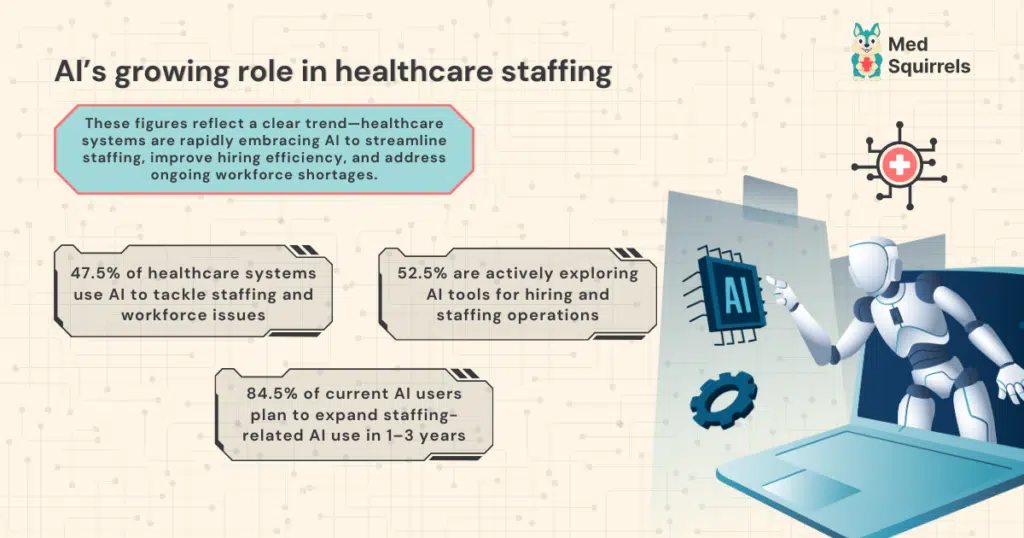
A technology-driven staffing strategy reflects operational efficiency. An infographic about the growing presence of AI in healthcare staffing is added to help you make more planned recruiting decisions.
Influence of AI technology in healthcare staffing
#5 Prioritize recruiting candidates open to transition
One underutilized strategy to attract top allied healthcare professionals is targeting those willing to make the switch between specialties or between care settings. These individuals usually have varied experiences and new ways of thinking that enhance your care provision. Through cross-training sessions or bridge programs, healthcare centers can reskill interested professionals and solve healthcare workforce shortages. This is not only a way to broaden the recruitment base but also helps in internal mobility and professional satisfaction. Facilities looking to hire allied healthcare professionals from diverse clinical backgrounds will benefit from this adaptable approach.
Example: A radiologic technologist who wishes to become a sonographer may be more encouraged to apply for a facility with in-house training and certification assistance.
The pitfalls of traditional staffing partnerships — and the MedSquirrels solution
Although numerous healthcare facilities continue to use traditional staffing agencies to recruit allied health roles, these partnerships usually carry drawbacks. One primary drawback is that there is no customization—traditional agencies have predictable routines that do not quite fit your unique staffing requirements. This leads to misaligned placements, lagging onboarding, and increased administrative burdens, all of which exacerbate healthcare workforce shortages. Another area of concern is the use of outdated recruitment processes by many traditional agencies. With a lack of tech adoption, they are struggling to reach top-quality candidates or optimize job placements. Such inefficiency does not just delay hiring, it also increases costs and turnover. Read more on how flexible staffing models improve hiring outcomes.
Example: A hospital or a healthcare facility working with a traditional staffing agency may take weeks to fill a physical therapist position, losing business and stressing existing staff in the interim.
MedSquirrels addresses these issues using a new, modern, AI-driven platform designed exclusively for healthcare staffing. Whether you need to scale up fast or replace hard-to-fill positions, MedSquirrels provides affordable allied health workforce solutions that outperform traditional approaches.
MedSquirrels caters to you with three useful and affordable plans. The Plan offers full-service staffing with end-to-end support, such as sourcing, onboarding, payroll, and liability protection—best for facilities in need of total administrative relief.
The Purple Plan is most suitable for hospitals that have a preferred candidate but need help with credentialing, HR compliance, and onboarding. This plan enables you to be in control while lessening your burden of operation. Lastly, the Blue Plan is tailor-made for the tricky-to-fill positions. It provides highly focused recruitment by taking advantage of AI technology to entice the best allied healthcare professionals more effectively.
The platform also offers real-time hiring transparency, ensuring you can test its efficiency without long-term risk. With its pay-per-hire model and flat-rate options, MedSquirrels keeps staffing costs affordable and aligned with your budget.
By making the move to partner with MedSquirrels, healthcare facilities have a strategic partner that knows the special challenges of allied health staffing and offers the solutions and flexibility to overcome them.
Allied health staffing will continue to shape how care is delivered across disciplines. Understanding these key strategies and adapting your approach is the best way forward for those aiming to succeed amid rising demand and tighter talent pools. For forward-thinking healthcare providers, MedSquirrels offers the best-fit allied health staffing model for the modern era. You can book a free demo to see our staffing platform in action!
FAQs
How can healthcare facilities attract top allied health talent?
Healthcare facilities can attract top allied health talent by offering competitive compensation, professional development opportunities, fostering a positive work culture, and implementing modern recruitment strategies. Providing work-life balance and flexible scheduling also helps.
What types of allied health professionals are in demand?
Some of the most in-demand allied health professionals include physical therapists, radiographers, respiratory therapists, occupational therapists, speech-language pathologists, and medical laboratory technicians. The demand varies depending on the specialty and geographic location.
What qualifications are required to become an allied health professional?
The qualifications vary by profession but typically include relevant education (degree, diploma, or certification), clinical training, and licensure or certification from an accredited regulatory body. Some roles may also require specific experience or specialization.
How does MedSquirrels differ from traditional staffing agencies?
Unlike traditional staffing agencies, MedSquirrels uses advanced AI technology to automate recruitment, match candidates to job openings faster, and provide tailored solutions. MedSquirrels is more transparent, flexible, and efficient, offering modern workforce solutions that meet the unique needs of healthcare facilities.
What makes MedSquirrels a strategic partner for healthcare staffing?
MedSquirrels is a strategic partner because it understands the unique challenges of allied health staffing and provides a tech-forward, flexible, and cost-effective approach to meet healthcare facilities’ staffing needs. The AI-driven platform ensures quicker, more efficient placements, reducing strain on administrative resources.

Jani Basha is a Content Specialist with a background in healthcare content development, recruitment, and workforce management. His work focuses on the challenges healthcare facilities face in attracting, staffing, and managing clinical and non-clinical professionals. He develops content on healthcare recruitment, workforce trends, and staffing strategies. His work translates complex workforce topics into practical insights for healthcare recruiters. His work aligns with MedSquirrels’ mission to make healthcare staffing more efficient and cost-effective through technology-driven workforce solutions.