
7 strategies to combat the staff shortage in radiology
Radiology staff play a crucial role in the healthcare team. They use imaging technologies such as ultrasound, CT scans, and X-rays to support accurate diagnoses. These diagnoses assist physicians in personalizing patient treatment.
However, there is a growing shortage of radiology professionals, which poses a challenge for facilities.
This shortage may be caused by increasing patient numbers and a lack of skilled professionals. These shortages are creating challenges in maintaining adequate staffing levels.
In this blog, you will know about strategies to overcome the radiology staffing shortage.Along with this, as a recruiter, you will also know the top reasons contributing to the shortages.
Key factors contributing to the radiology shortage
Factor #1:Increasing demand for medical imaging
Recent developments in medical technology have made healthcare imaging services a vital part of patient care.
This demand is creating a major gap between available radiology capacity and service growth. Workforce capacity outpaces recruiting, increasing pressure on radiology staffing.
Factor #2: Increase in the number of aged workers
The radiology sector is currently facing challenges related to an aging workforce approaching retirement.
This retirement challenge is creating an imbalance in your facility’s workforce levels due to the radiologic tech shortage.
It can also result in delays in patient care and will increase turnover rates among exciting team members.
Factor #3: No planned workforce scheduling
Clinical workforce demand can increase due to patient volume and unexpected absences from your team members.
So, maintaining planned work scheduling ensures your facility runs smoothly.
It will also help you enhance your patient care and assist you in effectively overcoming radiology staffing shortages.
Having planned workforce management allows facilities to adjust workforce levels in response to patient demand.
Over time, based on your facilities’ requirements, practising flexible workforce management will improve cost control and care quality.
Strategies to combat the staff shortage in radiology
The radiology workforce shortage is becoming a challenge across healthcare systems.
Many facilities are facing challenges to maintain adequate staffing levels while meeting increasing patient demands.
To overcome the staffing challenges, facilities need to implement strategic plans that can help you maintain quality care.
Strategy #1: Improve employer branding
In this competitive world, brand value has its own importance. Recruiters must understand that a strong employer brand can make staffing much easier and more effective.
To build a strong employer brand as a facility owner, you need to focus on a few key values:
- Provide a stress-free work environment and maintain a strong social media presence.
- Encourage employees by recognizing their efforts and supporting their growth.
- Offer regular promotions and skill-development courses to help employees grow.
These values can help you build a strong image, and they will also assist you in planning to hire skilled radiologists.
Strategy #2 Hire based on the clinic’s necessity
Staffing for a role is a continuous process for a clinic or facility. Recruiting needs can arise for many reasons, including unplanned leave, an aging workforce, unexpected patient growth, and workforce turnover.
Unexpected growth of patients and workforce dropouts are linked to the radiologic tech shortage.
To overcome workforce gaps as a recruiter, you must make planned decisions. It may include a thorough evaluation of the required workforce numbers.
If your facility is in immediate need of healthcare staff, you need to choose a flexible workforce model, such as contract or per diem staff.
Flexible radiology department staffing models allow you to quickly hire and adjust workforce levels in response to patient growth.
They help you provide patient care effectively during the radiology workforce shortage.
This can reduce the pressure of full-time recruiting while helping maintain patient care and operational stability.
To help you hire efficiently, multiple flexible approaches are outlined below:
- Opt for temporary staffing: This involves recruiting employees for a defined period or until a specific season is completed.
- Temp-to-hire: It refers to recruiting a professional on a temporary basis with the potential for full-time employment after a performance evaluation.
- Contract staffing: Focuses on engaging employees under a contractual agreement for a set term.
Choosing the right flexible staffing model can help your radiology department respond to its workforce gaps faster while maintaining patient care.
Strategy #3: Prepare an effective job description
The most essential step while staffing is to draft a detailed job description with a clear understanding of the role’s responsibilities.
Those responsibilities must include everything from patient care to imaging device management.
When drafting a job description, you must also address whether handling of specialized equipment or specific applicants are required.
These details will help you attract qualified candidates with the necessary skills for the position.
By providing a glimpse into the responsibilities, you help professionals see the value and purpose of their job.
For example, if your clinic is planning to hire a radiologist, make sure the job description clearly outlines responsibilities to support recruitment and strengthen radiology staffing solutions.
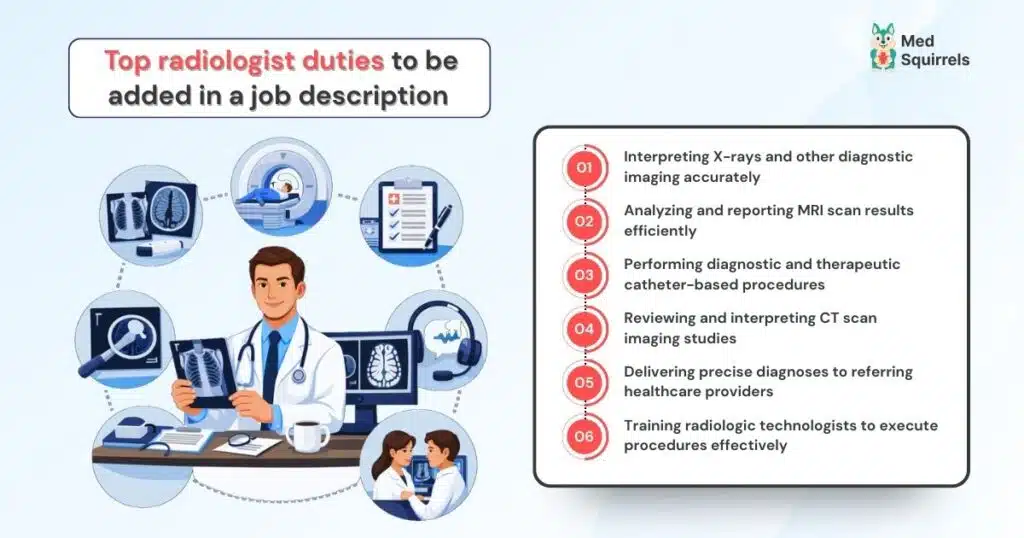
To provide a detailed understanding of what can be included in a job description, an infographic has been added to streamline staffing.
Key radiologist duties to include in a job description
Strategy #4: Use referral programs to hire
One under used strategy during staffing is employee reference.Healthcare managers should encourage their employees to recommend qualified candidates through referral programs.
Here are simple ways to make referral programs more effective:
- Use your employees’ professional networks to find certified radiologic technologists.
- You can also offer referral incentives to encourage employees to recommend qualified and certified professionals.
Recruiters must understand that employee referrals can be an effective way to hire qualified radiologic technologists. It will also help you address staffing challenges in your budget.
Strategy #5: Encourage and support your employees with a positive workplace
Health care managers must understand that a supportive workplace is essential.
Having supportive management and a supportive workplace can make employees feel valued and motivated to do their best. To maintain a supportive workplace, recruiters must practise a few steps.
Focus on these simple ways to encourage your employees:
- Encourage open communication.
- Promote teamwork and collaboration.
- Recognize employees and celebrate their achievements.
A supportive work culture can also improve employee retention and encourage staff to recommend your clinic to other jobseekers.
You must understand that when employees feel supported, they are more likely to stay and contribute to a strong team.
Strategy #6: Optimize the onboarding process
Facility owners might be aware of the importance of the onboarding process. It is a vital process done after recruiting. Having planned and optimized onboarding processes can significantly help you enhance radiology staffing at your facility.
As a recruiter, you need to implement a planned onboarding process to overcome staffing shortages at your facility.
It helps your facility ensure that newly hired professionals receive the required instructions about the role and the facility, including its dos and don’ts.
These detailed instructions help a candidate prepare to care for patients seeking imaging services:
- To optimize the onboarding process, clinics need to maintain digital onboarding solutions, such as eLearning platforms and virtual orientations.
- You can also maintain a team of instructors with senior employees to create a structured onboarding process.
These detailed instructions help a candidate prepare to care for patients seeking imaging services.
Strategy #7: Award competitive compensation packages
Encouraging your employees with competitive radiology technologist salaries is a vital step in reducing burnout in your team.
Clinic owners must understand that offering competitive wages not only increases their chances to attract skilled radiology staff but also motivates them to stay longer with the facility.
Recruiting managers planning radiology technologist recruitment must know that competitive wages also position your facility as an employer of choice in a competitive market and strengthen your overall branding.
A facility that offers competitive radiology technologist compensation is more likely to reduce recruitment challenges caused by the radiology staffing shortage.
For example, if you want to hire a radiology technician, offering a market-trending salary is essential.
As a recruiter, it is your duty to stay up to date on the current nationwide pay structure. To help you understand the pay structure, a detailed infographic about salaries in top states is provided.
Top-paying states for Radiologic Technologists
State | Hourly pay | Annual pay |
$ 49.59 | $ 103,150 | |
$ 44.84 | $ 93,270 | |
$ 44.31 | $ 92,170 | |
$ 43.56 | $ 90,610 | |
$ 43.22 | $ 89,910 |
Source: BLS
Partnering with modern platforms to overcome shortages in radiology
Radiology clinics facing workforce shortages must adopt structured strategies to address staffing gaps and maintain operational stability.
A proactive and results-driven recruiting approach helps clinics reduce time-to-fill while maintaining high standards of patient care.
One vital strategy is to avoid over-dependence on traditional staffing agencies and free job portals.
It is said to avoid agencies because they often practise traditional radiology department staffing models.
This traditional model of staffing gives access to limited verified profiles, which may increase overall recruiting time.
In the same way, free job boards can pose additional challenges during the recruiting process, including high competition, unverified applicants, and delayed candidate engagement.
To overcome these challenges, facilities should partner with modern platforms such as MedSquirrels.
Partnering with MedSquirrels is one such bright option. This modern platform supports hospitals with structured recruitment solutions to overcome the radiology workforce shortage.
Staffing with MedSquirrels is cost-effective, as it has affordable staffing plans that align with your recruiting plans.
By implementing these recruitment strategies, healthcare imaging centers can fill both immediate vacancies and long-term workforce needs.
Facility owners can book a free demo to evaluate how the platform accelerates the staffing process.
Healthcare professionals can also explore open jobs and apply for positions aligned with their qualifications and career goals.
FAQs
What are the biggest recruitment challenges in radiology today?
Facilities often face limited access to qualified candidates, intense market competition, and longer time-to-fill metrics. The radiologic technologist shortage further narrows the available talent pool.
How does a radiology workforce shortage impact healthcare facilities?
A shortage directly affects turnaround times, patient satisfaction, and revenue cycles. Delays in imaging services can slow diagnosis and treatment planning. Over time, this may increase staff burnout and operational instability.
Are flexible staffing models effective in radiology?
Yes. Contract staffing models allow facilities to manage fluctuations in patient demand. These models provide workforce agility without increasing long-term fixed labor costs.
How does MedSquirrels ensure candidate quality?
MedSquirrels focuses on verified professionals and a structured screening process. This helps recruiters connect with qualified clinical and non-clinical candidates whose credentials match the facility’s requirements.
Is MedSquirrels suitable for facilities of all sizes?
MedSquirrels is designed to support small clinics, specialty practices, and large hospital systems. Its tiered plans allow facilities to select recruitment support that aligns with their staffing volume, budget, and administrative capacity.

Jani Basha is a Content Specialist with a background in healthcare content development, recruitment, and workforce management. His work focuses on the challenges healthcare facilities face in attracting, staffing, and managing clinical and non-clinical professionals. He develops content on healthcare recruitment, workforce trends, and staffing strategies. His work translates complex workforce topics into practical insights for healthcare recruiters. His work aligns with MedSquirrels’ mission to make healthcare staffing more efficient and cost-effective through technology-driven workforce solutions.