
10 ways to recruit top radiologic technologists
Radiologic technologists are also known as radiographers. These certified professionals mostly work in hospitals and perform X-rays and other diagnostic imaging examinations on patients.
Surgeons and physicians use these examinations to treat patients. The success of radiologic departments and healthcare facilities mostly depends on the strength of their workforce.
This is because in medical imaging, the workforce’s expertise, empathy, and precision play a crucial role.
The ability to attract, hire, and retain qualified radiologic technologists through planned recruitment strategies is essential for healthcare facilities aiming to provide high-quality patient care
In this blog, you will learn proven strategies for recruiting radiologic technologists in the ever-changing talent acquisition landscape.
Steps to build a radiologic technologist workforce
Technology and data-driven radiologic technologist recruitment have transformed how clinics hire radiologic technologists. If your facility can use a data-driven recruiting format, it means it maintains complete data on professionals working there.
Following these steps will help you to maintain data-driven staffing:
Step 1: Maintain complete professional data
As a recruiter, you must use a data-driven approach to maintain records of professionals working in your clinic.
Step 2: Track professional availability
Facilities need to maintain data that includes the total number of professionals present and on leave on a daily basis.
Step 3: Compare staffing requirements with patient growth
Clinics must use technology to assess the number of radiologists they need to hire as patient volumes grow.
Step 4: Estimate future staffing demands
Recruiting managers must use prior recruiting data and patient growth to estimate future staffing demands.
Key takeaway for recruiters:
Recruiters must adopt data-driven staffing practices to help facilities maintain workforce visibility and plan for future radiologic technologist staffing requirements
Strategy#2: Use a detailed job description for radiologic technologist recruitment
Successful talent recruiting in the healthcare sector requires a detailed job description.
When you have a transparent role description, it will help you attract candidates who are a good fit for the role you want to hire.
A well-written job description clearly mentions required certifications, shift expectations, and workplace responsibilities.
This clarity helps recruiters filter and qualify applicants who only fit the job requirements.
To strengthen the radiologic technologist recruitment process, you can consider the following:
- As you plan to hire, it is essential to specify the required licenses and certifications for this role.
- You can define the key technical skills you are seeking.
- Remember to outline work schedules and responsibilities upfront
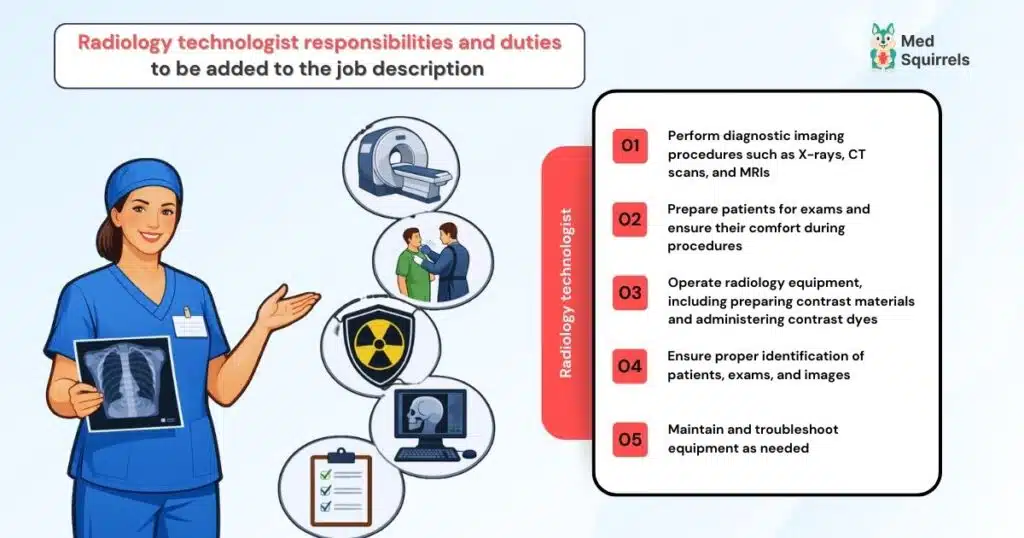
To define skills in a job description, it is essential to stay informed about the trending skills. A detailed infographic about the skills has been provided to add to the job description.
Radiologic technologist responsibilities and duties for job description
Strategy#3: Upgrade the onboarding and training process
Hospital managers need to examine how onboarding and their current training are implemented in their facility.
This examination helps you identify any gaps and enhance the onboarding process.
If your training processes do not meet your facility’s needs, then you may not provide quality patient care.
To overcome these issues, recruiters can talk to experienced and newly recruited radiologic technologists about where training can be improved and take their feedback.
A better option is to create a team dedicated to improving the onboarding training process.
Recruiters looking to refine staffing in healthcare should follow a planned onboarding process such as:
- A structured onboarding plan should introduce radiologic technologists to the imaging equipment they use in your facility.
- It should also explain working guidelines in your facility, safety protocols, and daily workflows.
This detailed process helps them start their work with confidence from day one. Demonstrations from senior technologists help new hires learn faster.
Guidance during onboarding makes it easier to understand your facility’s standards. It also strengthens patient care practices.
A clear onboarding process reduces confusion in the early stages. It also lowers the chance of mistakes. This helps radiologic technologists become confident team members.
Strategy#4: Invest in technology
Technological advancements in radiology have significantly improved the quality of imaging.
These technological advancements improve imaging clarity within healthcare facilities, enabling more accurate diagnoses from medical images.
Improved imaging quality also supports better clinical decision-making, helping healthcare providers plan personalized treatments and enhance overall patient care.
The percentage of employees who prefer to work with the latest technology and equipment is growing day by day. It also comes with benefits such as:
Benefits
If facilities and clinics invest in technology, it also improves their brand.
Examples
For example, the usage of AI-powered shift-assignment tools such as ShiftLink helps automate shift management. It also ensures fair scheduling and reduces administrative workload for healthcare teams.
Similarly, AI-driven radiology platforms such as Aidoc can assist clinicians at your facility by flagging urgent findings in medical images.
These tools help radiologists prioritize crucial cases and improve diagnostic efficiency.
Along with these tools, cloud-based imaging systems such as Philips IntelliSpace PACS enable facilities to securely store and access imaging data. They also allow facilities to share data across departments, improving workflow efficiency.
So, if you want to attract and hire a certified radiologic technologist, investing in new technology and equipment is mandatory.
Strategy#5: Implementing flexible working arrangements
Maintaining rigid work timetables is a major cause of employee burnout in your facility.
This rigid work schedule may lead to burnout within your clinic. It will lead to a shortage of radiology techs in your healthcare facility.
As a recruiter, one major strategy you can offer is flexible schedules and work options. By following these schedules, you can accommodate individuals with diverse needs.
Flexible working arrangements provide several benefits, such as:
- Flexibility in work schedules will also enable professionals to attend to their personal responsibilities without affecting their professional work.
- Facility owners must acknowledge that a healthy work environment allows for work-life balance.
Following flexible working arrangements helps your facility create a supportive work environment.
Strategy#6: Promote a healthy workplace
Maintaining a healthy work environment is not about offering perks to your employees.
It is about creating a workplace where working conditions allow your team to work stress-free.
These conditions will allow your team to give their best work and enjoy working in your clinic.
So, to overcome the radiology tech shortage, you need to create a happy workplace; it takes consistency and a culture that puts employees first.
A healthy workplace is important because radiologists want a stress-free work environment. There is also growing demand from professionals to maintain a balance between their professional and personal lives.
A happy workplace will also reduce turnover, and retention in healthcare facilities will be higher.
To maintain a stress-free workplace, you can offer benefits such as paid time off and wellness programs.
For example, if your facility can provide wellness programs such as paid yoga classes can improve employee health and maintain their overall well-being.
Strategy#7: Encourage professional development
Providing professional development opportunities to your employees is essential for building a motivated workforce.
Healthcare professionals, including radiologic technologists, often prefer to work at facilities that support career growth and skill development.
- Promoting professional development through training programs, certifications, and workshops.
- Supporting career advancement through training and mentorship programs.
Professional development also includes learning opportunities that help professionals improve their performance or develop new skills.
When healthcare facilities highlight training, certification, and workshop opportunities in their job postings, they are more likely to attract skilled radiologic technologists.
For example, offering support in advanced certifications in areas such as computed tomography (CT) or mammography can help radiologic technologists expand their skills.
Strategy#8: Use internal referrals to hire
One proven staffing method is to use in-house referral programs, such as employee referrals, which are among the most effective for recruiting radiologic technologists.
Whenever you want to hire a radiologic technologist, it is a good idea to check with your internal staff’s networks.
During referrals, follow these steps:
- Check internal staff networks for skilled talent.
- Ensure referred professionals have the required experience.
They may refer you to skilled talent with the required experience and may also keep them longer at your facility.
Professionals referred may play a vital role on your team in improving patient satisfaction.
To increase employee participation in the referral programs, you can offer attractive incentives, such as referral amounts.
This will encourage your staff to refer qualified talent and help you overcome the radiology tech shortage.
Strategy#9: Partner with radiology colleges
A proven and helpful way to hire radiologic technologists is to partner with colleges or institutions.
It is advisable because clinics often face workforce shortages, and the demand for qualified staff grows faster than the supply, leading to ongoing shortages in hospitals.
As a recruiter, you need to hire professionals within your allotted timelines and strengthen your hospital recruitment process.
By collaborating with educational institutions, facilities can hire skilled candidates on time.
Facilities can follow these ways to collaborate with educational institutions:
- Facilities need to contact radiology colleges to discuss partnership opportunities regarding the curriculum.
- Clinics can build relationships with students and graduates seeking opportunities.
This collaboration will improve healthcare recruiting and ensure facilities maintain quality patient care.
Strategy#10: Offer competitive compensation packages
Radiologic technicians are in high demand nationwide. Due to this demand, most technicians have the opportunity to choose from multiple job offers.
To meet demand, facilities should offer competitive salaries, regular incentives or bonuses, and tuition assistance to attract top talent.
To award good compensation, you must be aware of the current market-trending salary range for this role.
A detailed table about the compensation structure has been added to make your radiologic technologist recruitment process stress-free.
Radiologic technologists across different states in the USA
State | Hourly wage | Annual wage |
California | $ 47.92 | $ 99,680 |
Hawaii | $ 42.52 | $ 88,440 |
Massachusetts | $ 41.25 | $ 85,800 |
Oregon | $ 40.65 | $ 84,540 |
Nevada | $ 40.54 | $ 84,330 |
Source: BLS
Partner with MedSquirrels for faster radiologist technician recruitment
Most recruiters are aware of strategies that help clinical recruiters speed up the staffing process while maintaining high-quality patient care.
Recruiters must also remember that facilities should avoid depending on traditional staffing agencies and free job portals.
This is because of the following reasons:
- Agencies often lack transparency in pay structures and offer limited control over candidate selection. This delay can result in slower response times.
- Free job portals may also pose challenges, such as delayed candidate engagement and difficulty verifying qualifications.
To overcome these challenges, choosing a modern platform such as MedSquirrels is a better choice. Partnering with this platform gives facilities access to a verified talent pool.
MedSquirrels comes with multiple benefits and cost-effective staffing plans. These plans make recruiting affordable.
Recruiters and facilities can book a free demo to see how the platform helps you make faster decisions. Healthcare professionals can also browse open jobs and apply for those that match their skills.
FAQs
What causes the radiology tech shortage?
The radiology tech shortage is caused by many factors, such as rising patient demand and fewer graduates entering the field. Retirements and burnout also reduce the active workforce.
How can facilities improve radiologic technologist recruitment?
Facilities can improve radiologic technologist recruitment by following strategies such as providing a clear job description and competitive pay. Strong onboarding and flexible scheduling also attract qualified candidates
Why is employee retention important in radiology departments?
Keeping skilled technologists reduces hiring costs and workflow disruptions. Strong turnover and retention in healthcare strategies help maintain stable radiology teams.
What makes MedSquirrels different from traditional staffing agencies?
Unlike traditional agencies, MedSquirrels offers transparency in pay structures and candidate selections. Clinics pay only the payroll cost and a flat fee per hire. Hospitals can maintain greater control by reviewing verified candidate profiles on the platform and selecting the professionals they want to hire..
How does MedSquirrels support healthcare workforce management?
MedSquirrels supports healthcare workforce management through its platform that handles credentialing, onboarding, payroll, and compliance. This platform also assists you in timekeeping for hired professionals. Facilities can review candidate profiles, finalize pay upfront, and manage payroll and contracts within the system, reducing administrative workload.

Jani Basha is a Content Specialist with a background in healthcare content development, recruitment, and workforce management. His work focuses on the challenges healthcare facilities face in attracting, staffing, and managing clinical and non-clinical professionals. He develops content on healthcare recruitment, workforce trends, and staffing strategies. His work translates complex workforce topics into practical insights for healthcare recruiters. His work aligns with MedSquirrels’ mission to make healthcare staffing more efficient and cost-effective through technology-driven workforce solutions.