
Surgical technologist vs surgical assistant: A complete comparison guide
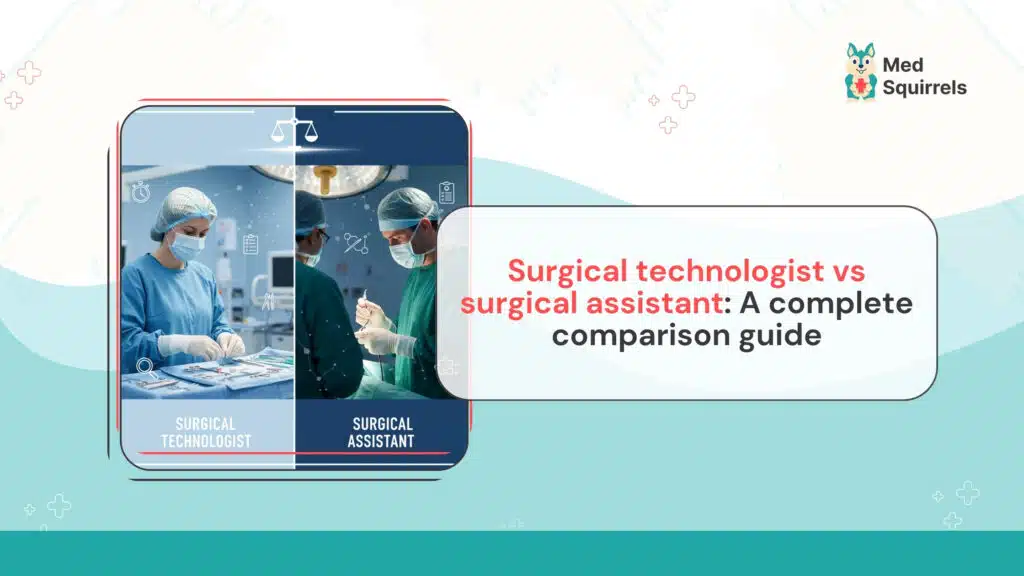
Comparing surgical technologists vs surgical assistants remains an important consideration for today’s clinical leaders who are responsible for building efficient surgical teams in a resource-constrained environment. While both roles support surgeons in the operating room, their scope of practice, training pathways, and level of clinical involvement differ in meaningful ways.
Understanding these differences helps administrators align staffing decisions with procedural needs, regulatory expectations, and patient safety goals. Clearly defined roles also support consistent outcomes and smoother workflows across surgical services.
Role overview and scope of practice
Understanding daily duties is essential to clarify how each role functions within the surgical team. When recruiting, facilities must develop a clear surgical technologist job description that outlines responsibilities such as operating room preparation, sterile field maintenance, and procedural support.
In contrast, surgical assistant responsibilities provide more direct clinical assistance during surgical procedures. These differences influence autonomy, accountability, and collaboration with surgeons. At a high level, surgical technologists’ responsibilities focus on maintaining sterile workflow and procedural readiness, while surgical assistants are more involved in hands-on intraoperative support. Both roles contribute to patient safety and operational efficiency, but their level of clinical authority differs.
To support accurate role evaluation while you hire, a dedicated infographic highlighting role-specific functions is included. This clarity reinforces the surgical technologist vs surgical assistant distinction in practice.
Also read: How to write a job description that attracts top healthcare talent
Education, training, and certification requirements
Educational pathways further differentiate these roles. The surgical technologist education requirements typically include completion of an accredited certificate or associate degree program with a focus on surgical techniques and sterile practices. When you hire surgical assistants, remember that they must undergo more advanced clinical training, reflecting their expanded responsibilities in the operating room. These differences directly influence staffing criteria and onboarding processes.
Credentialing establishes professional standards and expectations. Surgical technologist certification validates competency in core surgical support functions and is widely recognized across facilities. Surgical assistants pursue credentials aligned with their broader scope of practice and direct patient involvement. Clear credentialing standards help reduce confusion within the surgical technologist vs the surgical assistant framework.
Key differences in education and credentialing include:
- Programs aligned with surgical assistant education requirements emphasize anatomy, surgical procedures, and advanced intraoperative skills.
- Surgical assistant certification supports expanded clinical responsibility under surgeon supervision.
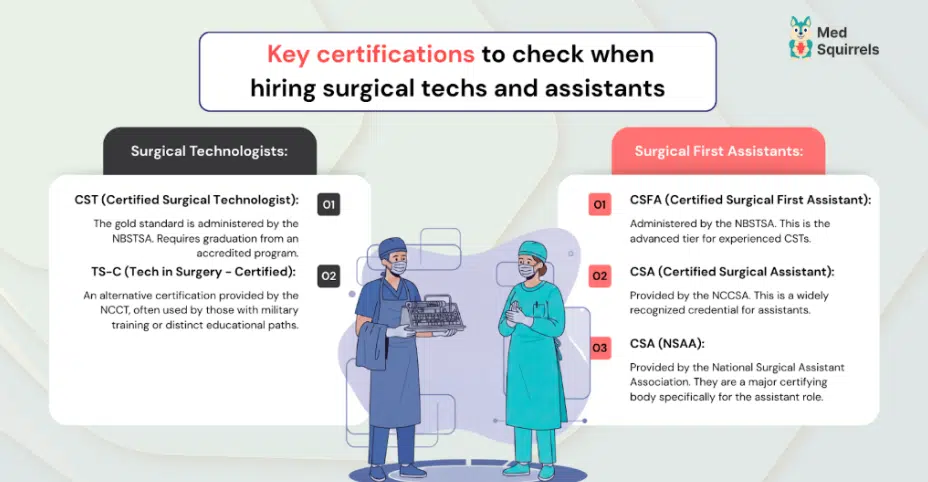
While planning to fill requirements for these roles, it is important to understand the certifications held by professionals, as this ensures the individuals you hire are properly trained, skilled, and qualified to deliver safe, high-quality surgical support.
To support informed staffing decisions, a detailed infographic is provided to help you stay aware of the top certifications these roles must have.
Certifications for surgical technologists vs surgical assistants
Regulatory and compliance considerations
State regulations and facility policies define the scope of practice, supervision requirements, and documentation standards for each role. Surgical technologists generally work under indirect supervision, while surgical assistants require more clearly defined oversight. These distinctions influence credentialing decisions and daily operational workflows.
Accurate role assignment is crucial for compliance and risk management. Credential verification and competency tracking ensure professionals operate within approved boundaries. Misalignment can increase legal exposure and disrupt surgical operations. Clear regulatory understanding strengthens workforce strategy within the surgical technologist vs the surgical assistant model.
Workforce planning, operational impact, and compensation
Effective workforce planning depends on case volume, procedural complexity, and specialty services. High-volume environments often rely more on surgical technologists, while complex procedures may justify greater surgical assistant involvement. These decisions you make to hire will directly affect efficiency, throughput, and surgeon support. Strategic alignment supports long-term operational stability.
Compensation trends also differ by role. The surgical technologist’s salary typically reflects technical support responsibilities and experience level, while the surgical assistant’s salary aligns with advanced clinical involvement. Geographic location, facility type, and tenure continue to influence earnings across both roles.
Facilities and recruiters like you must stay aware of vital points such as flexible staffing and compensation trends, as this insight directly supports smarter hiring decisions. A detailed infographic highlighting salary ranges across different states is included to help you evaluate regional pay expectations. If your facility operates in one of these locations, reviewing this data will help you stay aligned with current salary trends while you hire surgical technologists and surgical assistants.
Surgical technologists vs. surgical assistants: Top paying States

Source: www.bls.gov
Also read: The role of flexible staffing models in modern healthcare
Aligning surgical roles with smarter staffing decisianons
For healthcare facilities, understanding the differences between these roles is not optional; it is essential for safe, efficient, and compliant surgical operations. Knowing when to utilize a surgical technologist versus when a surgical assistant is required helps facilities match clinical expertise to case complexity, procedural demand, and regulatory expectations.
This clarity ensures that the right role is deployed at the right time, strengthening patient outcomes and operational performance. A clear understanding of the surgical technologist vs surgical assistant distinction allows leaders to make confident, informed decisions.
These insights play a vital role in shaping a sustainable staffing path. Facilities that understand role scope, training levels, and clinical authority are better positioned to plan workforce needs, control costs, and avoid compliance risks. However, even with strong internal knowledge, success depends heavily on choosing the right partner to support those decisions. Traditional staffing agencies often introduce challenges that slow progress rather than support it.
Two common drawbacks include:
- High percentage-based markups that inflate costs and reduce budget transparency
- Limited flexibility and slower turnaround times when urgent staffing needs arise
To overcome these hurdles, facilities need to partner with MedSquirrels. MedSquirrels offers an affordable staffing platform designed specifically to support real operational needs without unnecessary overhead. Unlike traditional agencies, MedSquirrels provides transparent pricing, faster access to qualified professionals, and flexible engagement models that scale with demand.
Facilities can choose from three cost-effective plans:
- Orange Plan: Recruitment plus EOR/Payrolling, helping you hire contract clinicians or non-clinicians while managing HR, payroll, compliance, and benefits.
- Purple Plan: EOR/Payrolling support when you already have a candidate and need HR, payroll, and benefits management.
- Blue Plan: Recruitment-focused support to help you hire full-time clinicians or non-clinicians efficiently.
By partnering with MedSquirrels, facilities gain access to affordable staffing plans that align with real operational requirements. You can book a free demo to explore available plans. At the same time, professionals can visit our open jobs and apply directly, ensuring a smoother experience for everyone involved.
FAQs
How do facilities decide which role is needed for a procedure?
Facilities typically assess case complexity, surgeon preferences, regulatory requirements, and procedure volume. Routine or high-volume cases may rely more on technologists, while complex surgeries often justify surgical assistant involvement.
Why is it important for facilities to clearly distinguish between surgical support roles?
Clear role differentiation helps facilities ensure regulatory compliance, assign appropriate responsibilities, and optimize operating room efficiency. It also reduces the risk of role overlap, credentialing errors, and workflow disruption during procedures
What is the key difference between surgical technologists and surgical assistants?
The difference is the scope of practice and clinical authority. Surgical technologists focus on sterile support and procedural preparation, while surgical assistants perform hands-on tasks that directly support surgical execution.
How does MedSquirrels support healthcare facilities with surgical staffing?
MedSquirrels provides a SaaS staffing platform that helps facilities connect with qualified surgical professionals while maintaining transparency and cost control. The platform is designed to simplify hiring workflows, reduce administrative burden, and support faster staffing decisions.
Can MedSquirrels support both short-term and long-term staffing needs?
Yes. MedSquirrels is built to support a wide range of staffing requirements, from urgent coverage needs to ongoing workforce planning. Facilities can scale staffing based on operational demand without being locked into rigid contracts.

Jani Basha is a healthcare content expert at MedSquirrels, sharing insights on staffing trends, hiring best practices, and career growth.