
Travel nurse vs. per-diem nurse: What is best for your budget and staffing needs?
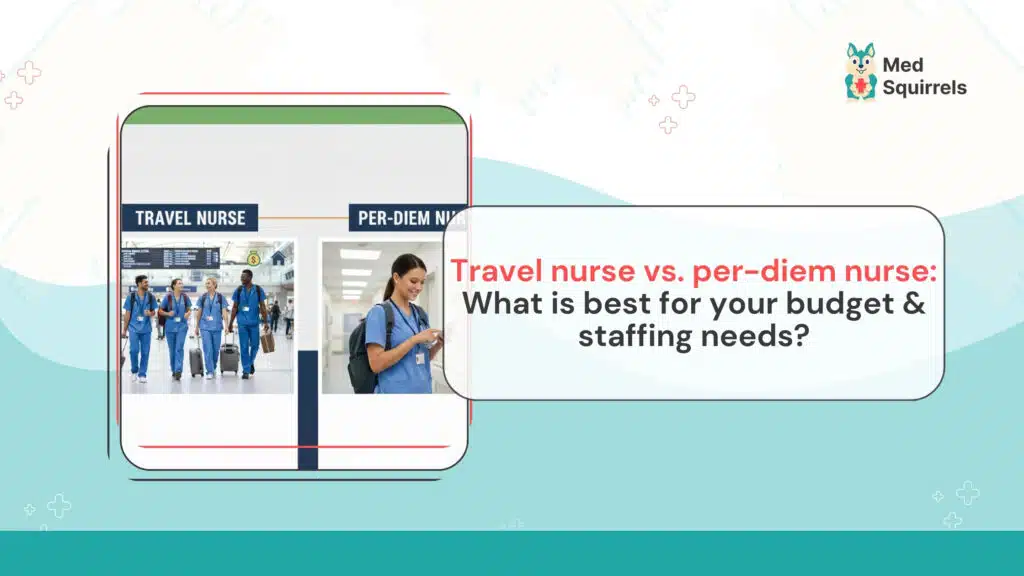
Hospitals and clinics have been dealing with fluctuating patient counts, staff shortages, and increased labor costs in recent years. To ensure consistent care, facilities are increasingly assessing the flexibility of different staffing models, such as comparing per diem vs. travel nurse models.
By doing so, they can find the right balance between controlling their expenses, maintaining flexibility in scheduling, and providing continuity of care to their patients. Comparing these staffing models allows facilities or recruiters to determine which is the best fit for their needs. During this process, facilities will assess budget limitations and long-term workforce planning by evaluating the availability of flexible schedules and the overall impact of per diem vs travel nurse.
Understanding travel nurses: roles, benefits, and certifications
Travel nurses must obtain licensure and be able to travel for a short period of time, usually 8 to 26 weeks, to assist facilities in covering staffing shortages due to staff turnover or a lack of qualified professionals locally.
The use of travel nurses is most often associated with covering full-time positions and highly specialized clinical needs during the off-peak periods of the year. Travel nurse staffing can be a solution to the increasing demand for qualified workers in specialty units or to fill immediate positions. The experience and skill set of a travel nurse can make the transition into a new workplace seamless, creating minimal disruption to operations.
Key advantages of recruiting travel nurses include:
- Access to specialized skills and clinical expertise
- Rapid deployment to meet urgent needs
- Consistent coverage for extended workforce shortages
Experienced travel nurses receive much higher pay than traditional staff because they work short-term contracts and are in high demand. Facilities also cover the cost of housing (lodging) and travel (transportation) for nurse travelers, enabling them to staff appropriately and avoid service gaps.
Recruiters can determine the value of travel nursing benefits by understanding how these professionals can minimize staff exhaustion. When comparing per diem vs. travel nurses, travel nurses are often the best option for longer-term needs or specialized coverage.
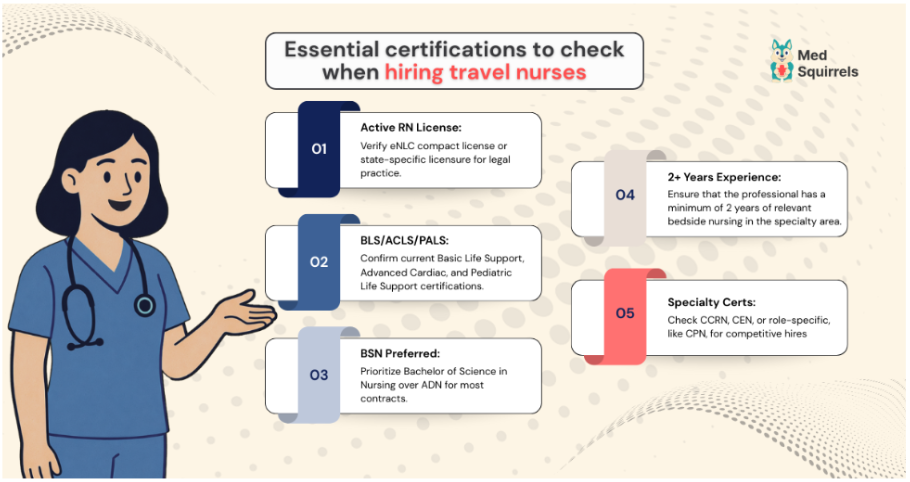
When planning to hire travel nurses, a recruiter should understand the pros and cons of per diem versus travel nursing, as this helps match the right nurse to the facility’s needs and ensures the nurse meets required certifications and clinical skills. It also facilitates a smoother onboarding process. This understanding allows recruiters to make informed decisions that improve patient care and operational efficiency. Facilities that are looking to hire nurse professionals, for example, travel nurse recruiters, must verify key certifications to ensure compliance and quality. Detailed infographic clarifies essential recruiter checklists.
Essential certifications for travel nurse staffing
Understanding per-diem nurses: roles, benefits, and costs
Per-diem nurses work temporarily, based on individual and facility needs. For example, they are typically used for short shifts or contractual jobs due to short staffing, covering for those who become ill unexpectedly, etc. And because these nurses are usually local or willing to travel, they are familiar with the travel healthcare systems.
For healthcare facilities, per diem nurse staffing can help fill gaps created by increased patient volume and other short-term scheduling challenges. The advantage of this model is that a facility can immediately benefit from a per-diem nurse whenever needed, without entering into a long-term contract.
Advantages of recruiting per-diem nurses include:
- Short-term scheduling flexibility
- Faster onboarding for familiar facilities
- No long-term employment commitment
From a budget standpoint, per diem nurse pay is usually paid on an hourly basis and changes based on demand or urgency before the shift starts. Understanding per diem nursing benefits can help recruiters ensure that their facility has the necessary balance of flexibility and scheduling requirements.
While it is possible to compare the per diem vs travel nurse model, having per diem staff in place is only adequate for short-notice scheduling, not for filling ongoing labour shortages. Facilities that rely on per diem nurses often use this approach to manage day-to-day operational gaps.
Comparing travel nurses vs. per-diem nurses for your facility
Comparing per diem VS. travel nurse reveals advantages for each model’s approach to operations. Travel nurses can provide more predictable coverage for more extended periods than per-diem nurses because they do not need to be hired again when a shortage lasts only a short time. However, per diem nurses offer the flexibility to adjust coverage day to day.
The following points should be compared when evaluating your options:
- Cost – Travel nurses generally cost substantially more than per diem nurses, who fill short-term needs at a much lower price point.
- Flexibility – Per diem nurse staffing is more adaptable to changing daily circumstances, while travel nurse models offer a more predictable and stable labor solution.
- Continuity of care – Travel nurse staffing creates a longer-term continuity within the unit. In contrast, the per diem model provides immediate support to the facility’s requirements as they arise.
Facilities with chronic shortages may find greater value in using travel nurses, while facilities with occasional shortages typically rely on per diem nurses. It is also essential to consider how each approach impacts staff morale, workflow efficiency, and patient outcomes.
Strategic recommendations for budget and workforce optimization
An effective workforce strategy blends multiple nurse engagement models that work in harmony rather than relying on a single approach. Ensuring that recruiters’ decisions made today align with your facility’s long-term goals and operational plans is key to achieving optimal results.
Some best practices are the following:
- Forecast future patient volume trends so that needs can be anticipated
- Utilize a combination of travel, locum nurse service, and per diem nurses to help contain labor costs.
- Track both travel nurse and per diem nurse salaries to enable optimal budget allocation.
Modern platforms offering nurse staffing solutions help healthcare facilities hire, credential, and place nurses efficiently while maintaining full compliance with government regulations. This enables facilities to respond quickly to changing patient care demands without disrupting operations.
Understanding the differences between per diem and travel nurse staffing helps healthcare facilities achieve better financial control, quality care, and the ability to meet short- and long-term needs. Travel nurses are a distinct category, so it is essential to track nationwide salary patterns, as benefits like housing, travel reimbursements, and meal allowances can vary. A detailed infographic is provided to facilitate understanding.
Annual wage of registered nurses by state, in the USA

Source: www.bls.gov
Choosing the right platform for your facility
Healthcare facilities must understand the differences between per diem vs. travel nurse staffing to make informed hiring decisions. Knowing these distinctions provides clarity on how to manage costs, flexibility, and coverage, but it only addresses half of the challenge. The other half depends on the partner you choose to implement your strategy.
Facilities should avoid traditional agencies, as they often have:
- High service fees that reduce cost-effectiveness
- Limited transparency in candidate screening and pay structures
- Slow response times, which can delay filling critical roles
Similarly, free job boards may seem convenient but can lead to inconsistent candidate quality, unverified credentials, and longer hiring cycles. To overcome these challenges, facilities should consider modern platforms such as MedSquirrels. Partnering with a platform like MedSquirrels ensures access to qualified candidates while supporting your specific operational needs.
Our platform offers cost-effective plans to hire:
- Orange Plan: Recruitment + EOR/Payrolling, helping you find contract clinicians or non-clinicians while managing HR, payroll, and benefits.
- Purple Plan: EOR/Payrolling, ideal if you already have a candidate and only need HR, payroll, and benefits support.
- Blue Plan: Recruitment service for locating full-time clinicians or non-clinicians.
These solutions enable facilities to hire efficiently within budget while maintaining high-quality clinical support aligned with operational goals. Facilities can book a free demo to explore these options.
Leveraging modern platforms ensures facilities have reliable nurse staffing solutions in place, reducing administrative burden and improving workforce stability.
FAQs
What is the difference between a travel nurse and a per-diem nurse?
A travel nurse is employed on short-term contracts, often covering long-term staffing gaps or specialized roles. In contrast, a per-diem nurse works on a flexible, day-to-day basis to cover immediate or unexpected needs from facilities.
How should facilities plan staffing decisions for the future?
Facilities should forecast patient volumes, analyze operational needs, track workforce-related costs, and align decisions with long-term goals to ensure sustainability and efficiency.
Can facilities use a combination of travel and per-diem nurses?
Yes. A mixed staffing model allows facilities to maintain flexibility, manage costs effectively, and ensure consistent patient care by balancing short-term coverage with longer-term solutions.
Can MedSquirrels help my facility hire nurses more cost-effectively?
Yes. MedSquirrels offers cost-effective plans that allow you to manage labor expenses more efficiently. By leveraging a mix of travel and per-diem nurses, you can avoid unnecessary overtime, maximize budget allocation, and ensure consistent patient care.
How does MedSquirrels ensure quality and compliance when you hire?
MedSquirrels screens and verifies all candidates, ensures proper licensure and certifications, and manages payroll and HR compliance. Their platform helps facilities maintain regulatory standards while providing highly qualified staff for specialized or temporary needs.

Suresh writes about healthcare staffing and industry insights for MedSquirrels, helping professionals and facilities navigate hiring needs.