
How the health staffing shortage affects pharmacist recruitment
Pharmacists are an indispensable part of the healthcare ecosystem, especially now that pharmacist recruitment is becoming increasingly competitive due to growing demand. The duties of pharmacists include not only dispensing medicines and educating patients, but also playing an important role in the hospital’s drug inventory management.
With the right skilled pharmacists, your facility can save money while enhancing operational efficiency. You might have most likely seen reports about the shortage of various drugs in the news.
Likewise, yet another pressing issue in the healthcare sector is the pharmacist shortage, raising concerns about overall pharmacist staffing in many regions.
The World Health Organization (WHO) recommends a pharmacist-to-population ratio of 1:2,000 for optimal healthcare. However, the rising pharmacy staffing shortage is clearly affecting operational capacity and patient care at many facilities.
In addition, several regions are experiencing a broader healthcare staffing shortage, further straining pharmacists and increasing workloads across care teams. The shortage of pharmacists in the USA is due to many factors, such as the COVID-19 vaccination, which has led to burnout among pharmacists, poor work-life balance, and unfair compensation packages, resulting in early retirement.
The growing demand for pharmacists
Pharmacists are in high demand in the USA. According to the Pharmacy Demand Report published by the American Association of Colleges of Pharmacy, 18,681 job postings are reported for pharmacists by the second quarter of 2024, which is significantly higher than the 14,200 yearly average job openings for pharmacists projected by the US Bureau of Labor Statistics.
The pharmacists‘ job growth is projected to increase by 5% in the next decade. This highlights the growing demand for pharmacists in most states in the USA. As facilities attempt to meet rising patient volumes, many recruiters are asking whether the pharmacist shortage by state is due to widening workforce gaps.
In parallel, ongoing supply–demand imbalances have prompted industry discussions, especially in underserved regions.
At the same time, many healthcare systems continue to explore whether there is a demand for pharmacists as new clinical care models expand their role.
This growing demand, especially in underserved areas and non-metropolitan regions, is affecting healthcare facilities. With technological advancements in the healthcare sector, pharmacists who are well-equipped to work alongside physicians to support pharmacotherapy and dosage optimization are in high demand.
Moreover, the rising public awareness of chronic disease management and the aging population have increased the number of patients in hospitals seeking preventive care, including immunization, worsening pharmacy staffing shortages in these regions.
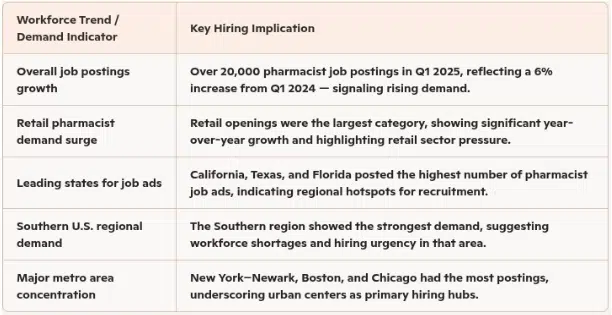
As a recruiter planning to hire pharmacists, it is essential to understand the steady growth of pharmacist demand across the USA; knowing these numbers helps you plan proactively and overcome staffing shortages in your facility. A detailed infographic is provided to better understand this growth.
Pharmacy workforce trends and demand insights
Challenges in pharmacist recruitment in the USA
Healthcare facilities in the USA are struggling to hire pharmacists due to their rising demand. The shortage of qualified pharmacists has created a competitive job market in which facilities are compelled to offer comprehensive compensation packages that exceed market standards. This intensifies the pharmacist staffing challenge and pushes some facilities to spend above budget to hire the right candidates.
- The pharmacist hiring process involves many regulatory complexities, as the role requires close collaboration with patients and other allied healthcare professionals. An adverse drug event can cause a huge financial and reputational loss to facilities. Hence, it is essential to navigate all compliance challenges associated with pharmacist recruitment.
- Another important challenge is the credentialing of potential candidates. Thorough credentialing is required to ensure that the hired pharmacist has no pending drug abuse or criminal history. Credentialing also includes verifying qualifications, experience, and licenses to determine whether the pharmacist is eligible to work in the state where the facility is located.
- While discussing pharmacy staffing shortages and their challenges, it is worth noting retention challenges as well. Many recruitment problems can be avoided with proper retention strategies, such as career development opportunities and industry-standard pay.
- The most important challenge in pharmacist recruitment is ensuring compliance with your state’s licensure requirements and scope of practice. This is subject to frequent revisions, and facilities must stay up to date with the latest rules, especially in regions where a pharmacist shortage is a concern.
State-by-state pharmacist licensure requirements
Before applying for any state license, pharmacists must understand that licensure rules vary widely across the U.S. Each state has its own eligibility criteria, renewal timelines, and regulatory expectations, so reviewing state-specific guidelines is essential before planning to work or relocate. This also ensures a smooth transition when moving between states.
For instance, to hire pharmacists in Alabama, you must ensure that candidates meet all state-mandated requirements and obtain licensure.
All Doctor of Pharmacy (Pharm.D.) graduates from accredited universities who have completed a minimum of 1500 internship hours can apply for Alabama State Board of Pharmacy licensure.
Candidates must also pass the NAPLEX and MPJE to demonstrate competence in technical and regulatory pharmacy practice.
Once the application is submitted, the board conducts background verification. A final virtual interview is held with board members, after which the pharmacist’s license is issued. This license must be renewed every two years to maintain 30 hours of continuing education.
Key metrics to track for successful pharmacist hiring in healthcare systems
To address pharmacist shortages, certain measures can be implemented to address the challenges associated with pharmacist hiring. This may include creating more pharmacist employment opportunities, building a strong employer brand, and offering compelling benefits such as competitive salaries, paid time off, flexible shifts, and career development opportunities.
Retaining existing pharmacists through clear career pathways and supportive workplace policies can significantly reduce turnover and relieve pressure on pharmacist staffing. The efficiency of these strategies can be measured using the following metrics:
- Time to hire pharmacists: Measures the average time taken to fill a pharmacist vacancy.
- Quality of hire: Evaluates the competency of newly hired pharmacists.
- Offer acceptance rate: Indicates the appeal of the facility’s compensation package.
- Candidate source effectiveness: Helps determine which recruitment channels yield the best pharmacist hires.
- Candidate experience feedback: Identifies improvements for the hiring workflow.
- Job satisfaction level: Tracks retention effectiveness and burnout risk.
- Turnover rates: A critical metric showing how well retention strategies are working.
There are several underlying factors driving today’s pharmacist shortage by state, and the infographic below clearly breaks them down for healthcare leaders.
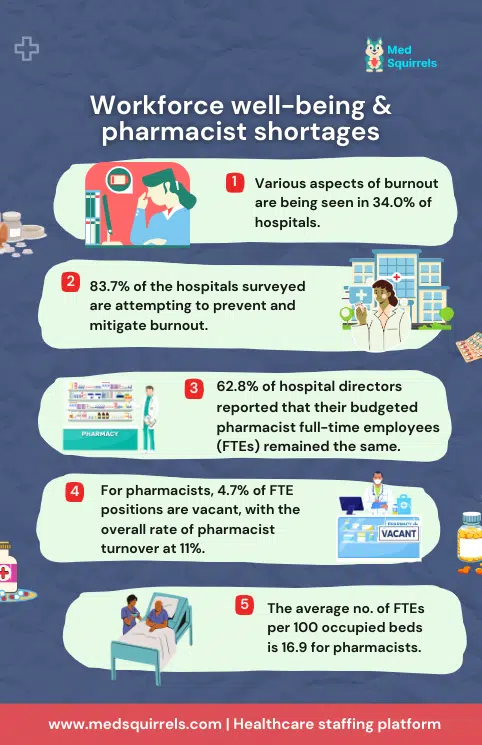
By enabling pharmacy technicians to assume some of the clinical tasks that do not involve clinical expertise
and judgment could decrease pharmacist burnout by reducing exhaustion and extending care (i.e., improved personal efficacy), similar to the way in which the sharing of clinical duties with pharmacists reduces physician burnout.
Source:American College of Clinical Pharmacy
How MedSquirrels addresses pharmacist staffing shortage
MedSquirrels leverages technology to optimize strategies to address the pharmacist staffing crisis and the broader healthcare staffing shortage. By centralizing workflows and reducing operational bottlenecks, the platform helps facilities speed up their end-to-end recruitment cycle.
- MedSquirrels uses AI technology to craft accurate job descriptions for your facility, improving pharmacist recruitment outcomes.
- The platform provides staffing solutions for full-time and contract hiring to support immediate staffing needs.
- MedSquirrels eliminates high markup fees typically charged by traditional agencies through a transparent pricing model.
- Facilities pay only a flat license fee plus pharmacist payroll based on the selected plan.
- The platform handles compliance and credentialing to ensure every pharmacist hired is qualified and state-ready.
With technology-driven workflows and an interactive dashboard, MedSquirrels streamlines the entire pharmacist recruitment process through its affordable staffing plans. You can book a demo to learn more. Professionals can browse open jobs and apply for those jobs that fit with their professional requirements.
FAQs
Is there a shortage of pharmacists?
Yes, several regions in the USA are experiencing a pharmacist shortage due to rising patient needs, expanding clinical responsibilities, and uneven workforce distribution. This makes it essential for facilities to offer competitive pay and clear career growth to attract qualified pharmacists.
Why is there a demand for pharmacists?
There is a growing demand for pharmacists due to rising prescription volumes, the expansion of clinical pharmacy services, and increased needs across retail, hospital, and outpatient settings. Pharmacists now play a larger role in patient counseling, medication management, and preventive care, which continues to elevate demand nationwide.
What are the common challenges in pharmacist recruitment?
Key challenges include talent shortages, high competition among employers, varying state licensure requirements, and lengthy credentialing timelines. Workload concerns and burnout also impact candidate availability.
What makes MedSquirrels cost-effective for pharmacist staffing?
Unlike traditional agencies that charge high markups, MedSquirrels operates on a transparent pricing structure with its affordable staffing plans. This allows facilities to control costs, forecast budgets accurately, and still access qualified pharmacists for full-time or contract roles.
How does MedSquirrels ensure compliance during pharmacist hiring?
The platform manages end-to-end compliance checks, including license verification, background screening, employment history review, and documentation tracking. Facilities receive real-time updates on each candidate’s compliance status, reducing risk and improving audit readiness.

Jani Basha is a Content Specialist with a background in healthcare content development, recruitment, and workforce management. His work focuses on the challenges healthcare facilities face in attracting, staffing, and managing clinical and non-clinical professionals. He develops content on healthcare recruitment, workforce trends, and staffing strategies. His work translates complex workforce topics into practical insights for healthcare recruiters. His work aligns with MedSquirrels’ mission to make healthcare staffing more efficient and cost-effective through technology-driven workforce solutions.