
Build an effective team: From nurse assistants to nurse practitioners

Providing quality patient care is the primary duty of healthcare facilities. To provide better care, facilities mostly rely on different nursing professionals.
As a recruiter, you must understand that each role has its own responsibilities, which can vary by state. Understanding these roles can help you build a well-balanced and effective nursing team.
This blog explains the nursing hierarchy from nurse assistants to nurse practitioners and how each role helps to enhance quality care.
Understanding the nursing hierarchy and roles
While planning to hire for nursing roles, you must understand that each role brings a different set of skills.
Along with skills, each role will also bring different responsibilities to the care team. Understanding these roles can help you maintain a balanced team and provide quality care to patients.
The key nursing roles and their responsibilities include:
- Nurse Assistant: Recruiting a nurse assistant will help your patients with daily activities, personal hygiene, mobility, and basic care needs.
- Licensed Practical Nurse (LPN)/Licensed Vocational Nurse (LVN): These professionals support patient care through routine nursing tasks under the direction of RNs or physicians.
- Registered Nurse (RN): Skilled RNs coordinate patient care, administer treatments, and guide nursing and support staff.
- Nurse Practitioner (NP/APRN): Certified NPs will deliver advanced care through patient assessment, diagnosis, and medication management.
These roles are explained in more detail below to make planned staffing decisions.
How RNs serve as the backbone of clinical care teams
Certified registered nurses play an important role in enhancing patient care. They also work with physicians and other allied health teams to provide customized treatment plans and optimize recovery.
While you are planning to hire registered nurses, you need to evaluate the skills of the applicant.
Checking skills is essential, as they are the backbone of clinical care teams. Onboarding certified professionals will improve patient advocacy and commitment to care.
You can also hire experienced registered nurses with skills based on the requirements of your clinic.
To hire a professional with skills as a recruiter, you must also stay informed about market-trending skills. A detailed infographic about skills to check in a professional is added.
Key RN competencies for stronger healthcare teams
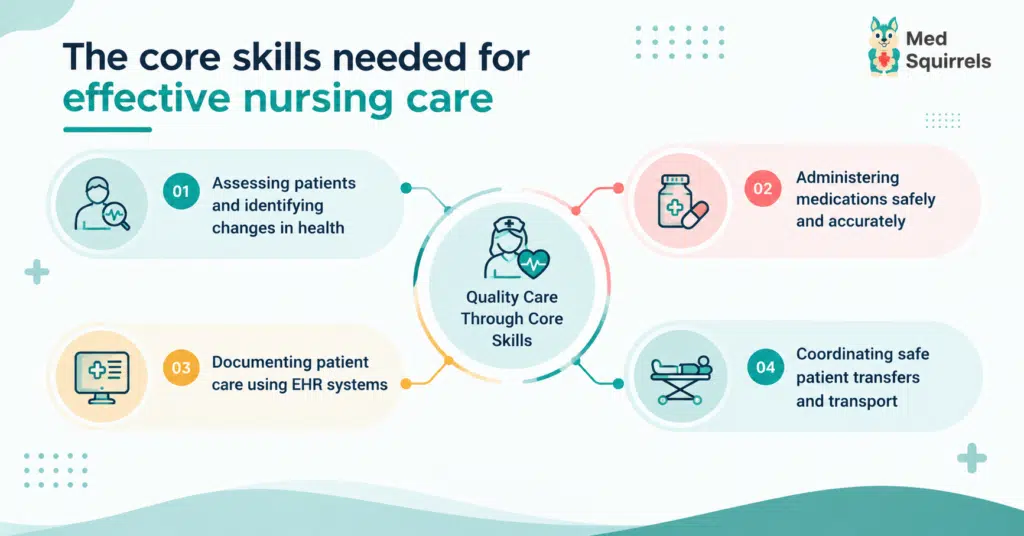
How NPs can bridge gaps between nursing teams
Nurse practitioners (NPs) are also known as Advanced Practice Registered Nurses (APRNs).
Recruiting nurse practitioners at your clinic is essential, as they can manage patient health conditions.
They will also provide advanced care within their scope of practice.
Skilled NPs contribute to patient care in multiple ways:
- NPs regularly monitor patients and check their vital signs.
- They also perform physical examinations and keep track of changes in a patient’s condition.
While you hire skilled nurse practitioners, they will also educate patients. Having skilled professionals can strengthen communication between nursing and medical teams.
Leveraging LVNs and LPNs to support core nursing teams
LPNs and LVNs at your hospital will take on routine nursing tasks such as monitoring patients’ vital signs.
This will help you reduce the workload of the core nursing team. Their support allows RNs and other team members to focus on more patient care needs.
LPNs and LVNs can support the nursing team in several ways, such as:
- Patient monitoring: LVNs and LPNs will be active in monitoring patients’ symptoms. This will be monitored and reported to the care team.
- Routine care: Skilled LVNs and LPNs will take up tasks such as maintaining patient hygiene and cleaning wounds.
- Patient records: They can also update electronic health records to keep patient information current.
For example, as a recruiter, you can hire an LPN to cover a staffing gap when your facility needs additional support for wound care.
Enhancing patient care with effective use of nurse assistants
If your facility is witnessing a high number of patients, it will be challenging to maintain quality care. To meet patient satisfaction, it will be necessary to hire nurse assistants who are skilled and certified.
These professionals will play a key role in assisting patients who need help with everyday activities. Certified NPs will handle essential non-clinical care; they allow RNs and LPNs to spend more time on clinical responsibilities.
Nurse assistants can support patient care in several ways:
- Mobility support: Nurse assistants will help bedridden patients maintain their comfort.
- Emotional support: These professionals will also provide reassurance to patients and their caregivers during the care process.
- Patient safety: NPs will need to follow safety and infection control practices to help maintain a safe care environment.
For example, as a recruiter, you can hire a nurse assistant when your facility needs additional support with daily patient care.
This recruitment will allow licensed nurses to focus on more complex responsibilities.
Assess your staffing and financial model before recruiting
Now that you understand the efficiency of each nursing role and what they do, you can plan your staffing needs better. Understanding each role can help address staffing gaps in a better manner.
Knowing about these roles can also help you choose the right professional for your staffing needs within your budget.
Before you make a staffing decision, consider the following factors:
- Check your facility’s staffing needs and identify them. It will help you determine how many nurses you need to hire.
- Staffing model: Evaluate your staffing needs and then choose the right model. You can consider a full-time or contract model based on your staffing needs and budget.
For example, if you want to hire RNs for your clinic in Alaska, you will need to pay an annual mean wage of $109,210. An infographic is included to keep you informed about salaries across the country.
Top-paying states for Registered Nurses in the USA
State | Hourly pay | Annual pay |
California | $ 64.10 | $ 133,340 |
Hawaii | $ 54.43 | $ 113,220 |
Oregon | $ 51.26 | $ 106,610 |
Massachusetts | $ 50.07 | $ 104,150 |
Alaska | $ 49.67 | $ 103,310 |
Source: BLS
Simplify your healthcare staffing with a modern staffing platform
To build an effective nursing team, you need to consider multiple factors. Those factors are knowing the roles you need to fill and staffing models.
Gaining knowledge about these facts will help you make planned recruiting decisions. These decisions will help you address staffing gaps on time and will improve patient care.
Along with this factor, one more essential factor to consider is choosing a staffing platform.
Having a recruiting platform will enhance your staffing. In this process, it is essential to know what to choose and what to avoid.
To make your staffing more stress-free, you can reduce staffing from traditional agencies. Most agencies follow manual processes and have a limited talent pool.
These agencies may also not provide credentialing support while you plan to hire. To overcome these recruiting challenges, you can choose a modern staffing platform such as MedSquirrels.
This AI-powered platform has affordable staffing plans that will help you hire within your budget. MedSquirrels provides credentialing support so you can hire on time.
This platform also eliminates traditional agency markups, which allows you to stay within your staffing budget.
Recruiters can book a free demo to know more about stress-free recruiting. Nursing professionals can also check open jobs pages and apply for those that match their skills.
FAQs
What nursing roles should I hire to build a balanced care team?
As a recruiter, you should consider roles such as nurse assistants, LPNs/LVNs, RNs, and NPs. You need to remember that each role handles different responsibilities. This helps you build a balanced team.
How should I decide how many nurses my facility needs?
You can start by reviewing your patient volume and current staffing needs. Then you can choose which nursing roles you need and how many professionals each role requires.
How do I decide between hiring full-time and contract nurses?
You need to look at how long you need the position filled. Choose full-time nurses for ongoing staffing needs. If you need to fill roles on temporary coverage, choose temporary staffing.
How quickly can I get nursing candidates through MedSquirrels?
MedSquirrels can provide curated candidate profiles within 2–5 business days. This helps you fill roles faster.
How can MedSquirrels simplify my nursing recruitment process?
MedSquirrels brings sourcing, screening, credentialing, onboarding, payroll, and compliance into one platform, reducing the administrative work involved in healthcare staffing.

Jani Basha is a Content Specialist with a background in healthcare content development, recruitment, and workforce management. His work focuses on the challenges healthcare facilities face in attracting, staffing, and managing clinical and non-clinical professionals. He develops content on healthcare recruitment, workforce trends, and staffing strategies. His work translates complex workforce topics into practical insights for healthcare recruiters. His work aligns with MedSquirrels’ mission to make healthcare staffing more efficient and cost-effective through technology-driven workforce solutions.