
Compliance and license considerations for hiring pharmacists
Recruiting a pharmacist can be a challenging task fewer times. It involves more than checking the qualifications of an applicant.
As a recruiter, you must also verify licenses and follow state and federal regulations. You must remember that each state has its own pharmacy licensing requirements. So maintaining strict licensing and compliance requirements helps you protect patient safety.
As staffing needs grow, you must verify licenses and credentials to ensure pharmacists meet state requirements. This blog explains the key licensing and compliance requirements you must consider when hiring pharmacists.
What facilities need to know about pharmacist licensing
When you are planning to hire a pharmacist from another state, check if the applicant has a valid license or not.
If the professional holds a license from another state, you must verify it. You must also check the endorsement requirements of the state where your facility is located.
To verify that the candidate is authorized to work in the state, you need to check the license of the applicant. You must also obtain their license renewal history and verify it.
During the licensing verification process, make sure you:
- You need to verify the pharmacist’s license status and expiration date.
- Check the license renewal history, where available.
- Confirm that the pharmacist meets the licensing requirements of the state where your facility operates.
Some states support pharmacist license verification through the National Association of Boards of Pharmacy (NABP). So, check the relevant state Board of Pharmacy for its accepted verification process.
Pharmacist compliance with employment laws and regulations
While recruiting, you must understand the applicable federal regulations. Pharmacists who dispense controlled substances must meet the Drug Enforcement Administration (DEA) registration requirements.
You must also remember that some states allow licensed pharmacists to work alongside physicians to prescribe medications and implement drug therapy.
If your facility is in those states, you must ensure that Collaborative Practice Agreements (CPAs) comply with your state’s regulations.
As a recruiter, you must also follow these key employment and workplace requirements:
- Workplace safety: Follow Occupational Safety and Health Administration (OSHA) standards to provide pharmacists with a safe working environment.
- Wages and working hours: Follow Fair Labor Standards Act (FLSA) requirements and applicable state employment laws.
- Anti-discrimination laws: Ensure that recruitment practices do not discriminate against candidates based on protected characteristics.
- Contract terms: Use a detailed job description and clearly outline compensation, contract duration, responsibilities, and required qualifications.
A detailed infographic about what responsibilities to add in a job description to maintain transparency is added for better staffing.
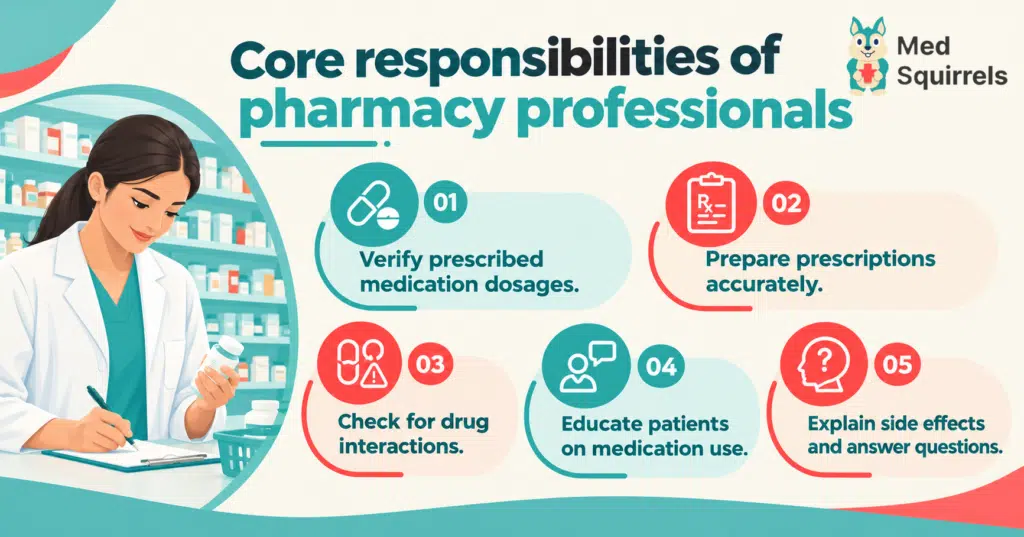
A pharmacist’s day-to-day tasks in the USA
How to verify pharmacist credentials and backgrounds?
Credential verification is essential in healthcare recruiting. To complete this, you can partner with an experienced medical staffing platform.
These platforms will verify the pharmacist’s license status and renewal history on time. This timely process will also help you address workforce gaps to maintain quality care.
You can also use the National Practitioner Data Bank (NPDB), where authorized, to review relevant disciplinary and malpractice reports.
Remember to check previous employers’ references to confirm the candidate’s work experience.
Importance of HIPAA compliance and data privacy
Patient privacy is the most essential to maintain within the facility.
So when you are planning to hire a pharmacist, you must also evaluate the recruited person’s work background.
Hired professionals must follow clinical rules and maintain patient privacy and data security. To maintain privacy, you must also train pharmacists on HIPAA regulations to help them protect patient health information (PHI).
Based on the situation, you can also limit access to medical records to authorized personnel. If your clinic is providing telepharmacy services, you can use secure authentication methods to protect patient information.
One of the most essential strategies to follow while recruiting is to provide comprehensive compensation. Providing market-trending salaries will allow you to hire qualified professionals.
These professionals can also work with your facility for longer periods. So we can say salary also plays an important role in maintaining privacy.
A table with top-paying states is added, which helps you to maintain salaries as per market standards.
Pharmacist salary trends across US states
State | Hourly pay | Annual pay |
California | $ 75.62 | $ 157,280 |
Alaska | $ 72.89 | $ 151,600 |
Oregon | $ 71.90 | $ 149,550 |
Minnesota | $ 68.85 | $ 143,210 |
Washington | $ 71.42 | $ 148,550 |
Source:BLS
How do modern platforms help you hire with compliance?
Having knowledge of compliance while you hire is an added advantage. But knowing about license verification and compliance checking may not completely assist you in onboarding a pharmacist.
To hire and onboard a professional on time, you need assistance from staffing platforms. Partnering with these platforms will not only assist with your compliance, but they will also complete all verification processes for a candidate on time.
Completing all background checks on time will allow you to onboard a professional on time.So, to maintain a timely onboarding process, you can choose modern staffing platforms such as MedSquirrels.
This AI-powered platform streamlines your end-to-end recruitment process.
MedSquirrels assists you from customizing job descriptions to onboarding pharmacists on time.
It also comes with staffing plans, which help you hire within your budget. This healthcare recruiting platform provides transparency in pricing. It also eliminates markups to ensure your pharmacists get paid above industry standards.
Healthcare owners can book a free demo to see how this platform transforms your workforce management. Working professionals can browse open jobs and apply for those jobs that fit with their skills.
FAQs
What should recruiters check before hiring a pharmacist?
As a recruiter, you need to verify the candidate’s license, qualifications, and work experience. Also, check the licensing requirements of your state.
How can I verify an out-of-state pharmacist’s license?
During the process of recruiting, you can check the candidate’s license status and renewal history. Also, confirm the requirements for practicing in your state.
What compliance requirements should recruiters consider when hiring pharmacists?
Recruiters need to check applicable DEA registration requirements. Along with these, you can also check state pharmacy regulations, workplace safety rules, and employment laws.
How does MedSquirrels help recruiters hire pharmacists?
MedSquirrels is an AI-powered platform that helps your facility to hire skilled pharmacists and manage recruitment, credentialing, and onboarding more efficiently.
How quickly can MedSquirrels provide pharmacist profiles?
MedSquirrels provides you with pre-vetted candidate profiles within 2–5 business days after receiving your specific staffing requirements.

Jani Basha is a Content Specialist with a background in healthcare content development, recruitment, and workforce management. His work focuses on the challenges healthcare facilities face in attracting, staffing, and managing clinical and non-clinical professionals. He develops content on healthcare recruitment, workforce trends, and staffing strategies. His work translates complex workforce topics into practical insights for healthcare recruiters. His work aligns with MedSquirrels’ mission to make healthcare staffing more efficient and cost-effective through technology-driven workforce solutions.