
How can hospitals improve speed-to-fill for staffing needs
The current fast-paced healthcare environment is changing day by day due to rising patient demand and workforce turnover, creating staffing shortages in hospitals.
In this situation, many facilities rely on a staffing agency for hospitals to stabilize operations and maintain continuity of care, rather than using a modern tech-enabled platform.
Unfilled roles can quickly disrupt patient care and increase pressure on existing staff.Delays in recruiting not only impact operational efficiency but also contribute to burnout and reduced service quality.
A facility recruiter needs practical, results-driven strategies to improve speed-to-fill for staffing needs while maintaining hiring standards. In this blog, we will explore effective strategies that help hospitals accelerate recruitment and secure qualified professionals on time.
Strategy #1: Use your employer brand
In today’s modern and competitive healthcare landscape, a compelling employer brand is your prime weapon for securing top talent and strengthening your hospital recruitment process.
Facilities need to remember that building a brand is a tough task and it will take time. As a recruiter, one key focus is your website. It is often the first option candidates go to learn about your facility, and first impressions are most important.
Clinics and facilities need to maintain job pages with clear functionality to target each unique audience, while blending seamlessly with your primary website’s look and feel.
To strengthen your facility’s brand as a healthcare provider, use engaging content such as employee testimonials and visual graphics to present your facility in the best possible light. You need to remember that a strong employer brand is essential for attracting skilled healthcare workers, strengthening hospital staffing efforts, and reducing turnover.
Strategy #2: Develop a talent pool with skills
Instead of searching for candidates during recruiting, facilities can focus on building a talent pool; this talent pool helps recruiters like you maintain timelines and reduce staffing shortages in hospitals.
To maintain a talent pool, clinics must use recruitment marketing tactics, such as promoting their websites and encouraging job seekers to submit resumes.
This submission process will allow you to build your own talent pool and create a structured approach to hospital recruitment. You can also leverage social media to gain qualified applicants and strengthen hospital staffing readiness. Selecting whom to hire from your talent pool is critical.
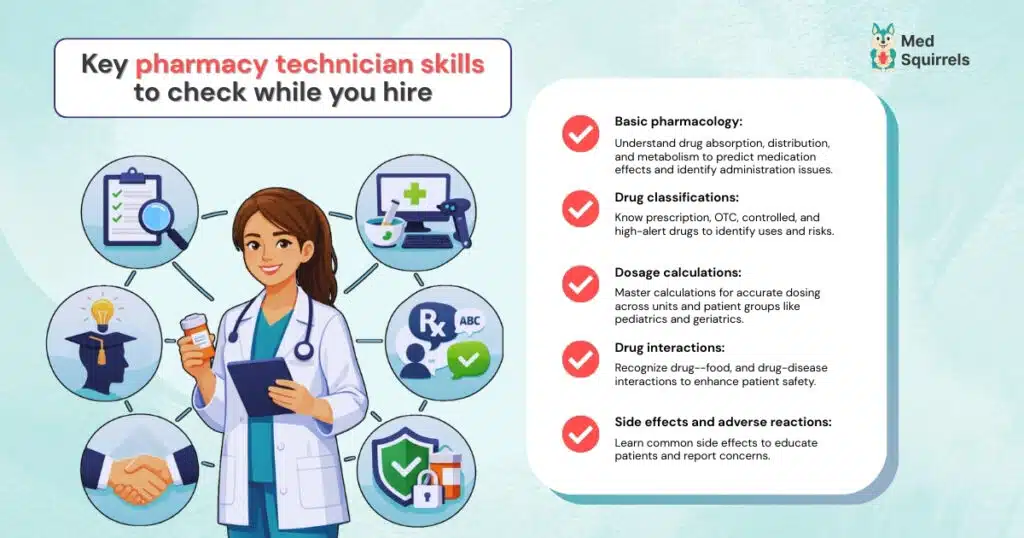
For example, if you plan to hire a pharmacy technician, you must evaluate candidates’ skills carefully. A detailed infographic has been added for better understanding.
Key pharmacy technician skills to check while hiring
Strategy #3: Leverage flexible recruiting models
To gain immediate workforce access, facilities looking to increase recruiting speed should choose a flexible model or collaborate with a technology-powered platform rather than a traditional hospital staffing agency.
A flexible model allows hospitals to quickly hire and adjust workforce levels in response to patient growth and unexpected absences, and as a recruiter, you must know how to fix staffing shortages effectively. It reduces the pressure of urgent full-time recruiting while ensuring uninterrupted patient care and maintaining operational stability throughout the hospital recruitment process.
Multiple flexible approaches are outlined below:
- Temporary staffing: Involves recruiting employees for a defined period or until a specific season is completed.
- Temp-to-hire: Refers to recruiting a professional on a temporary basis with the potential for full-time employment after a performance evaluation.
- Contract staffing: Focuses on engaging employees under a contractual agreement for a set duration or particular assignment.
- Per diem staffing: Allows facilities to hire professionals on an as-needed basis, typically to manage sudden increases in patient volume or unexpected gaps.
Strategy #4: Partner with educational institutions
Healthcare clinics often face workforce shortages because the demand for patient care grows faster than the supply of trained professionals, leading to ongoing shortages in hospitals.
To overcome the shortages as a recruiter, you need to hire professionals within the recruiting timelines and strengthen your hospital recruitment process. By collaborating with educational institutions, facilities can advise and help shape curricula to match real-time requirements in the healthcare sector.
This collaboration will improve healthcare recruiting and ensure facilities hire professionals who are ready to work upon graduation. These partnership procedures can accelerate recruiting and allow facilities to hire qualified professionals who can deliver better patient care while reducing reliance on external recruiting delays.
Strategy #5: Award with good compensation
Facilities looking to hire candidates on an urgent basis must offer competitive salaries to attract top talent. Partnering with a modern recruitment platform can further help secure qualified professionals quickly and efficiently, reducing reliance on a staffing agency for hospitals.
Clinics must understand that offering strong pay packages not only attracts skilled workers quickly but also motivates them to stay longer with your facility, reducing turnover. Hospital managers like you must know that competitive salaries also position your facility as an employer of choice in a highly competitive market and strengthen overall hospital recruiting capabilities.
Ultimately, in the healthcare sector, investing in compensation reduces recruitment challenges and ensures consistent, high-quality patient care. For example, if you want to hire a registered nurse within your facility, offering a market-trending salary is essential.
As a healthcare administrator planning to hire, you must stay aware of current pay benchmarks, which is why a detailed infographic has been added for clarity.
Top-paying states for registered nurses
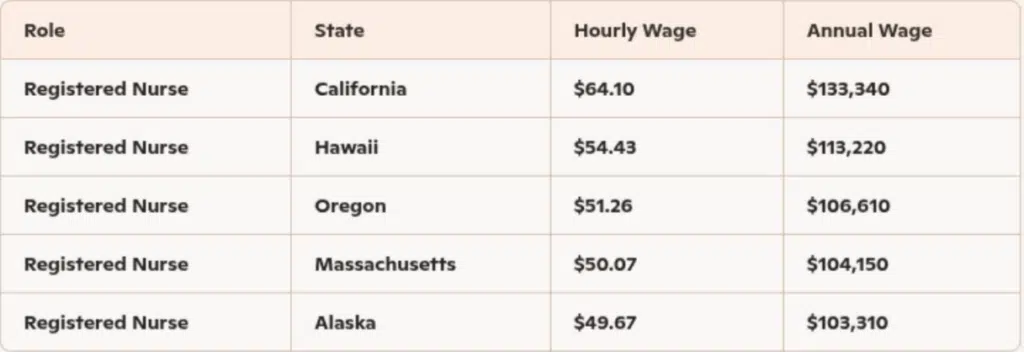
Source: BLS
Strategy #6: Optimize the onboarding process
Recruiters must recognize that the onboarding process is a key recruitment strategy that can significantly impact overall hiring outcomes and workforce stability. Implementing a planned onboarding process will help facilities ensure that newly hired professionals are prepared to care for patients from day one and improve overall hospital staffing efficiency.
When a facility collaborates with a platform to hire and avoid delays, a structured onboarding system ensures that professionals integrate smoothly into clinical workflows. It also reduces the facility’s dependence on a traditional hospital staffing agency for immediate role-filling.
To optimize the onboarding process, clinics need to maintain digital onboarding solutions, such as eLearning platforms and virtual orientations. These can help new hires understand your facility and adapt more rapidly and efficiently. These efforts not only increase employee engagement but also contribute to maintaining long-term relationships with the facility
How facilities can hire faster and overcome challenges wth modern platforms
Facilities and healthcare owners seeking to increase speed-to-fill for open roles must adopt structured, results-driven strategies. These strategies help clinics and owners hire more quickly while maintaining high-quality patient care standards.
At the same time, facilities should avoid relying solely on traditional staffing agencies for hospitals or free job portals. Traditional agencies often lack transparency in pay structures, offer limited control over candidate selection, and can result in slower response times.
Free job boards can pose challenges, including overwhelming competition, delayed candidate engagement, and difficulty verifying qualifications.
To overcome these obstacles, choosing a modern platform such as MedSquirrels is a better option. Partnering with this platform gives facilities access to verified, qualified professionals while reducing administrative complexity.
The process begins with a recruiter deciding to partner with MedSquirrels, unlocking several key benefits:
- Orange Plan: Recruitment plus EOR/Payrolling, helping hire contract clinicians or non-clinicians while managing HR, payroll, compliance, and benefits.
- Purple Plan: EOR/Payrolling support when you already have a candidate and need HR, payroll, and benefits management.
- Blue Plan: Recruitment-focused support to help hire full-time clinicians or non-clinicians efficiently.
By leveraging MedSquirrels, facilities can efficiently address both immediate and long-term workforce needs without depending on a staffing agency for hospital recruitment.
The platform provides better visibility into workforce availability, reduces reliance on traditional sourcing methods, and supports more predictable scheduling outcomes.
Recruiters and facilities can book a free demo to see how the platform enables smarter, faster decisions. Healthcare professionals can also browse open jobs and apply for roles that fit their skills.
FAQs
What is the best way to reduce staffing shortages in hospitals?
The best approach is to implement proactive recruitment strategies, maintain a qualified talent pool, and leverage technology-driven platforms to efficiently match candidates with open positions.
How can healthcare facilities improve speed-to-fill for open roles?
Facilities can improve speed-to-fill by leveraging flexible models, building talent pipelines in advance, and offering competitive compensation to attract skilled professionals quickly and efficiently across all departments strategically.
How can hospitals maintain high-quality staff during sudden patient surges?
Hospitals can maintain quality by using temporary or per diem solutions, cross-training existing staff, and keeping a ready talent pool of qualified professionals to ensure uninterrupted patient care services and support.
What makes MedSquirrels different from traditional recruiting models?
Unlike conventional agencies, MedSquirrels provides greater transparency, flexible hiring plans, and integrated EOR/payrolling solutions. Facilities maintain more control over candidate selection while reducing administrative burden
How does MedSquirrels support healthcare facilities in reducing time-to-hire?
MedSquirrels streamlines recruitment by connecting facilities with verified, qualified clinicians and non-clinicians through a structured, technology-driven platform. This reduces sourcing delays, simplifies compliance processes, and accelerates recruiting decisions.

Suresh writes about healthcare staffing and industry insights for MedSquirrels, helping professionals and facilities navigate hiring needs.