
Home health nurse vs. hospital nurse: Differences for healthcare staffing
Healthcare staffing managers plan coverage, balance costs, and support patient care across multiple settings. Staffing managers often compare home health nursing vs hospital nursing to determine where each nurse would best fit. This comparison helps you understand how to structure the nursing staff’s workflow and which skill mix to incorporate into your teams.
Understanding the differences gives you an advantage in staffing the right candidate with a suitable environment to provide the appropriate level of care. For healthcare recruiters today, in addition to aligning each candidate with the right environment, recognizing how home health nursing vs. hospital nursing impacts day-to-day operations helps you hire more intentionally and strengthen long-term staffing stability across your facility.
Overview of roles for both home health nurses and hospital nurses
Typically, home health nurses spend of their time working with patients in their homes. These nurses generally provide services focused on patient recovery from illness, monitor patients’ chronic illnesses, and teach families how to manage their ongoing needs. The training and education of home health nurses closely align with their home health responsibilities, and therefore, the services they provide are linked to the level of care required by patients receiving home health nursing services.
These responsibilities may pose challenges for home health nurses, depending on patient conditions and home environments. Hospital nurses work in structured units (med-surg, ICU, telemetry) and collaborate with larger teams, following established hospital nurse duties that are defined for each unit.
Comparing home health nursing vs hospital nursing highlights the differences between the two roles, including scheduling, patient flow, and the way staffing plans for both types of services are developed. These differences also relate to specific hospital nurse responsibilities that vary by unit.
Core skills and responsibilities
A home health nurse requires an exceptional degree of independence and field-based decision-making and will also be responsible for coordinating with other medical staff who are located far away. The responsibilities of a home health nurse encompass a range of activities that require confidence, flexibility, and the ability to trust one’s clinical judgment. These responsibilities can occasionally create challenges for home health nurses when evaluating patient needs independently.
A hospital nurse manages a greater number of patients than a home health nurse and deals with more rapid changes in a patient’s health status. This creates a greater demand for team-oriented, efficient work from hospital nurses than from home health nurses. These requirements align directly with the hospital’s defined nurse responsibilities, which guide daily expectations.
As a recruiter, you must also be aware of the specific skills required for both roles to make informed staffing decisions. A detailed table is provided below to help you better understand these skills.
Essential skills for hospital and home nurses

Source: pmc.ncbi.nlm.nih.gov
Work environment, schedules, and patient volumes
A home health nurse makes multiple visits throughout their day, creating multiple travel routes as they care for patients in their homes with limited equipment. The nurse must accommodate unexpected changes in an unpredictable environment, which frequently exposes the nurse to specific hurdles encountered by home health nurses, thereby impacting the nurse’s scheduling and caseload estimates. These obstacles are among the well-known home health nurse duties that shape productivity.
In contrast to home health nurses, hospital nurses typically work in shifts that are designed to provide a consistent amount of time with their patients while maintaining steady access to specialized equipment. They collaborate regularly on-site with members of their healthcare team.
Therefore, when you combine these differences between home health nursing vs hospital nursing, you are better able to project staffing ratios, anticipate changes in the nurses’ workload, and assign nursing duties accordingly to maintain patient safety and nurse wellness.
Pay, benefits, and retention considerations
The pay structures differ greatly between the two positions. For home health nurses, payment methods may include mileage reimbursement, visit-based payment, or flexible scheduling, depending on the home health nurse’s responsibilities and the independent workflow requirements.
As for hospital nurses, they may receive shift differentials and overtime, and may be eligible for structured career advancement based on their responsibilities in a medical setting.
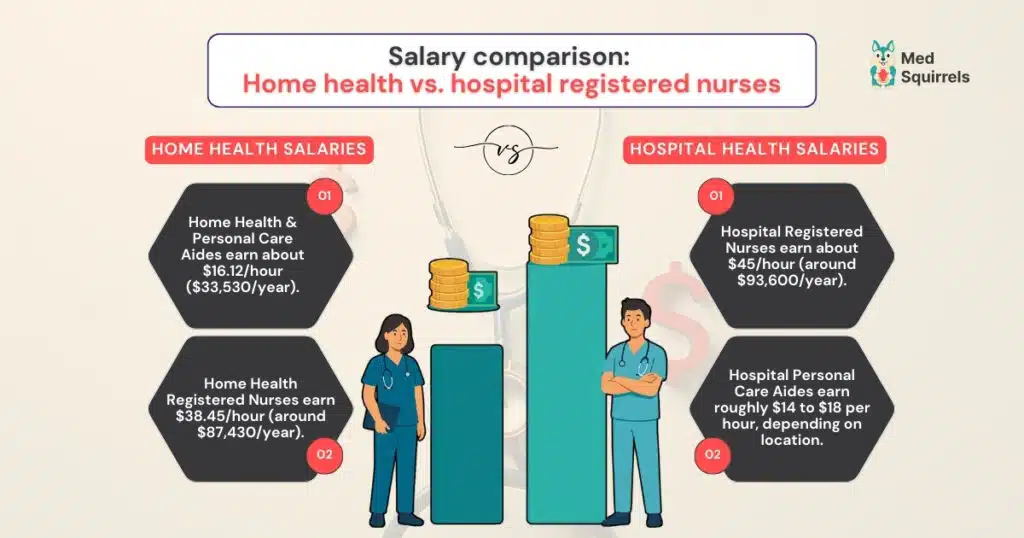
The differences in compensation structures between home health nursing vs hospital nursing are important for understanding how to develop competitive compensation offers, retain nurses effectively, and build staffing models that accurately reflect the true market for each nurse type. Staying aware of the salary structure also helps you stay competitive and attract stronger talent. A detailed infographic is included below for a clearer comparison of salary expectations for both roles.
Making the right staffing decisions while you hire
Your staffing decisions are determined by acuity level, volume, and the service lines that these professionals support. A home health program will likely benefit from staffing a candidate with excellent judgment in the field, especially one with experience in home health nursing duties. On the other hand, hiring a hospital nurse requires finding a candidate who functions best in an environment where teamwork is essential to providing quality care and where hospital nurse responsibilities shape much of the daily workflow.
When determining which of the two types of nurses, home health or hospital nurses, will be best for your facility, you should consider the types of skills and abilities that will best meet the expectations of the position and the organization. Skills such as adapting easily, demonstrating critical thinking, and working independently or within high-volume units all play a role.
Understanding these traits will help you hire the right nurse for your facility’s staffing needs and reinforce your facility’s operational stability while staying aligned with the differences between home health and hospital nurses that affect performance and fit.
Choosing the right staffing partner to fill your roles
Making the right decision can solve most of your staffing issues. It shapes the stability of your entire workforce. As a recruiter, you must know where to hire and whom to partner with to keep your operations running smoothly. When you do not understand the differences between home health and hospital nurses, partnering with the wrong service can slow your progress.
Many healthcare facilities may still partner with traditional staffing agencies, often without thorough research. These staffing agencies may come with drawbacks such as high markups, slower communication, and limited transparency.
High markups can strain your budget and limit the number of qualified professionals you can bring onto your team. Slower communication often results in delayed confirmations, missed updates, or interruptions in your staffing workflow. With limited transparency, you may not have a clear view of candidate quality, credential accuracy, or true availability, increasing the risk of mismatched placements and last-minute disruptions.
A modern platform like MedSquirrels helps you avoid these staffing issues by providing faster access to curated candidates, predictable processes, and clear pricing. It keeps your staffing affordable through three affordable staffing plans, such as:
- Orange Plan: Recruitment + EOR/Payrolling helps you find a contract clinician or non-clinician and handles HR, payrolling, and benefits.
- Purple Plan: EOR/Payrolling, ideal when you already have a candidate and only need HR, payrolling, and benefits support.
- Blue Plan: Recruitment service, designed to help you find full-time clinicians or non-clinicians.
With MedSquirrels, you only need to pay the payroll cost and a flat fee per hire. By choosing a partner such as MedSquirrels, you can prioritize speed, clarity, and affordability, thereby strengthening your staffing strategy and ensuring smoother, more dependable coverage across your facility. Book a free demo and see how MedSquirrels can transform your nurse staffing process.
FAQ
How do I understand the differences between home health and hospital nurses?
You can understand the differences by looking at how each setting shapes the nurse’s daily workflow. Home health nurses work independently in patients’ homes, while hospital nurses work in fast-paced, team-based units. These distinctions help you place candidates where they can perform effectively.
What should I know before I hire a nurse for my facility?
Before you move forward, clarify the role, the work setting, and the level of support the nurse will receive. Many facilities also consider the differences between home health and hospital nurses to determine which skill set best aligns with their needs. Clear expectations make the process smoother and help you bring in someone who can adapt quickly.
What work experience(s) should I look for when screening a home health nurse profile?
When screening a home health nurse’s resume, look for essential duties such as wound care, medication support, home safety checks, and patient education. These duties show whether the candidate can handle independent fieldwork.
How does MedSquirrels help my facility hire the right nurse for our service lines?
MedSquirrels helps your facility hire by using AI to craft job descriptions and match skilled candidates. It handles credentialing, background/licensing checks, and onboarding compliance, while you handle interviews directly.
What makes MedSquirrels a dependable option for ongoing nurse staffing?
MedSquirrels offers consistent support and suitable matches for your open roles. You can receive curated profiles in 2–5 business days, allowing you to hire without delay.

Jani Basha is a healthcare content expert at MedSquirrels, sharing insights on staffing trends, hiring best practices, and career growth.