
Compliance and certification requirements for hiring registered nurses
When recruiting registered nurses, proper measures must be taken to navigate state compliance and RN certification requirements. There are various ways to hire registered nurses, including full-time and contract.
Each has its own regulatory guidelines and policies set by the state, which must be followed throughout the recruitment process to maintain registered nurse staffing compliance. In addition, facilities must stay aware of evolving regulatory expectations to keep their processes current. By doing so, recruiters can also meet the broader registered nurse compliance requirements expected across healthcare systems.
The legal requirements for practicing as a registered nurse in the USA include obtaining a state-specific license and meeting the required qualifications. The minimum qualification requirement for nurses consists of a bachelor’s degree in nursing, an associate’s degree in nursing, or a diploma from a university accredited by the board.
Even though this legal requirement verification seems simple, other state regulatory guidelines and policies, as well as the primary responsibilities, complicate the RN recruiting process. Healthcare facilities must also consider legal factors when recruiting a nurse to avoid noncompliance risks and maintain safe, accountable staffing practices.
Understanding the legal challenges and staying up to date on current regulatory guidelines is key to staffing your facility with the providers you desire. This blog explains the key recruiting and nursing certification requirements for RN staffing and how you can simplify the process while maintaining proper standards.
Legal and compliance challenges healthcare facilities face when they hire RNs
The following are key challenges and solutions to consider when you plan to hire registered nurses for your healthcare facility. Many of these steps require careful coordination among HR, clinical leadership, and credentialing teams to avoid onboarding delays. A structured guide for facilities to hire registered nurses also ensures your facility remains audit-ready and aligned with evolving regulatory expectations.
Challenge: Confirm that the candidate has a valid work license in the state where your facility is located.
Solution: The NCLEX (National Council Licensure Examination) for RNs is the licensure examination for nurses in the USA that assesses a nurse’s competency to work as a registered nurse. The state board of nursing can verify the validity of the licensure.
Most boards offer online tools that let you enter the license number to check its status. You can also look up and verify a license through Nursys, the national nurse licensure database used by most state boards, in addition to your state’s verification board, to ensure legal issues in healthcare during staffing.
Challenge: Conducting a thorough background check for any criminal, drug abuse, or sexual harassment history.
Solution: There are reputable medical staffing solutions providers in the USA that can handle the entire credentialing process.
Challenge: Adhering to the equal employment opportunity law (EEO) to restrict any bias based on gender, age, race, disability, etc.
Solution: When you hire registered nurses, a structured interview process that evaluates all candidates against a common benchmark can help ensure compliance with equal employment opportunity laws.
In addition, documenting every step of the recruitment process can help you avoid compliance issues in healthcare and support essential legal considerations when you hire a nurse.
Challenge: Following federal and state labor laws regarding employment and workplace policies.
Solution: Staying up to date with changing state norms and labor laws can help ensure timely reviews of staffing policies and strengthen your approach to registered nurse compliance.
Challenge: Complying with Occupational Safety and Health Administration (OSHA) regulations to secure workplace safety standards
Solution: Proper training on safety standards must be provided during onboarding. Make this training mandatory so that even experienced candidates are aligned with current protocols. Regular safety audits should also be conducted to ensure legal compliance with RN staffing.
Challenge: Ensuring compliance with the Health Insurance Portability and Accountability Act (HIPAA), which protects patient data privacy.
Solution: Execute strict policies for handling and sharing patient information, and educate all staff on best practices for data confidentiality as part of registered nurse staffing compliance.
Bonus tip: To ensure continuing education qualification, provide ongoing training to your existing registered nurse staff and support them in taking certifications.
Potential legal implications of hiring unlicensed or uncertified nurses
Given the criticality of the healthcare industry, facilities can face serious consequences if they hire unlicensed or uncertified nurses. Legal considerations for recruiting a nurse must be followed, as unlicensed nurses can misdiagnose symptoms, violate infection-control measures, fail to meet safety standards, or cause medical errors that harm patients.
Severe regulatory penalties will be imposed on healthcare facilities that fail to ensure legal compliance. Moreover, if any patient is harmed, a lawsuit may be filed, and the facility may be held liable for negligence. Based on severity, healthcare facilities may lose their accreditation. Consequently, this can damage the facility’s reputation and erode patient trust.
Reputational damage can harm the facility’s employer brand, leading to a shortage of skilled candidates willing to work there. A history of non-compliance can also increase liability insurance premiums due to heightened risk to the facility.
When HIPAA regulations are compromised, the facility will be fined depending on the severity of the data privacy violation. The American Medical Association clearly states that HIPAA violations are enforced and stipulates penalties for civil violations that range from $100 for unknowingly violating HIPAA guidelines to $50,000 per violation, depending on severity.
A detailed infographic has been added to explain how HIPAA breaches result in penalties based on the severity of the privacy violation.
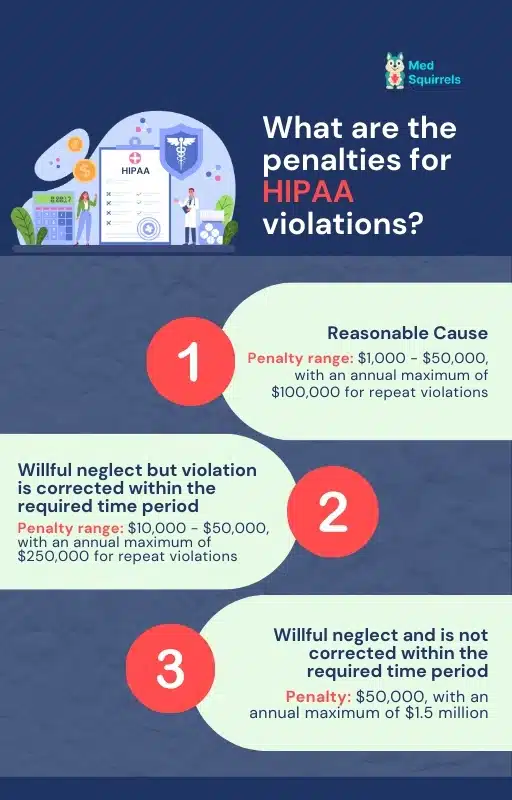
U.S. Department of Health and Human Services (HHS) Office for Civil Rights (OCR) enforces the HIPAA Privacy and Security Rules.
Failure to comply with HIPAA can also result in civil and criminal penalties. If a complaint describes an action that could violate the criminal provision of HIPAA, OCR may refer the complaint to the Department of Justice (DOJ) for investigation.
Source:American Medical Association
License renewal requirements for registered nurses in Texas
The Texas Board of Nursing permits the license renewal of registered nurses on a case-by-case basis. Registered nurses practicing in Texas must renew their license every two years, beginning 60 days prior to the license expiry date. The renewal procedure includes submitting an application, paying a $68 fee, and providing proof of completing at least 20 hours of continuing nursing education (CNE) from an authorized provider.
Once submitted, the board validates the credentials and approves renewal within 15 working days. The verification process supports RN certification requirements for nurses practicing in the state. As a recruiter hiring registered nurses in Texas, you must have a clear understanding of the state’s RN licensing requirements and licensure application process to ensure timely onboarding and compliance.
A detailed infographic is provided below, outlining the key licensing requirements to help you better understand the process and avoid staffing delays.
Number of years licensed
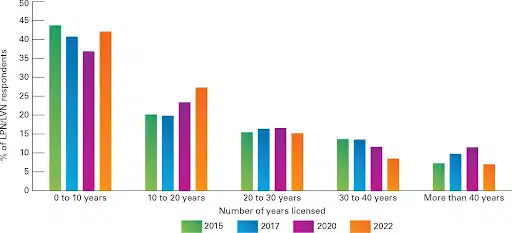
Source: Journal of Nursing Regulation
How HR teams can streamline RN certification verification
Certificate verification is a necessary step in the pre-recruitment stage of RN hiring. It helps improve staffing in healthcare by confirming candidate competency and ensuring qualifications come from accredited institutions as defined by state requirements.
Strengthening this process supports registered nurse recruiting compliance by reducing credential-related risks for facilities. Additionally, maintaining a clear, consistent verification workflow helps facilities stay aligned with broader registered nurse compliance requirements across different states.
Here are some quick suggestions to streamline the verification process:
- Keep a certification verification checklist handy.
- Train HR staff thoroughly on the process.
- Leverage technology to detect data mismatches as part of the credentialing process.
- Maintain digital, cloud-based documentation for easy access.
- Conduct comprehensive background verifications.
- Ask for references to validate experience.
- Collaborate with medical staffing platforms that can manage the full credentialing process.
How can facilities craft effective job descriptions?
When you hire registered nurses, a well-written job description helps attract top talent and ensure quality hires. Craft job descriptions by clearly outlining job duties, workplace expectations, and ideal candidate criteria.
The responsibilities include coordinating patient care, assessing vital signs, administering medications, educating patients and families, and providing emotional support.
Briefing the additional perks and benefits of working in your facility, which includes the comprehensive compensation package, professional growth opportunities, and D&I initiatives, can enhance the attractiveness of your job description.
Always create customized job descriptions based on your facility’s specific needs. Consult existing staff if needed. For contract positions, specify contract periods and terms. A clear, step-by-step application process and a designated point of contact can make your job posting stand out.
Such clarity in job postings further supports RN certification requirements by helping candidates understand every prerequisite before they submit an application.
Streamlining credentialing and staffing with modern staffing platforms
To simplify the complex processes involved in recruiting registered nurses, healthcare facilities can use RN staffing platforms. These platforms help manage requirements efficiently, reduce administrative work, and ensure all legal standards are met during onboarding.
Many healthcare staffing platforms across the USA assist facilities with the RN credentialing process. However, traditional staffing agencies often charge high markup fees and may include hidden costs. Some agencies lack transparency, limiting facility insight into the credentialing process.
The highlight of our RN staffing platform is that you will only have to pay a flat license fee along with the payroll cost of the registered nurses hired through us: no markup charged!
MedSquirrels is a modern staffing platform that addresses these challenges with a flat-fee structure, providing transparent pricing and alignment with registered nurse recruiting compliance. This platform also supports both contract and full-time RN recruiting and offers three affordable staffing plans.
The AI-powered platform also assists with job description development, credentialing, and onboarding. Book a demo to learn more about the plans and associated costs. Nursing and other healthcare professionals, you can also check open jobs and apply for those that match your skills.
FAQ's
What are the legal considerations when recruiting an RN?
When recruiting a registered nurse, healthcare employers must ensure compliance with state licensure requirements, scope-of-practice regulations, and background check standards. It is also important to follow equal employment laws and verify that candidates meet all legal eligibility criteria before onboarding.
What compliance is needed to hire registered nurses?
To hire registered nurses, facilities must confirm active state licensure, complete credential verification, conduct background screenings, and meet regulatory requirements, including documentation, onboarding process, and adherence to labor and healthcare laws.
How to verify nurse credentials before recruiting?
Nurse credentials can be verified by checking state board licensing databases, confirming education and certifications, reviewing work history, and ensuring there are no disciplinary actions or license restrictions before proceeding with recruiting.
How does MedSquirrels help facilities hire qualified nurses faster?
MedSquirrels streamlines the selection process by matching facilities with vetted nurses who meet clinical and compliance standards. Our platform reduces delays, improves accuracy, and ensures you connect quickly with the right professionals.
Can MedSquirrels support specialty nurse roles?
Yes. MedSquirrels provides access to nurses with varied specialties, from critical care to long-term support. You can hire skilled RNs based on patient needs, case volume, and required certifications.

Jani Basha is a Content Specialist with a background in healthcare content development, recruitment, and workforce management. His work focuses on the challenges healthcare facilities face in attracting, staffing, and managing clinical and non-clinical professionals. He develops content on healthcare recruitment, workforce trends, and staffing strategies. His work translates complex workforce topics into practical insights for healthcare recruiters. His work aligns with MedSquirrels’ mission to make healthcare staffing more efficient and cost-effective through technology-driven workforce solutions.