
How to hire radiologists specialized in MRI & CT imaging

When diagnostic imaging reliability is crucial to your service provision, learning how to hire a radiologist will be your top priority before you recruit. Radiologists specializing in MRI and CT bring advanced training that enhances diagnosis speed, clinical accuracy, and operational efficiency.
Whether you are in a hospital radiology department or an outpatient imaging center, your staffing process must be tailored to meet your specific needs. This blog will help facilities like yours realign recruiting practices to meet today’s imaging demands.
When you plan to hire for a healthcare facility, consider flexible staffing models, such as short-term contracts or full-time placements. It will help you to meet your specific caseloads and scheduling gaps without compromising quality.
Assess imaging volume and define the radiologist’s role
Before considering how to hire a radiologist, evaluate your facility’s imaging volume and service model. Break down MRI and CT scan volumes by weekday, modality, and urgency to determine if you need generalists or subspecialists. If your center is expanding, consider flexible staffing models to include more neuro or musculoskeletal MRIs or to manage a high-trauma CT volume; role clarity becomes vital.
Consider whether you will need weekend or evening coverage, and if teleradiology can support lower-volume shifts. A well-defined job role enables you to hire a radiologist with the right skills and availability.
Here are some areas to assess when shaping role expectations:
- MRI vs. CT daily case load
- Percentage of advanced subspecialty reads (e.g., MSK MRI, Cardiac CT)
- On-site vs. remote interpretation needs
- Coverage gaps for evenings or weekends
Carefully assessing these factors ensures you hire a radiologist whose skills and availability align perfectly with your facility’s workflow and coverage needs.
Confirm certifications and subspecialty credentials
Recruiters like you must understand that knowing how to hire a radiologist for MRI and CT is verifying that candidates meet professional and legal requirements. Ensure the radiologist holds current board certification through ABR or AOBR and is licensed in your state.
Prioritize subspecialty fellowship training in MRI or CT, especially in domains like neuroimaging, MSK, or cardiac imaging. Do not overlook malpractice coverage or continuing medical education records. A rigorous credential check during radiology staffing helps ensure quality care and a smooth onboarding process.
Use this checklist to streamline your credential verification process:
- ABR/AOBR board certification
- Active state licensure
- Fellowship training in MRI/CT specialties
- Malpractice insurance coverage
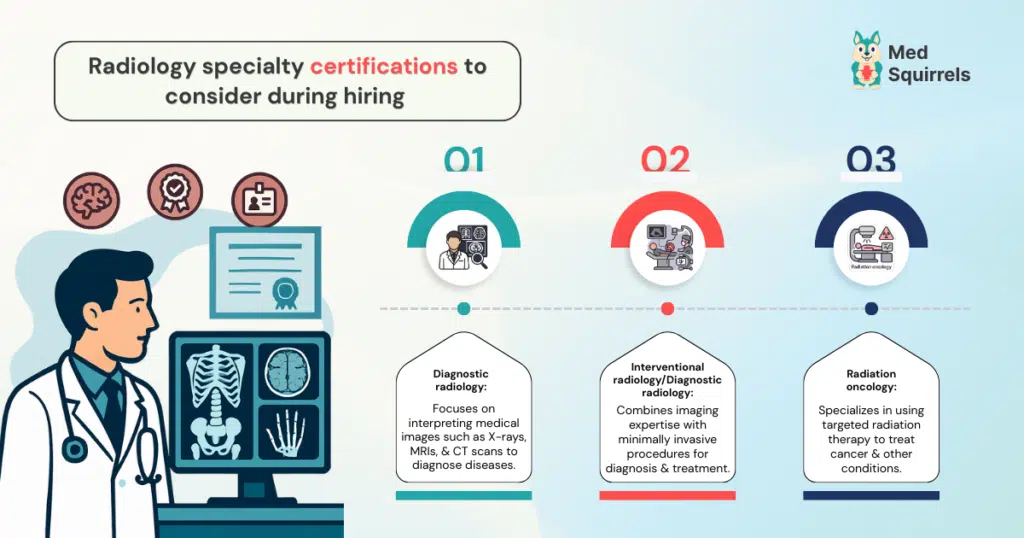
In addition to certifications, check a candidate’s subspecialty training, such as neuroimaging, musculoskeletal imaging, or cardiac imaging. This directly affects diagnostic efficiency and case accuracy. A detailed infographic has been added for better understanding.
Key radiologist certifications to check before recruiting
Check technical skills and imaging system experience
Modern radiology departments rely heavily on digital integration. During the recruitment, you must assess how comfortable candidates are with your specific imaging platforms and software. Ask about their familiarity with structured reporting tools, AI-driven protocols, and specific vendor systems like GE, Siemens, or Philips.
Inquire about their turnaround times, peer review participation, and preferred QA processes. Technical familiarity directly impacts your workflow efficiency and patient throughput.
Here are some useful questions to assess technical readiness:
- Which PACS/RIS systems are you proficient in?
- What is your process for maintaining quality across different CT protocols?
- How do you engage in peer review or feedback discussions?
Evaluating these technical skills ensures candidates can seamlessly integrate into your workflow and maintain high standards of patient care.
Evaluate communication skills for collaborative care
During the recruitment process, as a healthcare owner, you must know the essential skills that a professional must have. You must also ensure that effective interdepartmental collaboration is a key consideration when planning to recruit radiologists for team-based environments. Radiologists must communicate findings clearly to referring physicians, technologists, and care teams.
Ask scenario-based questions to gauge their ability to handle urgent or complex cases. Smooth communication reduces reporting ambiguity and supports rapid clinical decisions, especially in trauma or emergency settings. Communication skills are just as crucial as clinical ones in today’s multidisciplinary settings.
Here is a scenario-based example that reflects real-time diagnostic communication:
Q: How would you handle a case where you detect an unexpected mass on a CT scan originally ordered for lower back pain?
A: I would call the referring physician immediately, explain the findings, and discuss next steps. I would also document the call and highlight the conversation in my report for transparency and continuity.
Offer competitive packages and streamlined onboarding
Understanding how to hire a radiologist also means designing a compensation structure that reflects their expertise. MRI and CT specialists often command higher market rates due to the complexity of their reads. Offer a clear base salary, productivity incentives, and optional perks like sign-on bonuses or CME reimbursements.
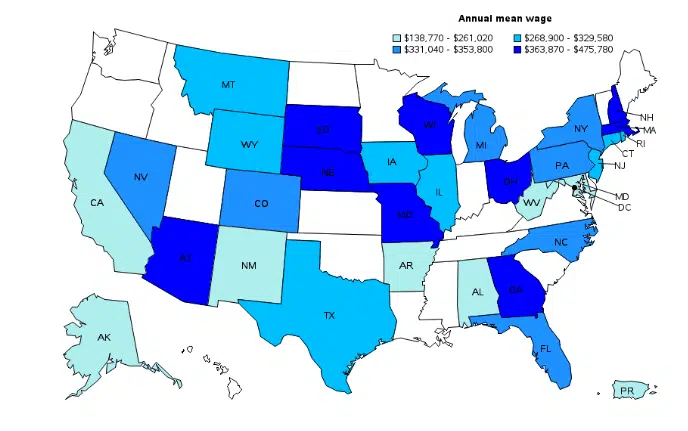
To attract top-tier talent, your offer must remain competitive, especially in high-demand states, so providing a strong compensation package is essential. For better clarity, refer to the attached infographic showcasing state-wise salary ranges.
A smooth onboarding process, including credentialing timelines, EMR access, and orientation to imaging protocols, ensures early integration and long-term retention. Competitive packages and organized onboarding can make or break successful radiologist recruitment.
Consider including the following elements in your offer and onboarding flow:
- Competitive salary plus incentive bonuses.
- Coverage of malpractice and CME costs.
- Pre-boarding credentialing packet.
- Orientation on scanners, workflows, and documentation standards.
Implementing these elements ensures your recruitment strategy is both attractive to candidates and effective for long-term retention.
Annual salaries of radiologists by state in the USA.
Source: www.bls.gov
Use smart staffing platforms to fill radiologist roles faster
When a healthcare facility decides how to hire a radiologist, many begin by partnering with traditional staffing agencies. These agencies often face inefficiencies because they may rely on manual workflows, leading to credentialing delays, profile mismatches, and longer time-to-fill, all of which directly affect patient care.
To overcome these inefficiencies, partner with MedSquirrels, which offers AI-powered staffing solutions built for healthcare managers. Whether you need full-time staff or contract radiologists, our streamlined approach supports fast staffing.
MedSquirrels offers cost-effective radiologist staffing plans designed to support workforce needs. These plans support facilities at every stage of staffing, from sourcing and screening, interview scheduling, credentialing, onboarding, payroll, and benefits.
Recruiters can also book a free demo to see how the platform makes recruiting easy. Professionals can also check open jobs and apply for those that match their skills.
FAQs
What is the first step when planning to hire a radiologist?
The first step is to evaluate your facility’s imaging volume and service model, determine whether you need generalists or subspecialists, and define clear role expectations for MRI and CT coverage.
What technical skills should you assess before recruiting candidates?
You must assess familiarity with PACS/RIS systems, structured reporting tools, AI-driven protocols, and vendor-specific platforms such as GE, Siemens, or Philips to ensure seamless workflow integration.
When is it appropriate to hire a radiologist on a contract basis versus full-time?
Contract placements are ideal for temporary staffing gaps, high-volume periods, or specialized coverage needs, while full-time hires support long-term operational stability.
Can I use MedSquirrels for short-term or per diem radiologist roles?
Yes, our platform supports both long-term and flexible short-term staffing through customized plans that adapt to your imaging volume, shift gaps, and seasonal coverage needs.
How quickly can MedSquirrels fill an MRI/CT radiologist vacancy?
Depending on urgency and required credentials, the recruiting process can begin within days. Our AI-powered platform typically delivers verified resumes in 2to 5 business days faster than traditional staffing agencies.

Jani Basha is a Content Specialist with a background in healthcare content development, recruitment, and workforce management. His work focuses on the challenges healthcare facilities face in attracting, staffing, and managing clinical and non-clinical professionals. He develops content on healthcare recruitment, workforce trends, and staffing strategies. His work translates complex workforce topics into practical insights for healthcare recruiters. His work aligns with MedSquirrels’ mission to make healthcare staffing more efficient and cost-effective through technology-driven workforce solutions.