
How to hire a phlebotomist: A step-by-step guide
A phlebotomist is a healthcare professional who specializes in drawing blood from patients. Most facilities and clinics hire phlebotomists to handle blood transfusions and tests.
Hospital recruiters must understand that a phlebotomist’s role includes making patients comfortable during blood draws.
Once this drawing process is completed, the phlebotomist will take st0eps to preserve the sample for later testing. Your phlebotomist staffing process will be much more efficient if you make well-planned decisions.
This blog explains proven tips that will assist you in your efforts to hire phlebotomists more efficiently within your budget.
Tip #1: Determine your staffing needs
The need for these skilled professionals fluctuates with patient volume, seasonal trends, and unexpected absences within your team, leading to workforce gaps.
These gaps can affect patient care if not addressed promptly. To overcome these challenges, as a recruiter, you must decide whether to choose contractual or full-time staffing.
Contractual staffing can help quickly fill short-term gaps. If it is a busy season and patient volume is increasing while your facility is short-staffed, choosing a contract-based approach can be a good solution. This approved method helps you fix staffing shortages in your facility.
On the other hand, the full-time recruiting approach will help you maintain a stable phlebotomist team and consistent service. Full-time staff will help you build a trusted team. This approach will also ensure consistency and high-quality patient care.
Recruiting for full-time roles helps you find committed professionals who want to grow with your clinic. This planned phlebotomist recruitment approach allows hospitals to adjust staffing levels and reduce last-minute recruiting pressure.
Tip #2: Create a compelling job description
A detailed, transparent job description for phlebotomist recruitment will address most of your staffing challenges. You must draft a job description that clearly outlines the role’s responsibilities and skills to attract more professionals.
When drafting a job description, remember to address whether the candidate needs to handle specialized equipment or require specific certifications. These details will help you attract qualified candidates with the necessary skills for the position.
The detailed infographic below highlights key phlebotomist responsibilities to include when drafting an effective job description that helps you hire qualified professionals.
Key phlebotomist responsibilities for job descriptions
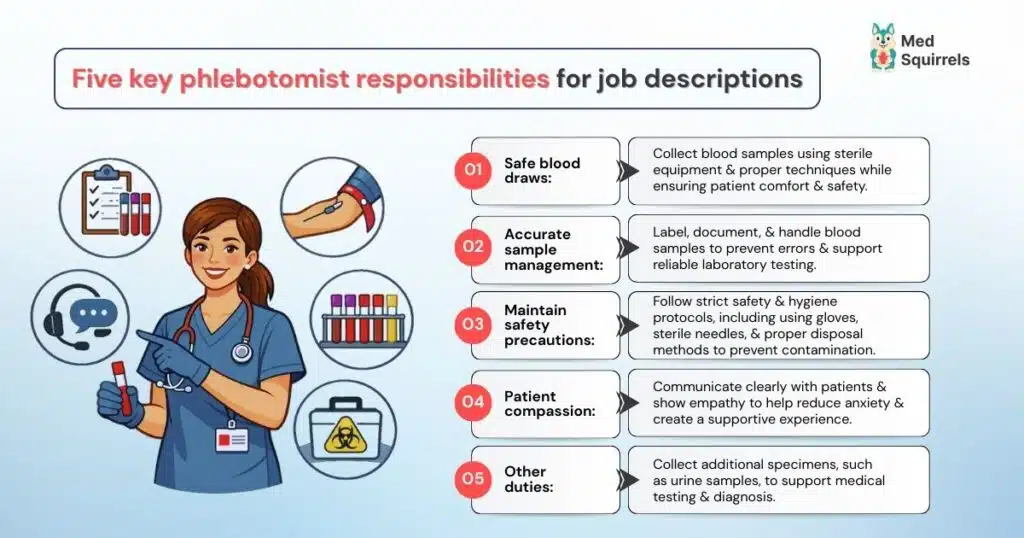
For example, if your hospital is looking to hire phlebotomists, make sure that your job description clearly outlines responsibilities and strengthens your phlebotomist hiring process.
Tip #3: Hire phlebotomists from new sources
You need to practise new staffing methods rather than relying on traditional ones, such as advertising for job roles. One such method is an employee referral program. You can hire skilled, experienced professionals on time using this approach.
To achieve better recruiting results through employee referrals, you must encourage your staff with benefits. Employee referrals will allow you to hire phlebotomist professionals in a short span of time.
Offering referral bonuses can motivate employees to recommend qualified professionals from their networks. This approach not only expands your talent pool but also improves the chances of recruiting reliable candidates who are already trusted by your staff
For example, when you plan for phlebotomist recruitment, it is better to inform your current staff and their networks to hire skilled professionals.
Tip #4: Maintain effective onboarding and training for new phlebotomists
Once you complete the recruiting process, the most vital step is onboarding. As a healthcare owner, you need to examine how onboarding and current training are implemented in your facility.
This examination helps you identify any gaps and improve the process. Remember that the training and onboarding process must include details about the role and its responsibilities.
Along with this, you must also include your facility’s work culture and policies. If your training processes do not meet your facility’s needs, you may create a team of senior professionals from your learning department.
Recruiters can also talk to newly hired professionals and ask for their feedback. It would be a better option to create a team dedicated to improving the onboarding training process.
Clinic owners who aim to improve patient care should follow a robust onboarding process. A structured onboarding plan should train phlebotomists in the process of drawing blood and in interacting with patients.
You must also include an explanation of the modern tools and how they can be used in the laboratory. This detailed process helps them start their work with confidence from day one. It improves patient care practices and reduces the chance of errors in the work.
Tip #5: Maintaining the retention process
A proven and effective strategy to fill staffing gaps in your facility is to practise a retention process. Retention is one of the best options to keep your workforce in your facility.
It is considered the best option because it can significantly reduce the huge recruiting costs and administrative workload associated with the phlebotomist hiring process.
Here is a quick overview of phlebotomist retention strategies you can implement to reduce staffing turnover in your facility.
- Detect the main reasons for employee resignations.
- Cross-check the work schedules.
- Maintain flexible and rotational shifts.
- Check and revise salaries to align with market standards.
- Encourage your team with rewards and recognition programs.
- Provide professional growth opportunities.
- Maintain a healthy workplace culture.
In many healthcare facilities, rigid shift schedules are a key driver of turnover. If you can address this shift challenge, you can also maintain a team without gaps.
Tip #6: Offer competitive compensation and benefits
To maintain a healthcare team of qualified phlebotomists, offering competitive salaries is important. Competitive pay can help improve job satisfaction and support staff retention within your team.
Clinic owners must understand that offering market-trending salaries along with benefits such as bonuses and incentives not only increases their chances of attracting experienced phlebotomists but also enhances the facility’s brand image.
Recruiting managers planning the hiring process should recognize that competitive wages position the facility as an employer of choice in a competitive market.
A clinic that offers competitive salaries is more likely to overcome recruitment challenges caused by workforce shortages.
For example, if you want to hire phlebotomists, offering an attractive salary is essential. To help you understand current salary trends, a detailed infographic is provided
Top-paying states for radiologic technologist

Source: BLS
How facilities can hire phlebotomists efficiently using modern platforms
Healthcare facilities facing workforce gaps must implement structured strategies to address shortages and maintain operational stability.
A proactive and results-driven recruiting approach helps facilities reduce time-to-fill while maintaining high standards of patient care. Understanding practical recruiting tips is an advantage for facilities seeking to hire phlebotomists, but success also depends on choosing the right platform to support efficient recruiting.
One vital strategy is to avoid over-dependence on traditional agencies and free job portals. It is often recommended to avoid agencies because they frequently practice conventional healthcare staffing models.
Traditional staffing agencies may bring challenges for facilities. Many agencies charge high markups, sometimes reaching 40%–60% of a professional’s annual pay, which can significantly increase recruiting costs.
In addition to this, facilities may still receive a limited number of candidate options even when paying a good amount. Additionally, pricing details are often unclear, and the recruiting process may involve multiple approvals and administrative steps that slow recruitment.
To overcome these challenges, facilities should consider partnering with modern platforms such as MedSquirrels. The platform provides verified talent, streamlined processes, and greater visibility into workforce availability to address shortages.
Unlike traditional agencies, MedSquirrels offers better pricing transparency and reduces unnecessary markups while maintaining access to qualified professionals.
The platform simplifies the recruiting process with a single streamlined system, helping healthcare facilities connect directly with verified talent without navigating complex processes or multiple tools.
Partnering with MedSquirrels is one such effective option. The platform supports hospitals and clinics with structured solutions that simplify phlebotomists’ recruiting while attracting both contract and full-time professionals within your recruiting budget.
For example, if phlebotomy recruiting is your requirement, the process begins when a recruiter partners with MedSquirrels and selects a plan that aligns with their recruiting requirements. The plans include:
- Staffing Plan: Full recruitment combined with Employer of Record (EOR) and payrolling services.
- EOR Plan: EOR and payrolling support for facilities that have already sourced a candidate but require HR, payroll, and benefits administration.
- Direct Hire Plan: Recruitment-focused support for hiring full-time clinicians or non-clinicians efficiently and directly.
By implementing these recruitment tips, facilities can hire phlebotomists without relying solely on traditional agency models.
Clinics can book a free demo to explore affordable plans. At the same time, healthcare professionals can visit our open jobs and apply directly, ensuring a smoother experience for everyone involved.
FAQs
What factors should healthcare recruiters consider when recruiting phlebotomists?
Recruiters should evaluate certifications, clinical experience, and patient communication skills. Facilities should also check whether candidates can operate modern equipment or not. Considering these factors helps ensure reliable and professional phlebotomy services.
How can healthcare facilities reduce shortages in phlebotomy roles?
Facilities can reduce shortages by implementing structured strategies such as employee referral programs, competitive compensation packages, and flexible work schedules. Using modern platforms can also improve recruiting efficiency and workforce stability.
Why is a clear job description important when recruiting phlebotomists?
A detailed job description helps healthcare facilities attract candidates with the right qualifications and skills. Clearly outlining responsibilities, certifications, and work expectations ensures that applicants understand the role. This improves candidate quality and reduces time spent reviewing unsuitable applications
Why should healthcare facilities choose MedSquirrels for staffing solutions?
Facilities choose MedSquirrels because the platform combines technology with staffing expertise to simplify recruiting. Its transparent pricing model and affordable plans help facilities save time and reduce costs.
Can MedSquirrels help healthcare facilities hire both contract and full-time staff?
Yes. MedSquirrels provides affordable solutions for healthcare facilities. Organizations can hire contract clinicians for temporary needs or recruit full-time healthcare professionals through the platform’s recruitment services and plans.

Suresh writes about healthcare staffing and industry insights for MedSquirrels, helping professionals and facilities navigate hiring needs.