
NP credentialing and compliance checklist in the USA
In the present healthcare industry, verifying a nurse practitioner’s credentialing is an essential step before they can start working at your facility. But recruiters must understand that this process can take time and may slow down their recruiting efforts.
This blog gives you informational steps about NP credentialing and a compliance checklist to assist recruiters like you in completing the process faster.
It also covers the essential steps to ensure your NPs are qualified to work. With a planned approach, credentialing can become easier and help your teams stay fully staffed while delivering patient care.
Step #1:NP License and certification verification checklist
Hospital owners planning to hire nurse practitioners must remember that, when reviewing candidates, it is important to follow a structured nurse practitioner credentialing process. It will also help you avoid staffing delays and ensure compliance.
As a recruiter, you can start by ensuring the NP professional has an active state license and a valid national certification, such as AANP or ANCC. Expired or inactive licenses can delay onboarding and lead to compliance violations, contributing to credentialing delays that impact patient care. Verifying certification early helps prevent credentialing rejections during payer or facility review.
Key verification steps to be followed:
- Remember to check whether their specialty certification matches the role you want to hire for and to confirm interstate licensing eligibility.
- Make sure you complete primary source verification to ensure all credentials are genuine
Primary source verification ensures the information is directly confirmed with issuing authorities rather than relying on submitted documents.
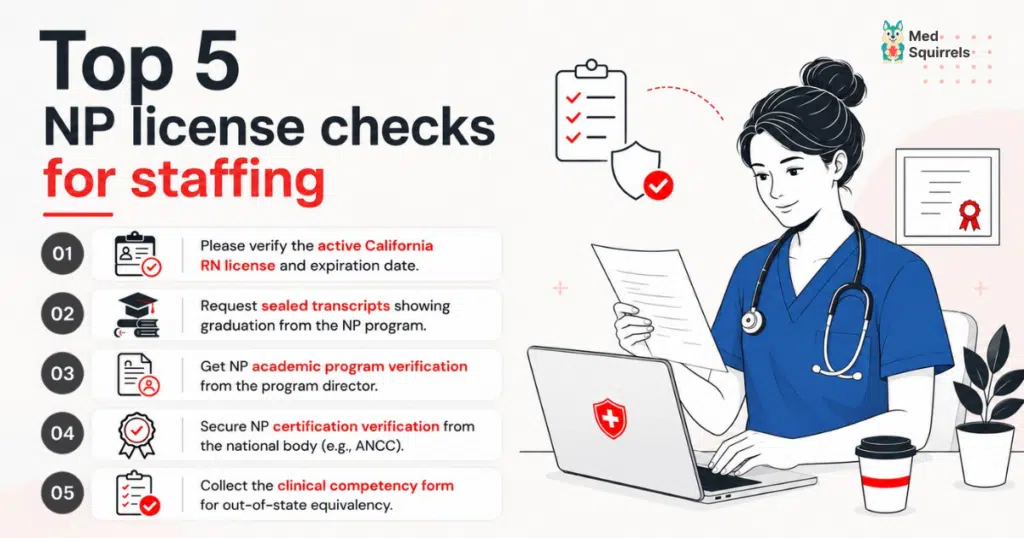
For example, if you want to hire a nurse practitioner in California, you must be aware of the state licensing requirements, and a detailed infographic is added for better understanding.
Essential NP license verifications for staffing
Step #2:Documentation and credentialing checklist
Facilities in the credentialing process must know how to organize documents. Documentation is an important process to follow to meet nurse practitioner compliance standards; it will help you avoid recruitment delays and ensure everything is in place.
Missing or incomplete documentation is one of the most common reasons for delayed credentialing approvals in healthcare. Qualified recruiters like you must verify all required NP credentialing documents and verifications before the onboarding process begins.
The following points outline the key requirements for completing the process.
- Recruiters must confirm if the NP has an accredited MSN or DNP degree and has completed the required clinical training
- Must check DEA registration, NPI number, and ensure malpractice insurance is active
- Ensure the CAQH profile is filled out and ready for insurance enrollment
Keeping these documents ready helps facilities speed up the staffing and nurse practitioner credentialing process and reduces last-minute issues.
Step #3:Compliance and regulatory requirements checklist
Healthcare recruiters who have completed the staffing process must carefully manage regulatory checks as part of the nurse practitioner credentialing process. It is to ensure safe and legal practice. In addition, clinics must maintain compliance with legal and organizational standards before a nurse practitioner begins working at your facility.
The following steps will help you confirm that all required approvals and standards are complete before the onboarding process. Regulatory requirements can vary significantly by state, especially regarding prescriptive authority and supervision rules.
Regulatory compliance checks must be done as:
- Recruiters must check the NP’s state practice rules and prescribing authority.
- Hospital owners must also ensure that HIPAA training and credentialing approvals are completed on time
- You must also track continuing education (CE) credits to meet nurse practitioner compliance requirements
For example, as a recruiter, once you hire a nurse practitioner, you can start verifying prescriptive authority and ensuring HIPAA training is completed to meet licensing requirements before the NP begins patient care.
Step #4:Payer enrollment and onboarding checklist
Clinical owners must know that securing payer enrollment is an essential step in nurse practitioner credentialing, as it helps NPs start working and billing without unnecessary delays, such as those caused by credentialing and onboarding.
Healthcare managers usually need to ensure all insurance and enrollment steps are completed before the NP begins patient care. Payer enrollment is often one of the longest steps in the onboarding process, especially with Medicare and commercial insurance panels. Delays in the onboarding stage can prevent an NP from billing even after they are fully credentialed and clinically ready.
- As managers, you must confirm Medicare and Medicaid enrollment status, along with private insurance panel completion
- You must fix common issues, such as verification gaps, that can slow down the NP credentialing process
- Make sure all credentialing steps are done before clinical onboarding
For example, finishing payer enrollment early helps meet nurse practitioner licensing requirements and makes it easier for the NP to start seeing patients without billing or administrative delays. Recruiters must understand the full onboarding process, and a detailed infographic has been added to make onboarding easier and more structured.
Top 5 NP onboarding points to check after recruiting
Checklist | Benefits |
Verify Corporate Compliance & Code of Conduct completion | Reduces audit exposure and liability |
Confirm HIPAA/PHI training certification | Protects patient privacy and reduces breach risks |
Validate infection control and PPE competency | Meets Joint Commission standards |
Document transmission-based precautions training | Ensures CMS reimbursement compliance |
Confirm Patient Rights module completion | Supports value-based care metrics |
Source: umaryland
Partnering with the right platform for credentialing compliance
Hospital owners must understand that nurse practitioner credentialing is essential to ensuring healthcare staffing is conducted safely and in compliance. When recruiters follow a clear credentialing checklist, they can reduce onboarding delays and avoid compliance issues. It also leads to more consistent and reliable recruiting outcomes across facilities.
A strong NP credentialing process ensures every step, from verification to onboarding, is handled properly without gaps. This not only improves compliance and patient safety but also helps healthcare facilities reduce recruiting delays.
However, in the process of obtaining credentialing assistance, many hospitals are relying on traditional staffing agencies and free job portals. These come with unverified profiles, huge markups, and a lack of transparency. To overcome staffing challenges, many healthcare recruiters choose MedSquirrels
This platform comes with affordable recruiting plans to attract both contract and full-time professionals. This recruiting platform comes with multiple benefits, such as:
- Flat-fee pricing model with no hidden markups
- Cost transparency compared to traditional agencies and traditional job portals.
- Reduced overall recruitment expenses through a simplified pricing structure
Healthcare owners can book a free demo to see how the platform helps them make planned recruiting decisions. Professionals can also check open jobs and apply for those that match their skills.
FAQs
What are the most common credentialing challenges faced by recruiters?
Common challenges include missing documentation, expired licenses, mismatched NPI or CAQH data, delays in primary source verification, and slow payer enrollment approvals. Credentialing gaps often extend onboarding timelines and increase administrative workload for recruitment teams managing multiple provider hires
How can healthcare owners reduce delays in NP credentialing?
Healthcare owners can reduce delays by standardizing credentialing checklists, ensuring early document collection, validating CAQH profiles in advance, and closely monitoring verification timelines. A structured credentialing workflow also improves coordination between recruitment teams, compliance departments, and payer enrollment units
How can recruiters ensure compliance during NP credentialing?
Recruiters can ensure compliance by following state-specific licensing rules, verifying prescriptive authority, completing HIPAA training checks, and maintaining accurate documentation records. Regular audits of credentialing files further reduce compliance risks and help prevent onboarding errors across healthcare facilities.
How does MedSquirrels help facilities with credentialing?
MedSquirrels supports credentialing by helping recruiters access candidates with verified profiles and structured professional data. This reduces time spent on manual verification and helps healthcare teams focus on compliance and onboarding efficiency.
Is MedSquirrels suitable for small clinics as well as large hospital systems?
MedSquirrels is designed to support healthcare organizations of different sizes, including small clinics, specialty practices, and large hospital networks. Scalable access allows recruiters to adapt hiring strategies based on facility size and demand.

Jani Basha is a Content Specialist with a background in healthcare content development, recruitment, and workforce management. His work focuses on the challenges healthcare facilities face in attracting, staffing, and managing clinical and non-clinical professionals. He develops content on healthcare recruitment, workforce trends, and staffing strategies. His work translates complex workforce topics into practical insights for healthcare recruiters. His work aligns with MedSquirrels’ mission to make healthcare staffing more efficient and cost-effective through technology-driven workforce solutions.