
How credentialing delays impact patient care and revenue
In the healthcare industry, provider credentialing is the formal process of verifying a clinician’s qualifications, such as licenses, certifications, and work history, to ensure they are authorized to deliver patient care and bill for services.
However, healthcare credentialing challenges, such as incomplete documentation, manual verification, and slow approvals, can extend the process for weeks or months. These delays increase administrative workload for facilities. This blog describes why slow credentialing occurs and the issues it creates for healthcare staff.
Real-world solutions to streamline credentialing
You will discover the true costs of these delays and practical solutions to enhance medical credentialing so your staff remains productive, patients receive care on time, and your revenue stays on track.
Whether you operate a large hospital or a small clinic, understanding these healthcare credentialing challenges is essential to improving operations. With the proper approach, credentialing can become an asset rather than an obstacle. A detailed infographic has been added to improve understanding of credentialing.
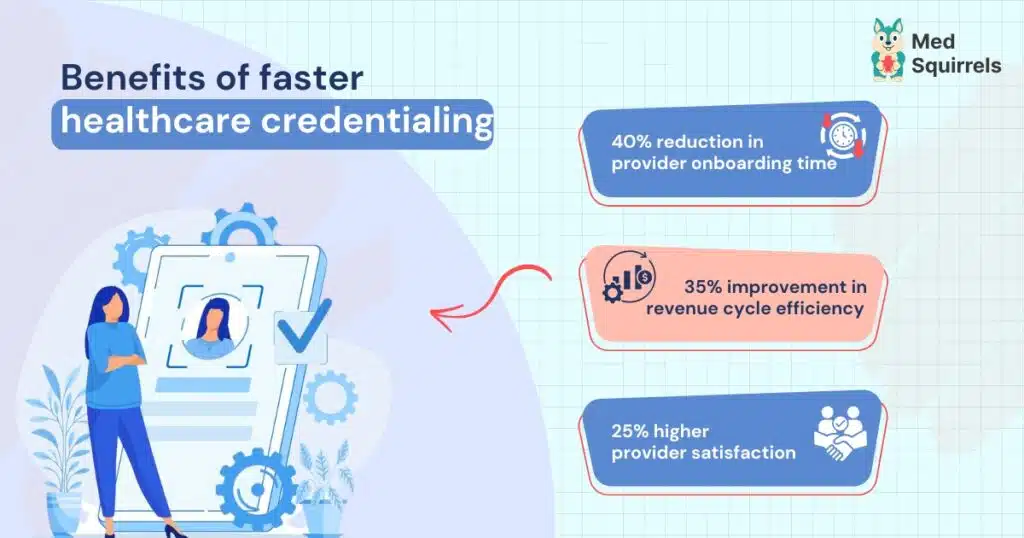
The impact of faster credentialing in healthcare
Understanding healthcare credentialing challenges
Credentialing is the validation process that ensures healthcare professionals are qualified and competent to practice. It includes license verification, background checks, malpractice history, and more. Many facilities still rely on manual systems that are vulnerable to errors and delays.
These approaches not only slow down onboarding but also increase the likelihood of regulatory risks and operational disruptions. Inefficient processes and a lack of standardization significantly contribute to delays. Incomplete documentation is a common cause of inefficient credentialing, resulting in missed deadlines and compliance problems.
For example, if you are a hospital manager and planning to hire a registered nurse, but incomplete documents delay credentialing, causing staffing shortages
The ripple effects of slow credentialing
When credentialing deadlines are slow, these create ripples that impact credentialing revenue. Along with the already overworked current staff, providers sit idle, and healthcare facilities lose revenue.
Overworked HR and credentialing staff face high burnout, making retention extremely difficult. This slows provider onboarding, increases patient wait times, and limits access to care, driving up unplanned staffing costs as facilities face challenges to fill workforce gaps.
- Slow credentialing is a heavy burden on HR teams, escalating burnout and decreasing morale with manual follow-up and backlogs.
- Delays in onboarding new providers diminish access to care, reduce patient satisfaction, and create significant service gaps. These issues consume resources and lead to lost opportunities. Staffing errors can significantly contribute to inefficiencies.
A detailed infographic below illustrates how slow credentialing impacts revenue, staffing, and patient care across the healthcare system.
The true cost of slow credentialing in healthcare
Impact area | Statistic / Data |
Revenue loss | Up to $7,500 per day lost per provider due to credentialing delays |
Average onboarding time | 90 to 120 days are needed to fully credential a provider |
Staff turnover | Credentialing issues contribute to higher HR and credentialing staff turnover |
Patient access delay | Credentialing delays can increase patient wait times by 20–30% |
Source: www.beckershospitalreview.com
Solutions to streamline credentialing
Effective medical credentialing demands an active, technology-enhanced, workflow-transparent, staff-trained approach. Standard checklists and automation can eliminate common errors and minimize wasted time. Healthcare facilities must review existing systems and update them as necessary to respond to current demands.
By addressing credentialing issues in healthcare, workflow inefficiencies, and unifying communication among departments, facilities can significantly reduce delays and improve compliance.
- Employ automated solutions and databases to reduce unnecessary credentialing and repetitive steps in the credentialing cycle.
- Use a comprehensive nurse credentialing checklist to verify licenses, certifications, background checks, and ensure standardized, accurate documentation.
The financial and operational benefits of faster credentialing
Overcoming the impacts of poor provider credentialing is not only about compliance but also about meeting immediate operational objectives, driving revenue growth, and improving patient satisfaction.
Providers who are credentialed can start seeing patients and billing sooner. It also minimizes the burden on other employees, which enhances morale and decreases turnover.
Facilities that overcome and automate credentialing issues in healthcare have a competitive advantage and can grow more rapidly. In fact, reducing bottlenecks in credentialing is one of the quickest ways to improve financial health and the efficiency of care delivery across your facility.
Faster turnaround times reduce staffing shortages, enabling new providers to bring in revenue sooner and reducing scheduling disruptions. Recruiters can choose modern staffing platforms to build a robust credentialing system that enhances retention and provider satisfaction by preventing credentialing errors that often infuriate new hires.
Overcoming slow credentialing challenges with MedSquirrels
Slow credentialing impacts the entire function of a healthcare facility. It slows patient care, results in revenue loss, and creates difficulties for employees and management. Traditional staffing agencies may rely on manual practices that slow down recruiting and create financial pressure. These healthcare credentialing challenges drain resources and lead to missed opportunities.
To overcome these hurdles, you can partner with MedSquirrels, which helps you streamline healthcare credentialing, making it quicker and easier. The platform offers an automated process that saves time and ensures accuracy.
To help your facility achieve these benefits, MedSquirrels offers three cost-effective plans with a swift credentialing process designed to meet your facility’s needs. Each plan is created to simplify and optimize your complete staffing needs, allowing you to focus more on patient care and operational efficiency.
Healthcare owners can also book a free demo to see how the platform makes recruiting easy. Professionals can also check open jobs and apply for those that match their skills.
FAQs
How do healthcare credentialing challenges delay the impact on the revenue cycle?
Credentialing delays slow provider onboarding, directly postponing the ability to bill for services. Incomplete documentation, manual verification, and slow approvals delay claim submissions, creating revenue gaps and increasing administrative costs for facilities.
How can hospitals reduce credentialing issues in healthcare?
Hospitals can reduce credentialing issues by implementing standardized workflows and leveraging automated credentialing platforms. Regular audits and proactive follow-ups help ensure faster approvals, minimize compliance risks, and enable providers to deliver care without revenue delays.
What are the credentialing revenue impacts for healthcare facilities?
Delays in credentialing slow provider onboarding and billing, creating gaps in the revenue cycle and increasing administrative costs. Streamlining these processes helps maintain consistent cash flow and operational efficiency.
How can MedSquirrels help reduce poor provider credentialing impacts?
Poor provider credentialing leads to delayed onboarding, billing interruptions, and a higher administrative workload. MedSquirrels’ AI-enabled platform automates credentialing and compliance, cuts errors, accelerates onboarding, and keeps your facility compliant and fully staffed.
How does MedSquirrels simplify the hiring process for healthcare facilities?
MedSquirrels streamlines staffing by giving facilities a single place to review talent and complete onboarding, without having to juggle multiple vendors. Everything from reviewing clinician details to getting them ready to work happens in a single workflow, reducing delays and strain.

Jani Basha is a Content Specialist with a background in healthcare content development, recruitment, and workforce management. His work focuses on the challenges healthcare facilities face in attracting, staffing, and managing clinical and non-clinical professionals. He develops content on healthcare recruitment, workforce trends, and staffing strategies. His work translates complex workforce topics into practical insights for healthcare recruiters. His work aligns with MedSquirrels’ mission to make healthcare staffing more efficient and cost-effective through technology-driven workforce solutions.