
How flat-fee staffing solves occupational therapist shortages faster

The healthcare sector in the U.S. is facing growing occupational therapist shortages due to increased patient demand, expanded rehabilitation services, and workforce gaps. The shortage of OT has a direct impact on how care is delivered, the amount of work staff will do, and the facility’s overall performance.
At the same time, delayed and expensive processes make it difficult for facilities to respond quickly. In this blog, you will understand how flat fee staffing helps solve OT shortages more effectively, and you will also learn why many facilities are shifting toward flat-fee models that offer greater cost control and faster outcomes.
What is flat-fee staffing in healthcare recruitment?
Flat-fee staffing is a recruitment model in which facilities pay a fixed, upfront fee for support, regardless of the candidate’s salary or the time to fill the role. This cost-effective approach provides a clear alternative to traditional percentage-based fees and is increasingly used to manage healthcare roles impacted by provider shortages.
Unlike commission-driven recruitment, traditional staffing models focus on flat fees, efficiency, transparency, and speed. Recruiters who oversee occupational therapist staffing needs benefit from a flat-fee model, which provides immediate pricing stability. Facilities know their exact payment amount when they gain access to qualified occupational therapists.
This model enables facilities to hire occupational therapists and other healthcare professionals for clinics rapidly through a streamlined process. This eliminates ongoing negotiation expenses and unplanned financial costs. By removing commission-based incentives, the flat-fee model allows recruiters to prioritize role fit, availability, and clinical experience. As a result, facilities can address occupational therapist shortages more efficiently while maintaining staffing quality.
How flat-fee placement accelerates access to occupational therapists
Modern platforms operate on a flat-fee placement structure, reducing delays by providing faster access to pre-qualified occupational therapists ready to begin assignments. This allows internal teams to focus on evaluating clinical skills and availability rather than navigating complex fee negotiations, helping shorten overall turnaround time.
The resulting efficiency is especially valuable for facilities experiencing ongoing shortages of occupational therapists. With fewer administrative procedures, facilities and clinics can more smoothly hire occupational therapists for inpatient care, outpatient services, and rehabilitation settings.
By simplifying pricing and contracts, flat-fee placement removes common OT recruitment challenges from the process and enables facilities to respond faster without sacrificing compliance or care standards. This approach allows facilities to hire occupational therapists more quickly, and a detailed infographic is provided to help recruiters clearly understand the process and make informed decisions.
Why the flat-fee model is beneficial for long-term occupational therapy workforce planning
The flat-fee model will be helpful for long-term workforce planning, as facilities can project staffing needs with confidence. Because costs are predictable, it becomes easier to align budgets with goals, as recurring occupational therapist shortages can be managed through this model. Stability is another crucial factor that supports balance within therapy departments.
Clearly defined goals promote closer collaboration between facilities and recruiters. This clarity explains why facilities choose a flat-fee model for occupational therapists during periods of sustained growth planning. Continuous access to occupational therapists reduces reliance on last-minute placement support while helping facilities maintain consistent patient care.
When a facility needs to hire an occupational therapist and chooses a flat-fee model, it gains better budget control, allowing it to allocate resources more effectively and hire multiple OT professionals without exceeding the budget.
This approach enables facilities to recruit occupational therapists based on specific requirements, such as pediatric, geriatric, rehabilitation, mental health, or hand therapy specialists. By improving planning, controlling costs, and expanding access to qualified talent, the flat-fee process provides a strategic solution for facilities responding to long-term occupational therapy staffing demands.
How flat fees differ from traditional fees
Healthcare facilities today face ongoing pressure to find and retain qualified clinicians while maintaining strict cost control. Demand continues to outpace supply, forcing many facilities to rely on traditional staffing agencies and managed service providers (MSPs) to fill critical roles. While these models help address short-term staffing gaps, layered fees and markups often create long-term budget strain.
Under a traditional MSP and staffing agency model, facilities and recruiters are charged variable fees tied to clinician pay and assignment duration. These fees typically include agency markups and MSP charges that can collectively account for 30% to 60% of the total bill rate.
As illustrated in the chart, staffing a clinician at $66 per hour can result in a total bill of $100 per hour once a 41.6% agency markup and a 6.5% MSP fee are applied. When viewed across a full assignment period, the cost impact becomes even more significant. The visual below provides a clear breakdown of how these fees accumulate, making the cost structure easier to understand.
Traditional MSP & staffing agency cost breakdown
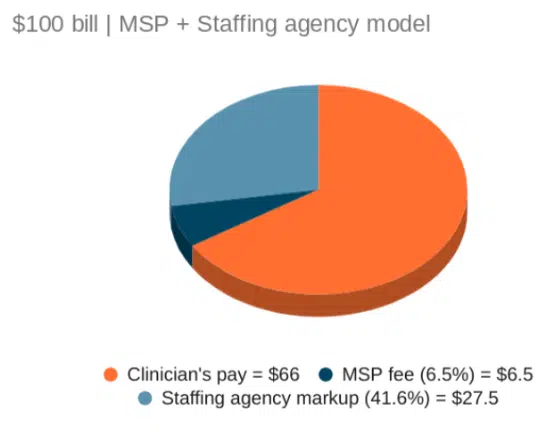
This pricing structure reduces cost transparency, inflates staffing expenses, and slows decision-making, especially when facilities must fill multiple roles simultaneously.
MedSquirrels’ Orange Plan takes a fundamentally different approach. Instead of percentage-based markups, facilities pay a flat platform fee combined with standard payroll costs. The chart below illustrates how the Orange Plan redistributes costs by eliminating percentage-based markups.
MedSquirrels Orange plan cost structure
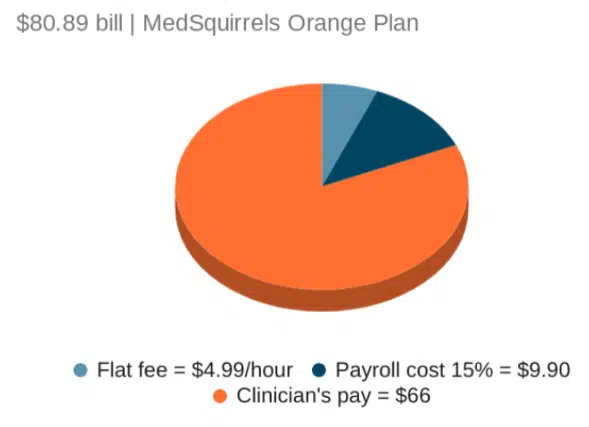
For the same clinician pay of $66 per hour, the total bill under the Orange Plan is $80.89, as shown in the comparison chart. A larger portion of the bill rate is allocated directly to the clinician, while facilities benefit from predictable and transparent pricing.
The staffing cost comparison further highlights the impact of this model. By eliminating agency markups and MSP fees, the Orange Plan delivers a total cost savings of $9,937 for a 13-week assignment at 40 hours per week.
These savings allow facilities to reallocate budget toward patient care, workforce stability, and long-term planning. The comparison below visually demonstrates the difference between traditional staffing costs and a flat-fee model.
Comparison of cost savings with MedSquirrels
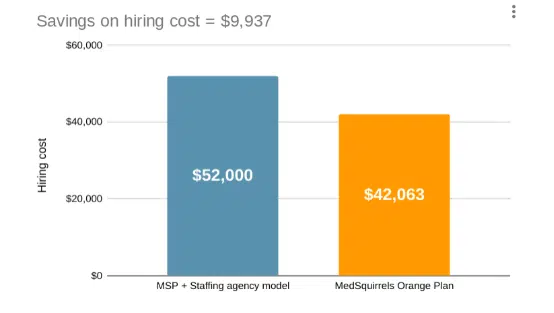
Beyond cost efficiency, the Orange Plan also simplifies operations. A centralized platform enables facilities to manage contractor time, tasks, and payments in one place, reducing administrative overhead and approval delays. By removing pricing uncertainty and streamlining processes, MedSquirrels assists facilities in responding faster to workforce shortages while maintaining compliance and care quality.
Making smarter staffing decisions with a flat-fee platform
Facilities and recruiters must stay informed and educated about the flat-fee process to make better decisions. By understanding fee structures, key benefits, and when the flat-fee process is most effective, facilities can approach with greater clarity and confidence.
At the same time, facilities and recruiters must be mindful of which platforms operate on a flat-fee model. Partnering with traditional agencies can introduce challenges, such as high agency markups, limited pricing transparency, and slower placement timelines, which can negatively affect placement outcomes and increase overtime and recruitment pressures.
Platforms like MedSquirrels combine flat fees with cost-effective plans that support your facility’s goals. Key advantages of this platform include eliminating agency markups by charging only payroll costs plus a flat fee per hire, as well as offering transparent, upfront pricing with no hidden costs.
MedSquirrels provides affordable plans:
- Purple Plan: Manages HR, payroll, and benefits for contract clinicians sourced by your facility.
- Orange Plan: Includes comprehensive recruitment services, along with HR, payroll, and benefits support.
- Blue Plan: Focuses on recruitment services for full-time clinician hires.
By choosing MedSquirrels, which prioritizes transparency, efficiency, and predictable costs, facilities can build a more reliable and sustainable process. You can schedule a free demo to see how MedSquirrels helps you onboard experienced professionals. Professionals can browse open jobs and apply for those that align with their professional goals.
FAQs
How does flat-fee differ from traditional agency staffing?
Traditional agencies typically charge a percentage of a clinician’s salary, which can fluctuate and increase the overall cost of a professional you hire. A flat-fee structure provides a consistent, upfront cost, reducing uncertainty and improving cost control during the staffing process.
Is the flat-fee model suitable for long-term workforce planning?
Yes, a flat-fee structure supports long-term workforce planning by enabling facilities to forecast needs and budgets more accurately. Transparent pricing allows better alignment between talent needs and financial resources.
Does the flat-fee model compromise candidate quality?
No, candidate quality is not affected. A flat-fee process or model shifts focus away from commission-based incentives and toward role fit, clinical experience, and compliance requirements.
How does your flat-fee model help healthcare facilities control staffing costs?
Our pricing model eliminates percentage-based agency markups by charging only the payroll cost and a flat fee per hire. This allows healthcare facilities to plan budgets accurately, avoid unexpected expenses, and allocate resources more efficiently across departments.
How do you ensure quality and compliance when you hire an occupational therapist?
We follow a structured recruitment process that focuses on credential verification, role-specific clinical experience, and regulatory compliance. This ensures every placement meets both organizational standards and industry requirements.

Jani Basha is a healthcare content expert at MedSquirrels, sharing insights on staffing trends, hiring best practices, and career growth.