
School nurse staffing requirements: What administrators need to know
Student health and safety rely on having the right number of qualified candidates available in schools. Effective school nurse staffing, including access to certified professionals, supports timely emergency response, consistent care delivery, and alignment with established regulations. School administrators planning to hire should clearly understand how qualified professionals contribute to student health, school readiness, and day-to-day operations.
This blog gives practical guidance to help schools plan nursing support while following established standards. With adequate presence in place, staff and teachers are better able to stay focused on students, with fewer disruptions caused by health-related emergencies.
The crucial role of nursing coverage in schools
Schools need to recognize that having too few school nurses can directly affect how quickly and effectively students receive care. When availability is insufficient, delays in treatment become more likely, and schools may also face challenges meeting local or state health regulations.
Without dependable staff availability, emergencies may not be addressed promptly, chronic conditions may go unmanaged, and overall student well-being can suffer. Recruiters like you who clearly understand this responsibility are better positioned to support school safety. You can improve student health outcomes and maintain district compliance by ensuring adequate support. This helps reduce burnout while promoting continuity of care and consistent service quality.
Key guidelines for supporting school health staff
Meeting these requirements involves several essential elements that guide scheduling, role definition, and compliance planning. Recruiters need to understand these needs to create schedules and roles that comply with legal requirements and fulfill student needs. Providing clear direction enables school leadership to prepare professionals for both routine care and emergency response.
Student-to-nurse ratios
These recommendations vary by age group and grade level, with younger students requiring more frequent visits and monitoring.
Certifications and credentials
School health professionals must hold valid licensure, complete continuing education, and demonstrate skills in chronic condition management and first aid.
Roles and responsibilities
Daily responsibilities include administering medications, managing emergencies, delivering health education, and maintaining accurate health records.
Coverage and scheduling needs
Institutions must plan full-time and part-time availability to ensure continuity of care during school hours.
Health and safety compliance
Adherence to regulations, immunization tracking, and emergency preparedness protocols remains crucial.
Clearly defined policies support emergency readiness and allow schools to plan proactively as enrollment levels or regulatory expectations change.
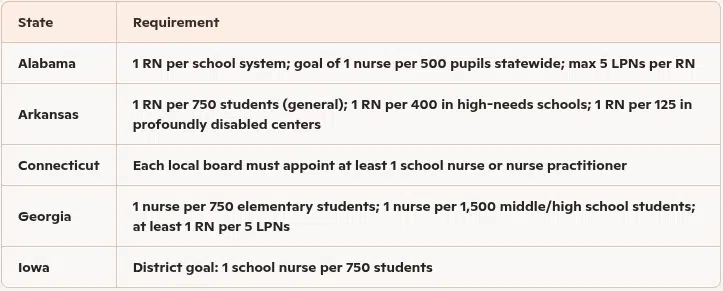
When recruiters like you plan to hire, awareness of key benchmarks, such as student-to-nurse and school-to-nurse ratios, simplifies your decisions and ensures adequate support. A detailed infographic is provided for clarity, supporting accurate planning, regulatory alignment, and more confident workforce decisions.
School nurse-to-student ratios: State guidelines
Source: www.apta.org
Challenges in maintaining adequate healthcare coverage in schools
Recruiters like you often face staffing challenges when trying to maintain reliable coverage, especially since requirements can vary widely by district, student population, and funding structure.
Many schools struggle to attract qualified professionals, particularly in underserved or rural areas where resources are limited. Budget constraints can further restrict access to full-time staff, leading schools to rely more heavily on part-time support.
When availability is inconsistent, it can disrupt ongoing care and create gaps in monitoring students with chronic health needs. Addressing these issues early helps create a safer, more stable environment for both students and staff.
- Shortages of qualified staff in educational environments
- Budget constraints limit full-time engagement
- Balancing administrative responsibilities with direct student care
As a result, you must understand that inconsistent availability can disrupt ongoing care and create gaps in monitoring chronic conditions. Addressing these challenges proactively supports a safer and more stable school environment.
Best practices for maintaining consistent nursing coverage
To address these challenges and strengthen staffing, schools that are planning to hire benefit from taking a proactive, well-structured approach to workforce planning. Strategic planning supports compliance while ensuring personnel availability stays aligned with student health needs throughout the academic year.
Collaboration, smart use of technology, and flexible engagement options allow teams to support schools effectively without overburdening clinical staff. When these elements work together, schools can maintain continuity of care while adapting to evolving demands.
- Follow the required guidelines and benchmarks to determine appropriate coverage
- Partner with healthcare platforms or local health departments for short-term or specialized support
- You can use technology to improve scheduling, documentation, and communication
- Offer professional development opportunities to support retention
Tracking and evaluating school health staff performance
Regularly monitoring performance helps you stay confident that care delivery remains consistent and compliant. Ongoing evaluation makes it easier for schools to spot gaps early and ensure availability continues to match student health needs.
- Track KPIs such as response times, health outcomes, and illness-related absenteeism
- Conduct regular audits to identify opportunities for improvement
- Gather feedback from students, parents, and staff to maintain alignment with regulations
This ongoing monitoring supports long-term planning by helping schools adjust staffing as enrollment changes and in alignment with school staffing guidelines. Continuous oversight also helps schools remain compliant while consistently supporting student well-being.
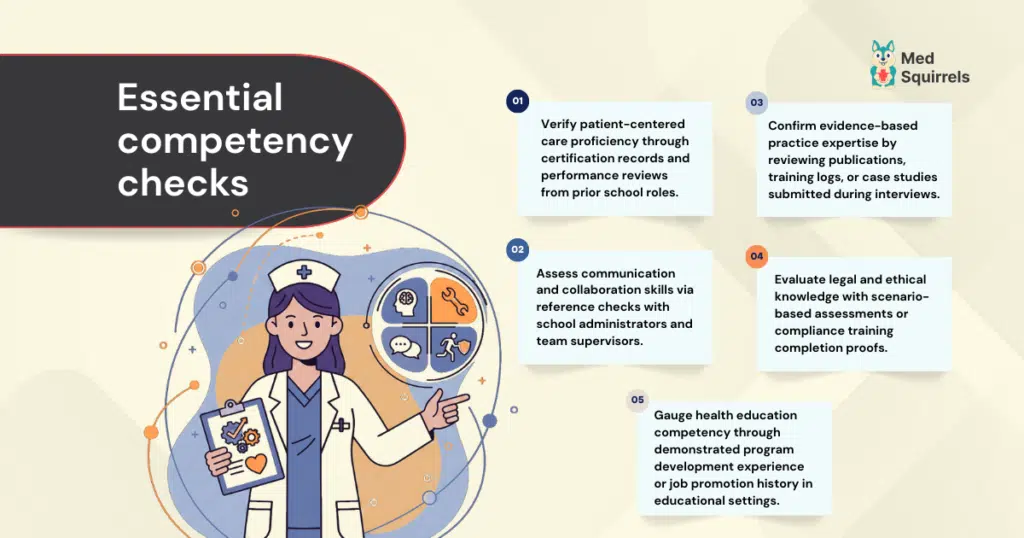
To maintain compliance, schools should also assess competency at the time of hire by reviewing credentials, clinical skills, and role readiness. A detailed infographic is provided to make this evaluation process clearer and easier to follow.
Creating a reliable strategy to support school health services and maintain compliance
Successfully managing school nurse staffing requires recruiters to consider multiple critical factors, many of which are outlined throughout this blog, including compliance and scheduling, coverage gaps, and long-term planning. While understanding these elements helps make the process more structured, the results ultimately depend on the schools that decide to participate.
Traditional staffing agencies often pose challenges, such as high percentage-based fees, limited pricing transparency, and slower turnaround times due to manual processes.
These constraints can make planning difficult, increase administrative burden, and reduce flexibility when school health needs change unexpectedly. In contrast, technology-enabled staffing platforms such as MedSquirrels offer you a more efficient and recruiter-friendly experience.
MedSquirrels simplifies credential verification, scheduling coordination, and compliance tracking, allowing recruiters to move faster with greater confidence. Our transparent plans include:
- Purple Plan – A complete solution that manages HR, payroll, and benefits for any contract clinician or non-clinician sourced directly by your practice.
- Orange Plan – This recruitment plan helps you hire a contract clinician or non-clinician while also managing HR, payroll, and benefits to ensure long-term flexibility and stability.
- Blue Plan – A comprehensive recruitment service for full-time hires with no ongoing costs after placement.
These plans help schools to scale needs, and centralized access to qualified professionals makes the process easier to manage and more predictable for schools that are staffing.
MedSquirrels reduces complexity, shortens timelines, and supports better decision-making, making it a practical, reliable choice for schools seeking consistent high-quality nursing support.
Schools can book a demo to see how our platform supports smarter, faster decisions. Professionals can browse open jobs and apply for those jobs that align with their professional goals.
FAQs
Why is school nurse staffing a priority for school administrators?
It is a priority because it directly impacts student safety, emergency response, and regulatory compliance. Adequate support ensures consistent care delivery, supports chronic condition management, and reduces operational risk for schools.
What challenges do recruiters face when supporting school health staffing needs?
Common challenges include limited candidate availability, budget constraints, varying compliance standards, and inconsistent scheduling needs. These factors make workforce planning and ensuring consistent student care more complex for schools.
How do flexible schedules improve school care program reliability?
Flexible schedules ensure consistent staff availability during peak times, emergencies, and absences. This maintains operational continuity for schools while supporting professional work-life balance.
How does MedSquirrels help ensure compliance with school nurse regulations?
MedSquirrels supports compliance by maintaining visibility into licensure, credentials, and engagement documentation. This helps schools align with regulatory expectations and reduce the risk of compliance gaps.
Why do schools prefer partnering with MedSquirrels for school nurse support?
Schools choose MedSquirrels for its technology-driven approach, operational transparency, and reduced administrative burden. The platform enables consistent processes, supports compliance, and creates a more predictable experience for recruiters and administrators.
How does MedSquirrels support compliance across school nurse engagement workflows?
MedSquirrels assists schools in maintaining alignment with regulatory expectations through credential validation. This reduces risk while allowing recruiters and administrators to operate with greater confidence.

Jani Basha is a healthcare content expert at MedSquirrels, sharing insights on staffing trends, hiring best practices, and career growth.