
How to fix staffing shortages in healthcare?
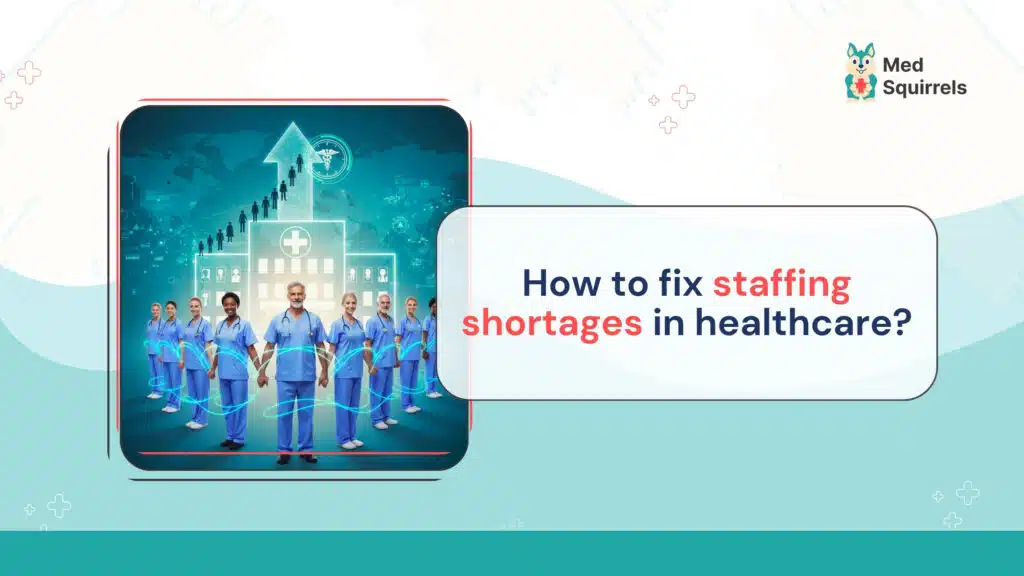
Facilities across the USA may face healthcare staffing shortages. This is because the patient demand rises faster than workforce availability. This is due to patient demand growing faster than the available workforce, resulting in a clear shortage of staff at the facility.
These shortages may increase pressure on the current staff, affect patient care delivery, and decrease patient satisfaction. These issues can be resolved with planned structuring. Addressing these challenges requires structured planning. It is more than short-term staffing; it calls for planned retention-focused strategies.
Understanding the main cause of shortages
Before looking for the healthcare workforce shortage solutions, as a recruiter, you must first understand the problems. Many facilities and recruiters try to address shortages without examining the reasons behind them. This may not solve your workforce issues.
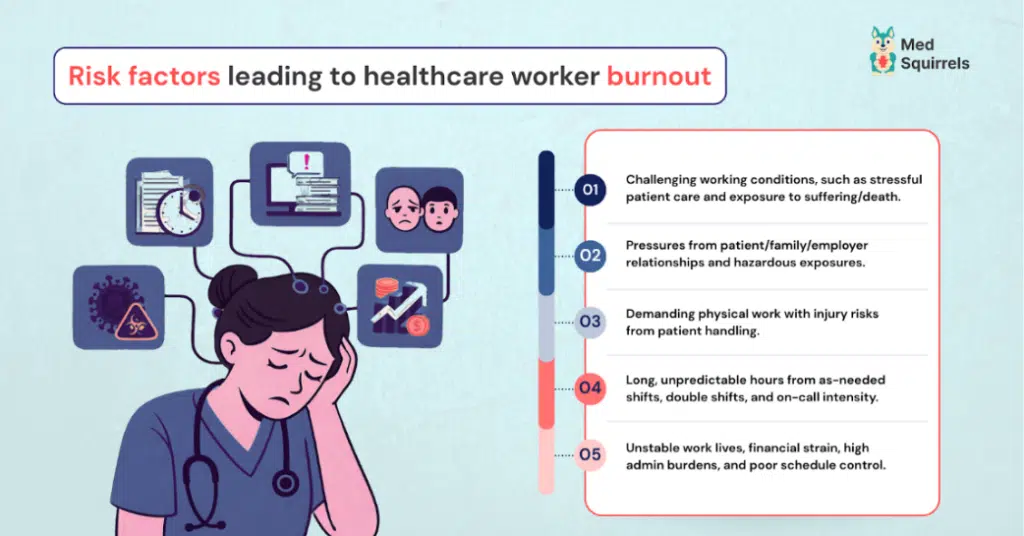
One common thing you can notice is recruiting teams saying there are a few candidates available for the role in the market. This is the most superficial explanation and may not solve anything. To make this easy, especially if you plan to hire a nurse practitioner, there will be many reasons from day one that may lead to burnout. To control this, a list of reasons that drive shortages is provided.
Top reasons driving the US healthcare staffing shortages
- Burnout because of unplanned and long shifts, and a lack of flexibility
- Retirements outpace the entry of new professionals
- Overdependence on temporary recruitment solutions
- Workforce planning misalignment with patient needs
Overall, the healthcare crisis impacts the entire system, from roles to departments. Facilities that understand these reasons early will typically recover faster.
A detailed infographic has been added that explains the key factors contributing to burnout in facilities.
Top reasons for healthcare staff burnout
Why traditional staffing methods may not be helpful
To understand the problems with traditional agencies, let us assume a hypothetical case as a recruiter.
Suppose a mid-size facility has an immediate need to fill five openings for allied health professionals. Recruiters like you would reach out to three different agencies. Out of those, two agencies may provide candidate CVs that are not aligned with the roles. The other agency provides candidates who lack consistency and may leave the position within 60 days.
The hospital has now lost time and money. This also lowers patient satisfaction. This is exactly what the traditional workforce shortage paradox may look like.
Most traditional agencies may attempt to fill the gap as quickly as possible with a candidate who might fit the role. However, there is a different perspective in these models. In these recruiting models, recruiting and retention are separated, creating a gap that widens over time.
In the remaining gaps, hospitals fill positions with available candidates. This will lead to filling again with the same unaligned roles. This is known as the replacement cycle.
Thus, hospitals need to integrate the parallel of recruitment and retention in staffing.
Practical ways to fix shortages
When it comes to resolving staff shortages in facilities, looking for one-universal answers may not yield ideal outcomes. As a recruiter, if you are wondering how healthcare facilities can overcome shortages, understanding a complete staffing approach can help you hire effectively while addressing healthcare recruiting shortages and related workforce challenges.
Facilities that implement multiple smaller, targeted adjustments can achieve positive outcomes. This outcome is achieved by prioritizing a few steps, and those are addressed below.
Top points to prioritize to be a successful facility
- Recruitment must be done based on alignment to workload, rather than numbers
- Prioritize operational support through role flexibility and cross-team training
- Apply policies to reduce burnout that reduce professional shortage
- Facilities must improve shift stability and predictable scheduling
The above points will help resolve the workforce shortage in the long term by bridging the gap between staffing decisions and operational needs rather than relying on operational assumptions.
Following and consistently applying these actions helps reduce burnout and stabilize schedules.
Retention is the other half of the equation
Experienced recruiters like you must understand that the shortages cannot be fixed by recruiting new professionals if facilities overlook retention policies.
Most facilities experience attrition within their first year, particularly among roles, such as RNs and other nursing roles. Employees resign due to a lack of support, vague job expectations, or rigid schedules and non-competitive pay or wages.
Important strategies to improve retention in the healthcare system emphasize
- Clearly mentioning the role responsibilities in the job description
- Establishing reasonable workload expectations and providing the associated guidelines
- Encouraging communication from senior leadership
- Awarding competitive pay for the staff
When retention improves at facilities, the impact of the healthcare staffing crisis will get less severe. Filling vacated roles becomes less pressing. This leads to improved overall workforce stability.
For example, when you hire RNs or other roles, offering competitive pay is vital, and the infographic highlights market-trending salaries in the USA across different states.
Top-paying states for registered nurses in the USA
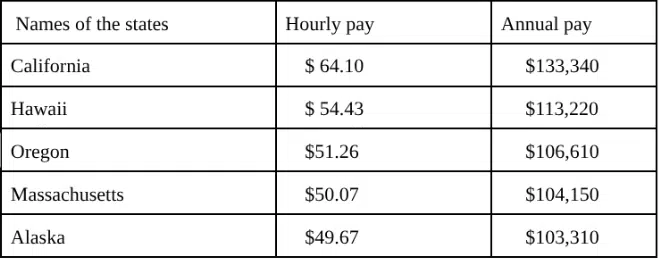
Source: www.bls.gov
Staying ahead with smart staffing models
Most facilities in the USA that depend on a last-minute-to-hire model experience the greatest strain. Healthcare recruitment and retention should be based on workload alignment, not headcount.
- Prioritize operational support through flexible roles and cross-team training.
- Apply policies to control burnout and professional void, operational support.
- Facilities need to improve shift consistency and predictable scheduling.
Rather than being reactive, a more balanced approach is forecast, mixed with flexible models and using support from modern staffing platforms, which will help you.
Recruiters like you can use predictive solutions to overcome workforce shortages, such as contracting and helping facilities plan for growth. You can also stay prepared for seasonal or unexpected staffing surges.
By using options like contract or full-time hiring, healthcare facilities and recruiters like you need to understand how your facility can adapt to evolving staffing trends in the USA.
Instead of filling gaps role by role, recruiting teams can construct flexible plans that scale with patient demand.
There are distinct benefits to following the given points
- Plan and decrease the need for emergency staffing
- Improved coverage across all departments in the facility
- Lessened the effects of chronic hospital workforce shortages
And most importantly, recruiters regain the initiative to manage workforce planning as opposed to continually responding to shortages.
Making informed decisions for long-term stability
Before facilities opt to hire, they must fully understand the strategies. This includes filling workforce gaps and strengthening retention efforts. Without this balance, even a well-planned process can also fall short.
When planning to hire, if facilities choose traditional agencies, these often entail limited transparency, slower turnaround times, and higher long-term costs.
These issues can reduce workforce flexibility. Choosing a modern platform like MedSquirrels can help overcome workforce shortages. It eliminates markups through transparent flat-fee pricing, ensuring facilities pay only payroll costs plus a flat fee.
Recruitment and payrolling/EOR are combined into a single, intuitive SaaS platform. This modern platform streamlines compliance, scheduling, and HR tasks from a single dashboard.
MedSquirrels will also deliver curated, AI-matched profiles of qualified nurses, physicians, and allied health professionals within 2-5 business days. This makes your work easy.
It is a better option to partner with this modern platform, which offers a better approach. It uses AI technology to improve candidate matching and provides affordable plans. MedSquirrels provides three plans without agency markups for efficient healthcare staffing. Such as:
- The Purple Plan: It handles EOR/payroll and manages HR, payroll, and benefits for self-sourced clinicians via an integrated platform.
- The Orange Plan : This delivers full recruitment plus EOR/payrolling, combining talent sourcing, hiring, compliance, and payroll in one solution.
- The Blue Plan: Focused entirely on permanent staffing, supporting direct recruitment of full-time clinicians and non-clinicians.
Facilities can book a free demo to explore available plans. At the same time, professionals can visit our open jobs and apply directly, ensuring a smoother experience for everyone involved.
FAQs
How do healthcare staffing shortages affect facility operations?
These shortages may increase because of workload pressure on existing teams, slow patient care delivery, and reduced patient satisfaction. Over time, they also raise turnover rates and costs.
Why cannot traditional agencies solve recruiting gaps?
Most traditional agencies often focus on speed rather than role alignment. This may result in poor candidate fit, higher attrition, and repeated recruiting that strain budgets and operations.
How can facilities fix staffing shortages without over-recruiting?
Facilities can reduce shortages by aligning with workload patterns, improving shift predictability, and offering role flexibility. These steps can stabilize your process without increasing unnecessary headcount.
Does MedSquirrels support contract staffing models?
Yes. MedSquirrels supports contract models, helping facilities manage seasonal demand and unexpected surges. This approach allows better planning and controlled costs.
How does MedSquirrels help control costs?
MedSquirrels offers affordable plans that allow facilities to hire within their budget. By reducing repeat hiring cycles and improving candidate alignment, facilities can lower turnover-related expenses and agency dependency.

Suresh writes about healthcare staffing and industry insights for MedSquirrels, helping professionals and facilities navigate hiring needs.