
Top employment laws every healthcare facility should know in 2025

Employment laws in the United States continue to change to maintain fair labor practices. Healthcare managers, HR teams, and compliance officers need to stay updated to avoid legal issues.
Federal and state regulations affect how healthcare facilities hire, pay, and manage their staff.
Understanding these laws helps you avoid compliance problems, reduce hiring delays, and manage your workforce more effectively.
This blog covers important employment laws that healthcare facilities should know. It explains what these laws mean, how they affect daily operations, and what steps you can take to stay compliant.
Understanding the Anti-Kickback statute and stark law in healthcare
In healthcare, referrals should never be influenced by financial gain.
The Fraud & Abuse Laws prohibit offering, paying, soliciting, or receiving any form of payment to induce referrals of services covered by federal healthcare programs like Medicare and Medicaid.
The Stark Law prohibits physicians from referring patients to certain healthcare services if they have a financial relationship with the provider. However, some legal exceptions may apply.
Both laws are designed to prevent conflicts of interest and ensure ethical, transparent care.
Violating either law can result in significant penalties. These include fines in the millions and exclusion from federal healthcare programs. It may also involve personal criminal charges for providers or employers.
Healthcare recruiters must carefully review service contracts and payments for patient referrals. They should also ensure that referral rewards follow the law.
To maintain compliance and avoid violations, facilities should take the following actions:
- Regularly review contracts for services and remuneration of providers to ensure they don’t include inappropriate incentives.
- Provide training for staff about the legal limits of financial relationships under these laws.
- Regularly review referral sources to identify unusual patterns, outliers, or red flags that may indicate non-compliant practices.
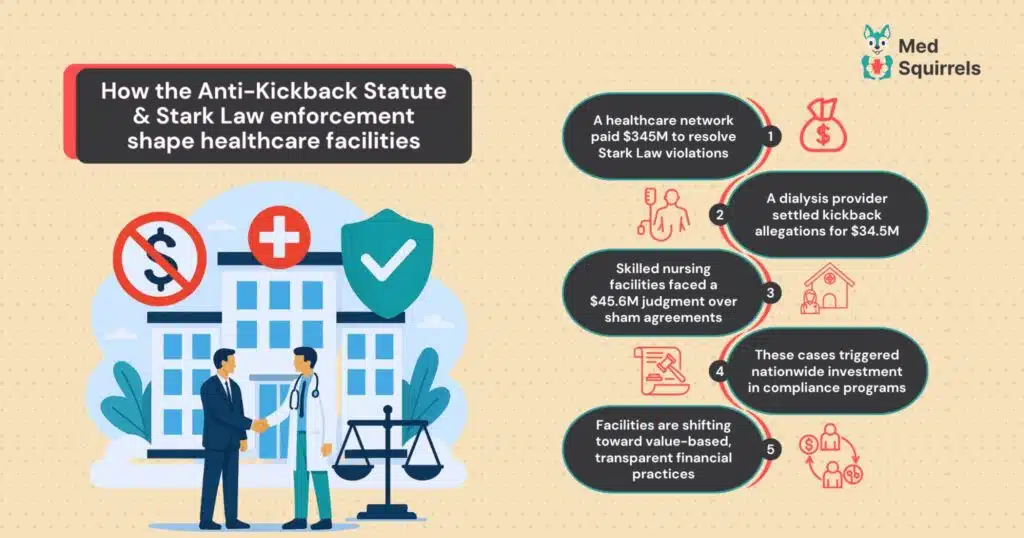
These steps help facilities reduce legal risks during recruiting. A detailed infographic about the laws is added saying about levied fines.
Stricter HIPAA & Data privacy compliance
With cyberattacks against healthcare facilities becoming more frequent and severe, stricter New HIPAA Regulations HIPAA security rule updates are being implemented.
These updates include shorter breach recovery timelines, expanded encryption requirements for various communication channels, and significantly higher penalties for non-compliance, up to five times greater than before.
Protecting patient data is no longer just an IT concern; it is a federally mandated legal obligation for all healthcare staff.
Both administrative and clinical teams must receive updated training on proper data handling practices across departments.
Facilities that fail to invest time or resources into cybersecurity risk losing access to approved funding programs, including government grants.
Recruiters and managers must stay updated on employment laws and HR requirements. This helps them avoid legal issues, control costs, and run their operations smoothly.
Key action steps healthcare facilities should implement include:
- Conduct risk assessments on a given cadence and review the systems’ conduct according to their policies.
- Use two-factor authentication and encryption when data allows.
- Provide HIPAA or Privacy Training across departments.
For a deeper dive into common staffing compliance risks and practical strategies to address them. Explore key staffing requirements, identify potential compliance gaps, and implement corrective actions to maintain compliance.
Protections on overtime and working hours
Some states, such as Washington, have introduced laws to limit mandatory overtime for nurses and other healthcare workers. These protections help reduce staff burnout and support better patient care.
Healthcare facilities should consider these laws when creating staff schedules. They should also consult employees to ensure working hours meet legal requirements and support staff well-being.
This means adjusting your scheduling tools, not scheduling last-minute changes, and setting clear boundaries on your working hours, etc.
This sounds like good staff well-being practices, but they also help reduce legal exposure of your workplace under the currently legislated labor laws in the USA.
- Review all of the positions in your schedule to decide what is exempt and what is not. Then make the changes to your scheduling system and also your scheduling policy.
- Log hours and provide compensatory time off if applicable.
Paid family & medical leave (PFML) expansion
More states are expanding their PFML programs. These changes give employees more options to take time off for important family or medical needs.
When employees plan to take PFML, HR teams need to prepare for their absence.
This process ensures enough staff are available to provide quality care.
These programs aim to support employees and improve workforce stability.
This is especially important in healthcare, where staff turnover can be high.
To stay compliant, facilities should also update their internal policies.
One more essential point to remember is to see if employees understand their rights under applicable employment laws.
Healthcare facilities should also follow a clear hiring process to fill staffing gaps quickly.
Key action steps for HR and compliance teams include:
- Align facilities’ internal policies with changing state legislation.
- Train HR staff on all application timelines, as well as the benefits.
- Communicate all leave requirements to employees.
For example, if you are planning to hire medical assistants for your clinic, you must consider the legal requirements and key considerations involved in the hiring process.
This is especially important when hiring allied healthcare professionals, such as medical assistants, who are in high demand.
Changes to noncompete agreements for healthcare workers
During the process of recruiting, you need to know that the FTC and some state governments have restricted or banned noncompete agreements for healthcare workers. These rules vary by state.
Generally, noncompete agreements that last longer than one year may face legal challenges. The rules depend on the state and the terms of the agreement.
These legal changes make it easier for healthcare professionals to change jobs and explore new opportunities.
Recruiters should review their employment contracts and focus on retaining staff. Offering an attractive salary, career development, and mentorship can help keep employees without relying on restrictive contracts.
Following recent healthcare labor laws is key to attracting and retaining valuable staff.
Actionable steps healthcare facilities should follow include:
- Review all employee agreements for compliance
- Use confidentiality and non-solicitation clauses in place of noncompetes
- Provide complex incentives that engender allegiance and promote work engagement
The table below outlines the legal landscape and projected economic impact regarding noncompete agreements for healthcare employees.
Healthcare employee noncompete agreements legal landscape
Aspect | Summary | Affected Group | Estimated Impact | Exceptions/Notes |
Rule Issuance | Final rule issued banning most noncompete agreements | All workers, incl. healthcare | Reduces restrictive employment practices | Takes effect 120 days after publication |
Economic Projection | Projected reduction in physician services spending | Healthcare sector | Up to $194 billion over 10 years | Reflects improved competition and lower costs |
Implementation Guidance | Employers must notify affected workers | Current employees | Increased transparency and worker mobility | Noncompetes still apply to a limited group of senior execs |
Source: www.asnc.org
Medsquirrels: The smarter alternative to traditional healthcare staffing
Following employment laws is essential when hiring healthcare professionals. However, keeping up with changing regulations can be challenging.
To overcome these challenges, you need to partner with a staffing platform.
During the process of selecting a platform, most recruiters make a common mistake. It is to choose traditional staffing agencies for recruiting.
But as a recruiter, you must know that these agencies may rely on manual processes.
Because of this process, it will be harder to track compliance and adapt to new labor laws.
These agencies also come with high mark-ups and unclear pricing. To overcome these challenges, you need to choose a modern staffing platform such as MedSquirrels.
This AI-powered platform offers a simpler approach to healthcare staffing. It streamlines candidate sourcing, credential verification, and onboarding.
MedSquirrels also supports compliance with requirements related to HIPAA, paid family and medical leave (PFML), and overtime regulations.
This helps you make informed decisions, reduce hiring delays, and manage your staffing process more efficiently.
MedSquirrels also comes with flat-fee plans designed for every hiring need. Facilities can book a free demo for stress-free recruiting. Professionals can browse open jobs and apply for those jobs that fit their salary requirements.
FAQs
What are the most important healthcare employment laws?
Key healthcare employment laws include HIPAA regulations, overtime rules, and anti-kickback statutes. Paid family and medical leave (PFML) requirements and non-compete restrictions also affect healthcare employers. Compliance helps healthcare facilities manage staff effectively and meet legal requirements.
How do HIPAA changes affect healthcare facilities?
HIPAA regulations require healthcare facilities to protect patient information. Strong cybersecurity measures help prevent data breaches. Regular staff training and effective breach response procedures strengthen data security. Compliance helps reduce security risks and potential penalties.
Are non-compete agreements still valid for healthcare workers?
The validity of non-compete agreements depends on applicable federal and state laws. Some jurisdictions restrict or prohibit these agreements. Healthcare employers should review current legal requirements before enforcing non-compete clauses. Competitive benefits and career development opportunities can improve employee retention.
What makes MedSquirrels better than traditional staffing agencies?
MedSquirrels offers transparent, flat-fee pricing and faster candidate placements. AI-powered technology streamlines healthcare recruitment. The platform helps healthcare facilities improve hiring efficiency and meet staffing needs.
Can I use MedSquirrels for both full-time and contract hires?
Yes, you can.MedSquirrels supports both full-time and contract recruiting. Affordable recruitment plans help facilities meet workforce needs. Streamlined documentation supports efficient staffing and compliance with applicable employment laws.

Jani Basha is a Content Specialist with a background in healthcare content development, recruitment, and workforce management. His work focuses on the challenges healthcare facilities face in attracting, staffing, and managing clinical and non-clinical professionals. He develops content on healthcare recruitment, workforce trends, and staffing strategies. His work translates complex workforce topics into practical insights for healthcare recruiters. His work aligns with MedSquirrels’ mission to make healthcare staffing more efficient and cost-effective through technology-driven workforce solutions.