
Registered nurse vs. licensed practical nurse, which should your facility hire?
Choosing the best nursing professionals for your hospitals, clinics, and long-term care facilities is essential, as the right mix of nursing staff can impact patient outcomes and staff efficiency. When facilities decide to hire between a registered nurse vs. a licensed practical nurse, it is a key decision for recruiters and facilities. The right staffing decision ensures that your facility runs smoothly while delivering high-quality care.
This blog post will help Healthcare Recruiters understand the differences in staffing needs and workforce planning for RNs and LPNs. Additional insights will help facilities use resources effectively while ensuring compliance and patient safety. Understanding RN vs. LPN distinctions supports more accurate decision-making.
Role-specific staffing considerations
Recruiters need a thorough understanding of patients’ needs and their facilities’ priorities to hire the right nurse. Each facility may have different staffing requirements depending on patient acuity, regulatory guidelines, and care complexity.
Staffing the right mix improves workflow efficiency, reduces overtime, and ensures high-quality patient care. Recruiters must evaluate these factors before making staffing decisions. Recruiters must determine these questions before making staffing decisions.
When to hire a registered nurse (RN) for my facility?
Facilities must have high-acuity units, critical care settings, leadership roles, or situations requiring advanced clinical judgment.
When is an LPN sufficient for my facility?
Routine care, supportive tasks, stable patient populations, or cost-sensitive roles. Recruiters should also determine how many RNs or LPNs are needed per shift to balance the workload efficiently. Cross-training staff provides flexibility during busy periods and ensures continuous coverage. Developing clear role expectations prevents confusion and improves workflow.
LPN salary vs RN salary
LPN and RN salaries vary because each role carries a different level of responsibility. RNs take on more complex clinical tasks, which usually lead to higher pay, while LPNs manage routine patient care and earn steady, reliable wages. These differences make it easier for facilities to plan budgets and compare LPN salaries vs RN salaries practically.
Salary also varies by facility type, location, and shift demands. RNs working in high-acuity units often receive higher pay, while LPNs support stable units with routine tasks. Understanding these differences helps teams decide when to hire registered nurses and LPNs for cost-efficient coverage.
How salary differences impact staffing
Knowing the pay gap helps facilities make better staffing decisions. It also allows teams to manage overtime and prevent burnout. These points show why salary planning matters for daily operations.
- Improves scheduling by matching nurses’ skills to unit needs and reducing overtime.
- Supports cost-efficient staffing by balancing RN and LPN roles according to budget and patient acuity.
- Helps assign roles based on care complexity, ensuring patients receive appropriate attention and support.
Is an LPN the same as an RN?
While staffing recruiters must know that an LPN is not the same as an RN. RNs complete more education, handle advanced clinical tasks, and make high-level care decisions. LPNs focus on direct, basic patient care and work under the supervision of an RN or a physician. The contrast between their training and responsibilities helps clarify the difference between LPNs and RNs.
RNs also lead care plans and conduct detailed assessments. LPNs support those plans by monitoring patients and assisting with daily care needs. Together, the two roles complement each other, and understanding how they function helps answer the question, Is an LPN the same as an RN?
Why the difference matters
Recruiters must know these differences to place staff accurately. It also helps when deciding whether to hire LPNs or RNs. The points below highlight why the two roles function differently and why each is important in patient care.
- Ensures each unit has the appropriate mix of RNs and LPNs to meet patient needs.
- Helps prevent skill-mix gaps by aligning staff competencies with care requirements.
- Enhances patient care quality through proper role assignment and supervision.
LPN vs RN certification
LPN and RN certifications differ because each role has unique training requirements. RNs take the NCLEX-RN exam after completing an ADN or BSN, while LPNs take the NCLEX-PN after a one-year program. These steps support safe LPN vs RN scope-of-practice standards.
Educational paths also differ based on clinical expectations. RNs complete broader programs with advanced coursework, while LPN training focuses on direct care skills. These differences help facilities match candidates to the right job requirements.
How certifications guide staffing
Understanding LPN vs RN certification helps recruiters quickly evaluate qualifications. It also ensures each candidate meets state rules. The points given below explain how certification differences guide hiring decisions and ensure safe practice.
- Helps identify the right skill level for each role to match unit needs.
- Ensures compliance with state licensure requirements for safe patient care.
- Minimizes onboarding errors by clearly defining responsibilities and qualifications.
RN and LPN skills comparison
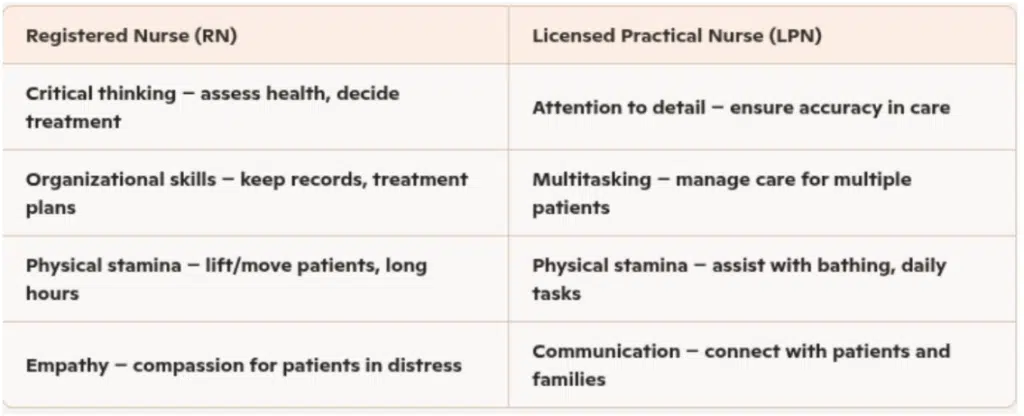
Source: online.utulsa.edu
LPN duties vs RN duties
LPN and RN duties are not interchangeable. RNs manage assessments, create care plans, and make clinical decisions, while LPNs handle routine tasks such as vital signs and daily patient support. These comparisons clarify LPN duties vs RN duties.
RNs also supervise LPNs and coordinate complex care needs. LPNs follow established plans and support workflow efficiency. These distinctions guide staffing choices in daily operations.
Why duty differences matter
Clear duty separation protects patient safety. It also helps recruiters match nurses to unit workload. The points outlined below say how duty differences affect workflow and care quality.
- Guides decisions on which role, RN or LPN, best fits each unit.
- Supports more accurate budgeting and workforce planning.
- Strengthens patient outcomes by aligning staff roles with care needs
Pros and cons of LPN and RN
Both LPNs and RNs offer essential benefits. LPNs provide consistent support for daily patient needs and help reduce staffing costs. RNs bring advanced clinical judgment and handle complex care, enabling teams to effectively evaluate the pros and cons of LPN vs RN roles.
However, LPNs cannot perform advanced clinical tasks, which limits their role in specific units. RNs require more training and usually expect higher salaries. These factors help facilities understand the responsibilities tied to each role.
How do their pros and cons influence their staffing?
Knowing the advantages and limitations helps with long-term staffing plans. It also supports safer care delivery. The factors below help recruiters choose the best staffing mix for each unit.
- Helps determine whether an RN or LPN is best suited for each unit.
- Supports accurate budgeting and efficient workforce planning.
- Improves patient outcomes by assigning the right staff to the proper care needs.
Retention, career growth, and workforce planning
Retaining skilled nursing staff is as important as recruiting the right candidates. To sustain retention, facilities need to offer career development, professional development, and work-life balance. These are some significant factors that influence staff retention.
For this reason, facilities should focus on developing long-term staffing programs that reduce turnover and maintain consistent, high-quality patient care. Healthcare facilities must consider the distinctions between registered nurses and licensed practical nurses to ensure they plan the right nursing staff for both immediate and future staffing needs.
Healthcare recruiters must remember that RNs’ and LPNs’ career development paths differ. RNs may pursue specialties, advanced practice roles, or leadership positions. LPNs can advance through bridge programs to become registered nurses, which again connects to ongoing RN vs. LPN workforce planning.
The key strategies for staffing and retaining top nursing talent include:
- Providing salary and benefits competitive with LPN and RN pay scales
- Continuing education and professional development programs
Recruiters should also focus on engagement and employee satisfaction. Facilities that invest in staff training and professional development tend to see higher retention rates. Weighing the pros and cons of each role will help the recruiter build an effective staffing plan. Considering the pros and cons of LPN vs RN will help you meet both operational goals and patient care needs.
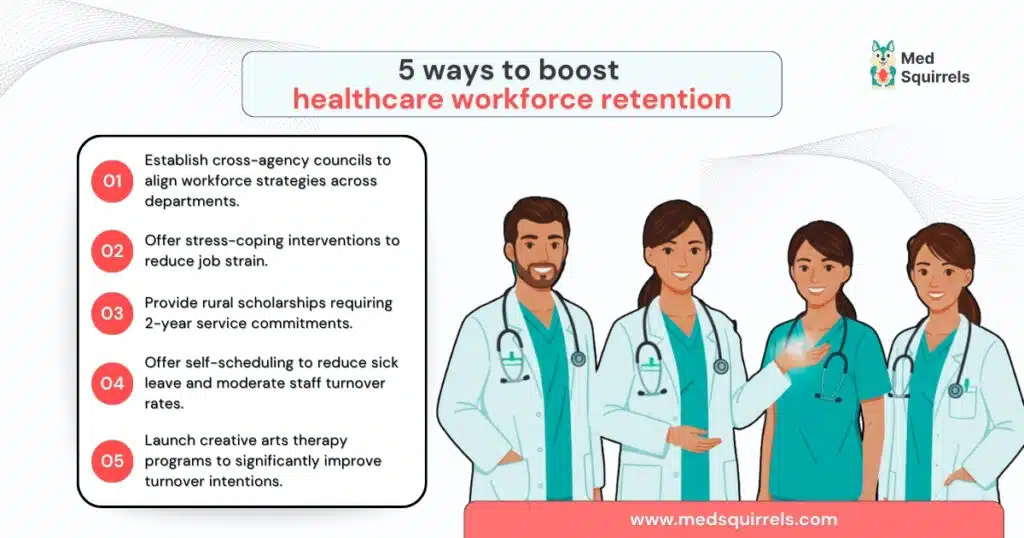
After staffing, recruiters or facilities must also follow employee retention strategies to ensure they have a stable workforce that remains with them long-term. Here’s a detailed infographic to help you better understand these retention strategies.
5 Ways to Boost Healthcare Workforce Retention
Building a strong nursing workforce with MedSquirrels
Facilities need a clear understanding of all staffing factors before they begin staffing. Those factors include evaluating skills, certifications, scope of responsibility, and the level of clinical judgment needed for each role. Understanding RN vs. LPN distinctions enables recruiters to plan staffing strategies with greater accuracy and confidence.
This clarity becomes essential when facilities decide whether to hire registered nurse talent for advanced clinical roles or for general patient care. But knowing these points only covers half the work. Many facilities struggle to hire on time and within budget because they end up partnering with traditional staffing agencies. These agencies often come with disadvantages such as slow turnaround times, limited transparency in the staffing process, and higher overall placement costs.
These drawbacks can delay staffing, create workflow gaps, and stretch budgets beyond expectations. Facilities should plan when to hire LPNs for routine or support tasks while keeping staffing costs under control.
Key advantages of partnering with MedSquirrels include:
- Purple Plan – Full HR, payroll, and benefits management for any contract clinician or non-clinician you source directly.
- Orange Plan – End-to-end recruitment for contract clinicians or non-clinicians, along with HR, payrolling, and benefits for better stability and control.
- Blue Plan – Comprehensive recruitment for full-time roles with no ongoing costs.
With cost-effective plans and innovative AI-powered tools, MedSquirrels helps facilities hire quickly, reduce operational burdens, and build a more reliable workforce. To explore how MedSquirrels can support your staffing strategy, you can request a free demo and see how the platform streamlines staffing from start to finish.
FAQ
What is the difference between an LPN and an RN, and how does it impact your decision when you need to hire LPN staff?
LPNs provide basic patient care and support RNs, while RNs handle advanced clinical tasks, assessments, and care planning. Understanding this difference helps you decide whether to hire LPN staff for supportive care needs or choose an RN for higher-level clinical responsibilities
What should facilities consider before they hire LPN staff?
Before healthcare facilities hire LPN professionals, they should assess patient acuity, required skills, supervision needs, and state-specific scope-of-practice rules. Clear job expectations help ensure consistency and reduce turnover.
What helps improve retention for RNs and LPNs?
Retention improves when facilities offer competitive pay, growth opportunities, supportive leadership, and ongoing training. Strong engagement strategies help reduce turnover.
How does MedSquirrels help facilities hire LPN staff more efficiently?
MedSquirrels streamlines staffing for LPNs by enabling faster sourcing, credential verification, and transparent staffing plans. Here, you only pay the payroll cost and a flat fee per hire. This platform helps facilities fill health care roles quickly without compromising compliance.
Can MedSquirrels help facilities plan long-term workforce needs for both RN and LPN roles?
Yes. MedSquirrels provides pre-vetted profiles who are willing to work long-term, helping facilities with staffing needs, evaluating skill gaps, and building sustainable pipelines for high-demand nursing roles.

Jani Basha is a healthcare content expert at MedSquirrels, sharing insights on staffing trends, hiring best practices, and career growth.