
Physical therapist vs. occupational therapist: Which role improves patient mobility more?

Healthcare facilities continue to search for professionals who can support patient mobility, recovery, and long-term independence. Understanding the difference between the therapy roles allows facilities to assign the right expert to the right patient.
When facilities compare PT vs OT, it becomes clear that both professions contribute to mobility, but in different ways. This blog helps healthcare facilities identify these key roles to improve patient outcomes and staff management systems.
Understanding the core differences
Healthcare recruiters use functional outcome assessments to select among therapy options to achieve patient mobility goals. The difference between OT and PT clarifies how each role contributes to rehabilitation. Physical therapists specialize in developing strength, balance, and control of movement patterns. Occupational therapists dedicate their work to helping people perform daily tasks while regaining their ability to live independently.
Many administrators also evaluate cost and workforce planning. The occupational therapist vs physical therapist salary can influence staffing decisions in competitive markets. Facilities use this information to build balanced clinical teams.
As teams design care plans, they often assess the scope of work. The OT salary vs. PT salary comparison offers additional insight into workforce budgeting across departments. These comparisons help facilities maintain quality care without exceeding staffing budgets.
PT vs OT key differences
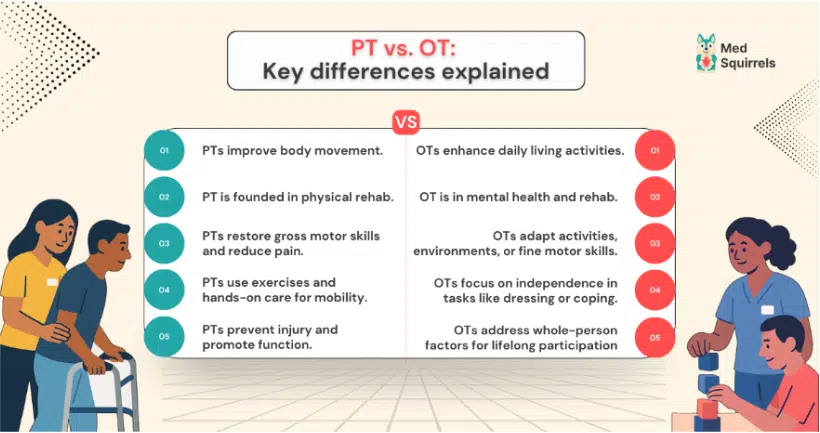
Key responsibilities in the PT and OT professions
The therapy objectives depend on what each patient requires, yet clinical leaders evaluate PT vs OT performance by looking at their specific focus areas. Physical therapists develop treatment plans to enhance joint movement and walking abilities, and to build muscle and bone strength. Occupational therapists help patients perform everyday activities safely and efficiently.
The evaluation process for staffing managers involves reviewing specific role-based duties to ensure compliance with both compliance requirements and work process standards. The PT vs OT responsibilities clarify which clinical areas require more support during a patient’s recovery phase. This supports better staffing allocation and scheduling.
Facilities also examine role definitions to maintain compliance. Staff training programs need regular documentation to operate successfully. The occupational therapist’s job description usually includes evaluating functional limitations and creating therapy interventions that improve patient independence. Meeting these requirements is essential for regulatory compliance.
Staff training programs also rely on consistent documentation. The occupational therapist’s duties include planning treatments that address self-care, environmental adaptation, and task efficiency. The operational responsibilities help healthcare facilities achieve their long-term business goals.
Job functions of PTs and OTs
Workload planning often depends on which therapy roles influence daily operations. Healthcare administrators need to understand the differences between PT vs OT professionals because they need to choose the correct professional for patients who need mobility assistance. Physical therapists provide services to patients with orthopedic problems and neurological conditions who need post-surgical rehabilitation.
Facilities operate with the assistance of clinical staff members who provide support. The physical therapist assistant’s duties include preparing equipment, assisting with exercises, and documenting patient progress. The expanded responsibilities enable physical therapists to handle more challenging patient cases.
Recruiters evaluate clinical qualifications based on the specific requirements of each job position. The job description for a physical therapist includes developing mobility plans, restoring physical function, and improving patient strength. These tasks directly support mobility improvement across healthcare settings.
How facilities decide between PT and OT
Healthcare teams make decisions about PT vs OT based on patient assessments that demonstrate which approach best improves mobility. PT focuses on physical movement, while OT focuses on functional movement. Together, both roles support rehabilitation programs.
The evaluation of long-term staffing requirements is the responsibility of administrators. The job description for a physical therapist directs facilities to select candidates who will work in mobility-focused departments. The descriptions enable facilities to assign therapists appropriately based on patient volume.
The need for OT staffing persists across various care facilities. The occupational therapist’s job description highlights responsibilities that contribute to patient safety and independence. These insights help therapy teams achieve better staffing balance.
The evaluation of supportive staff roles falls under the clinical leaders’ duties. The physical therapist assistant’s duties enable better results in PT care plans led by physical therapists. The system allows therapy teams to manage their work tasks more productively.
How OTs and PTs support patient outcomes
Patient recovery depends heavily on discharge planning because patient movement is a fundamental element. Clinical managers base their staff assignment decisions on PT vs OT evaluations to determine which care provider will deliver the most appropriate care. Patient rehabilitation receives essential support from both PTs and OTs through their professional skills.
Care teams analyze long-term outcomes through scope-of-practice evaluations. The PT vs OT responsibilities define how each profession contributes to progress milestones. Facility operations remain organized because of this understanding.
Budgeting directly affects how facilities manage their staff. The OT salary vs the PT salary offers insight into compensation differences when expanding therapy departments. These comparisons support sustainable workforce planning.
Medical staff depend on therapy responsibilities to deliver uninterrupted patient care throughout daily operations. The occupational therapist’s duties emphasize task training and environmental adjustments. The functions provide safety measures that help people move safely.
Salary considerations of OTs and PTs
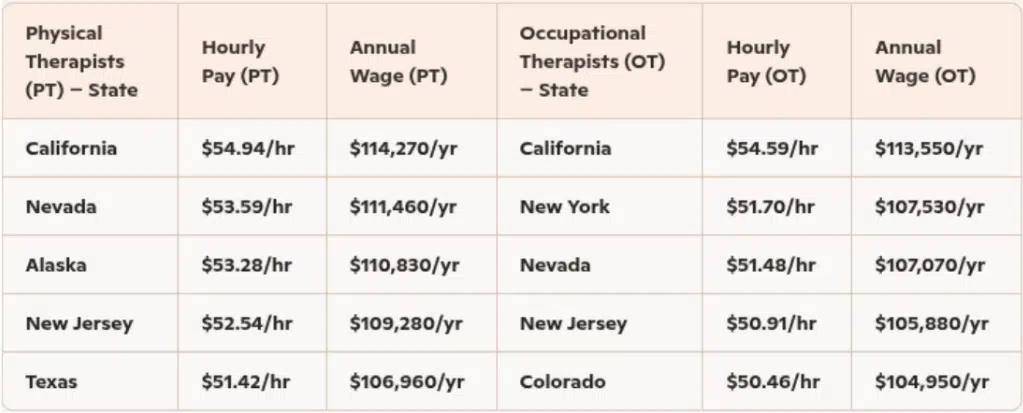
While facilities plan to hire OTs or PTs, it is vital to review their compensation systems when forming teams for competitive therapy work. The occupational therapist vs. physical therapist salary provides facilities with information on state-based and care-setting wage differences.
These salary patterns help therapy facilities plan finances. Facilities use this information to develop and hire qualified professionals, which also helps them create retention plans and attractive benefits programs for their skilled workforce. A detailed infographic is also included to provide a more precise, visual understanding of these salary variations.
PT vs OT salary comparison by state
Making the right staffing choice with a modern platform
Healthcare facilities need to develop their staffing plans by understanding the specific duties and required abilities of each role, as these directly affect patient mobility, safety, and recovery outcomes. The evaluation of physical therapist duties and responsibilities, along with knowledge of OT and PT, enables recruiters to determine each role’s operational results, yet this solution addresses only part of the staffing issue.
The main challenge begins after this stage, as facilities need to match their professionals to tasks, which creates delays that affect patient care delivery and overall healthcare staffing efficiency. Many recruiters start their search through internal references and free job portals. Yet, these channels yield limited numbers of qualified specialists and fail to provide proper credential verification, resulting in inefficient, unsuitable staffing outcomes in the nurse staffing process.
Facilities turn to traditional staffing agencies when these options prove ineffective. These agencies come with several disadvantages, including slow placement processes, expensive fees, and restricted candidate selection that often fails to meet the requirements of urgent care needs or support consistent clinical workforce staffing demands.
To overcome these challenges, healthcare facilities need a modern staffing solution like MedSquirrels, designed to deliver faster, affordable, and more reliable staffing results. Understanding PT vs OT responsibilities helps clarify the staffing needs, but efficient staffing still requires more substantial support. MedSquirrels offers cost-effective staffing plans:
- Purple Plan – A complete solution that manages HR, payroll, and benefits for any contract clinician or non-clinician sourced directly by your practice.
- Orange Plan – This recruitment plan helps you hire a contract clinician or non-clinician while also managing HR, payroll, and benefits to ensure long-term flexibility and stability.
- Blue Plan – A comprehensive recruitment service for full-time hires with no ongoing costs after placement.
These plans help facilities reduce operational stress, access pre-qualified professionals, shorten staffing timelines, and maintain predictable, affordable staffing. With workforce budgeting challenges such as OT vs. PT salary in mind, MedSquirrels provides cost-effective solutions that simplify staffing. With MedSquirrels, healthcare facilities can confidently hire the right PT or OT at the right time, achieving the staffing consistency required for strong patient outcomes. Get a free demo to see how we can fulfill your staffing needs.
FAQs
What is the difference between OT and PT?
OT focuses on functional tasks such as self-care, cognition, and daily living skills, while PT concentrates on strengthening, mobility, and physical rehabilitation. From a staffing standpoint, both roles complement each other in improving overall therapy outcomes.
What are the essential occupational therapist duties and responsibilities for employers to evaluate?
OTs assist patients with functional skills, adaptive strategies, and independence in daily activities. Facilities should evaluate problem-solving ability, documentation accuracy, and treatment planning skills when staffing.
Is an occupational therapist the same as a physical therapist?
No, these are distinct professions, though they often collaborate. PTs address physical movement and strength, while OTs focus on daily function, cognitive tasks, and overall independence. For workforce planning, both roles serve unique patient needs.
Can facilities request both part-time and full-time clinicians through MedSquirrels?
Absolutely. MedSquirrels offers flexible staffing options, including PRN, contract, temp-to-hire, and permanent placements, tailored to the facility’s needs.
How does MedSquirrels help facilities reduce time-to-hire for therapy professionals?
MedSquirrels uses AI technology to filter, screen, and quickly match qualified clinicians. This reduces manual search hours and shortens staffing timelines compared to traditional staffing agencies.
