
Navigating the challenges of recruiting surgical technologists

Surgical technologists play an essential role in ensuring safe surgical procedures. They assist surgeons by preparing instruments, maintaining sterile environments, and supporting procedures throughout the operation.
Their expertise helps surgical teams work efficiently and contributes to better patient outcomes. As healthcare facilities continue to meet growing surgical demands, the demand for qualified surgical technologists has increased.
However, factors such as staff burnout, high turnover rates, and an aging workforce have made surgical technologist recruitment increasingly challenging.
In some regions, these issues have also contributed to surgical tech shortages. This shortage has made it difficult for facilities to maintain adequate operating room staffing.
This blog explains the major challenges facilities face when recruiting surgical technologists and discusses practical strategies to attract qualified professionals.
It also helps you improve retention and maintain consistent surgical staffing.
Overcoming surgical technologist shortages
As a recruiter, addressing workforce gaps requires careful planning. For roles such as surgical technologists, you first need to understand if there are any shortages.
If yes, then you can address shortages by using effective recruitment strategies. In this process, the first step is to understand the reasons behind the shortage.
Those reasons can be increased patient demand, workforce turnover, or seasonal fluctuations in patient visits. Reviewing the existing surgical technologist recruitment approach can also help identify areas that need improvement.
Evaluate staffing requirements: Start by assessing patient demand at your facility. Determine how many surgical technologists are needed to support your surgical teams. Discuss staffing concerns with senior employees to understand workload challenges. This will help you decide whether to hire contract or full-time surgical technologists.
Develop competitive job opportunities: While your facility is planning to hire certified surgical technologists, understand your facility’s budget and staffing needs.
Check current market salaries to set competitive pay. Next, prepare a clear job description that explains the role, qualifications, and benefits.
Share the vacancy across job portals, social media communities, and professional networks to reach potential candidates.
Strengthen your employer brand: Along with salaries, as a recruiter, you must understand that you need a brand image.
Having a good brand image can help your facility attract surgical technologists. This also helps you build relationships with local training institutions to recruit newly graduated candidates.
Monitor salary trends and workforce demand: Understanding salary expectations across the USA can help healthcare recruiters offer competitive compensation.
Reviewing market trends and staffing requirements regularly also supports better workforce planning.
To provide comprehensive salaries as a recruiter, you must be aware of the salaries to provide during staffing.
A detailed infographic is provided for better understanding, which explains salary trends across the USA.
Top-paying states for surgical technologists in the USA
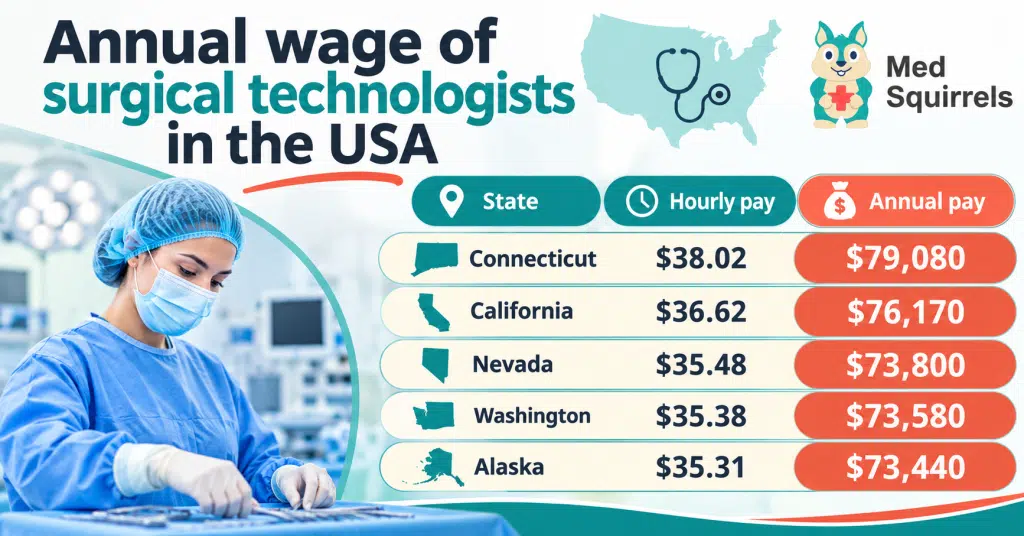
Source: U.S. Bureau of Labor Statistics
Developing long-term recruitment strategies for surgical technologists
The most essential practice to follow in staffing is maintaining strategies for long-term recruitment. These strategies help facilities attract skilled candidates.
It also helps you build a strong team that supports your long-term staffing needs.
Here are some approaches to consider:
- Offer competitive salaries based on industry benchmarks.
- Include additional benefits such as allowances and bonuses.
- Create a supportive and safe workplace where everyone feels heard and recognized.
- Provide career development opportunities through continued education and upskilling.
- Set clear career advancement pathways and communicate performance indicators to staff.
Following these approaches will help your facility retain skilled surgical technologists while building a stable workforce for the future.
Compliance and regulatory considerations to hire
Verifying the authenticity of the candidate’s academic credentials and documents is important. It ensures that the candidate has completed training from an authorized institution. In this process, as a recruiter, you can also ask for references from previous employers to verify the work experience.
You must also ensure that the surgical technologist is licensed to work in the state where your facility is located
If licensed, check the renewal history to avoid any future regulatory complications. It is important to document everything related to the surgical technologist hiring process.
Having fair evaluation criteria throughout the interview process might be useful in the future. If your facility plans to hire a surgical technologist for a specialized role, check certifications for that specialization.
A detailed infographic about the certifications related to specializations is added to make your checking process easy.
Certifications for surgical technologists and certifying bodies
Certifications | Issuing organization |
Ophthalmic surgical assisting | International joint commission on allied health personnel in ophthalmology |
Registered cardiac electrophysiology specialist | Cardiovascular Credentialing International |
Orthopaedic technologist-surgery certified | National Board for Certification of Orthopaedic Technologists |
Certified surgical instrument specialist | Certification Board for Sterile Processing and Distribution |
Certified Surgical First Assistant | Certification Board for Sterile Processing and Distribution |
source:mynextmove
Effective onboarding for the newly hired surgical technologists
When onboarding new surgical technologists at your facility, follow a detailed credentialing and compliance check process.
It is essential, as it ensures a smooth transition throughout the onboarding journey.
After credentialing, you can help newly hired surgical technologists collaborate with existing staff.
You can also start mentorship programs that help newly onboarded professionals. Starting mentorship programs is effective, as they can help them understand the facility’s values and policies.
Through these mentorship programmes, their performance can be evaluated at regular intervals. This will ensure that every surgical technologist integrates efficiently. It will also help them meet internal compliance standards.
On successful completion of the mentorship program, the newly hired professionals will be equipped to work independently in the facility. These efforts ultimately complement long-term surgical technologist recruitment strategies.
Simplify surgical technologist recruitment with staffing platforms
Recruiting surgical technologists involves more than sourcing profiles. It involves multiple tasks, and it also comes with multiple challenges. To overcome these challenges, you need to follow proven strategies.
One such strategy is choosing the right staffing platform. As a recruiter, you need to understand that there are various traditional staffing platforms throughout the USA.
However, partnering with these agencies comes with multiple challenges.Those challenges include high placement fees and slow onboarding processes.
A minimum credentialing process and limited screened profiles. To eliminate these challenges, you can choose technology-enabled platforms such as MedSquirrels.
This platform comes with multiple benefits, such as affordable plans to hire both contract and full-time professionals.
The platform operates on a flat-fee pricing model that is transparent and cost-effective.
Healthcare recruiters can book a free demo today to see how MedSquirrels can assist you in recruiting. Surgical technologists can also check open jobs and apply for those that match their skills.
FAQs
Are surgical techs in demand in both rural and urban facilities?
Yes, rural hospitals often face acute shortages, while urban centers compete heavily for experienced techs. Both settings require strategic recruitment approaches tailored to their specific market challenges.
How can healthcare employers address burnout among surgical technologists?
Facility managers can conduct workload assessments, create wellness initiatives, balance case distribution, and ensure adequate staffing levels to reduce stress and prevent burnout.
How can employers make their job postings more attractive to surgical technologists?
As a recruiter, you can mention clear compensation details, transparent shift expectations, and growth pathways; highlighting workplace culture can all make postings more competitive and appealing to candidates.
How does MedSquirrels ensure transparency in the hiring and billing process?
MedSquirrels uses a flat-fee pricing structure, giving facilities full visibility into pay rates, payroll costs, and licensing fees. This removes hidden markups and ensures complete clarity in every stage of the recruiting process.
Can MedSquirrels support both contract and full-time recruitment needs?
Yes. MedSquirrels offers tailored plans that allow facilities to hire long-term staff, short-term contractors, or a combination of both, depending on seasonal volume and staffing gaps.

Jani Basha is a Content Specialist with a background in healthcare content development, recruitment, and workforce management. His work focuses on the challenges healthcare facilities face in attracting, staffing, and managing clinical and non-clinical professionals. He develops content on healthcare recruitment, workforce trends, and staffing strategies. His work translates complex workforce topics into practical insights for healthcare recruiters. His work aligns with MedSquirrels’ mission to make healthcare staffing more efficient and cost-effective through technology-driven workforce solutions.