
What are the benefits of hiring a certified Midwife?

The need for quality maternity care continues to grow in recent times. There are multiple reasons for this growth, such as a growing population and a growing number of facilities.
To match the growth, every clinic is planning to hire skilled midwives to meet the needs of patients.
As a recruiter, you will be aware that meeting patients’demand while maintaining safe care can help your clinic to grow more.
Having a skilled midwife in your team can support mothers throughout their care.
This blog explains the key benefits of recruiting a certified midwife and how their skills can add value to your clinic.
Improves maternal and newborn outcomes at your clinic
The primary duty of facilities is to provide high-quality maternal care to improve the health and safety of both pregnant mothers and newborns.
To maintain quality maternity care, recruiters must hire certified midwives who are trained to deliver effective care before and after childbirth.
The presence of experienced midwives will give better patient outcomes, enhance care quality, and help hospitals provide safe maternity services.
Certified midwives contribute to safer maternity care through clinical expertise, such as:
- Skilled midwives will support mothers throughout pregnancy and childbirth, and help them recover after birth.
- These professionals will also identify possible pregnancy complications early and help mothers get timely care.
- Midwives will also check newborns and support their early care needs.
To maintain these contributions, you must have a planned midwife recruitment strategy.
Having a strategy helps you hire skilled midwives who will help you build a skilled maternity team for delivering quality maternal care.
To hire skilled professionals, as a recruiter, you must also be aware of market-trending skills.
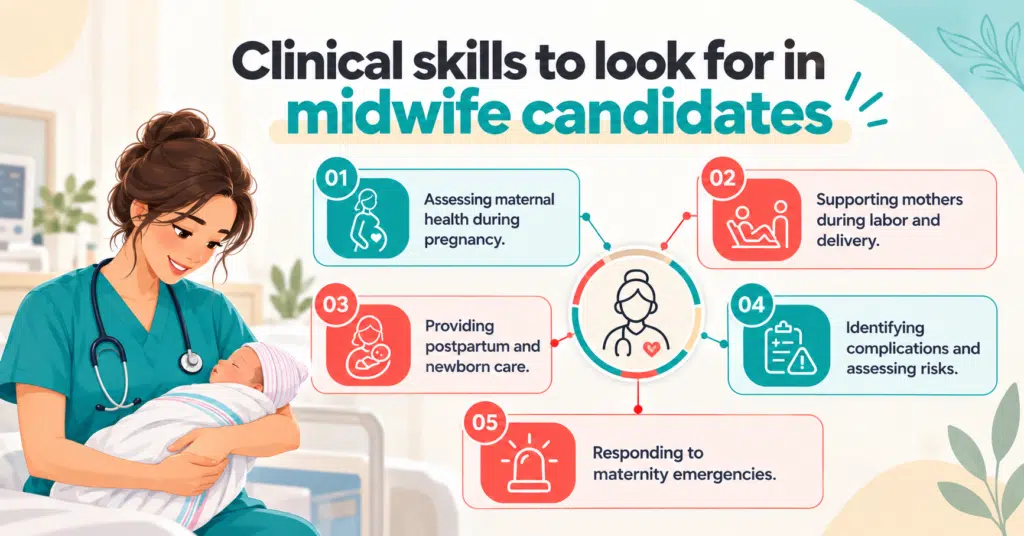
An infographic is added to provide a detailed overview of the essential skills you need to check and evaluate when recruiting.
Skills healthcare recruiters should look for in midwives.
Maximizes your clinical productivity
Healthcare facilities prefer recruiting professionals who can be efficient to overcome staffing gaps.
This is important because maternity care depends on well-coordinated teams. They help manage daily responsibilities and provide timely care to mothers and newborns.
A well-coordinated team is essential for effective collaboration. It helps physicians, nurses, and other healthcare professionals work together smoothly
This coordinated approach helps streamline daily workflows more effectively. It can also create a more efficient maternity care environment.
A certified midwife can support clinical productivity in several ways:
- Maximizes clinical efficiency by allowing each care team member to work at the top of their expertise.
- Optimizes clinical workflows by improving task distribution and resource utilization.
For Example:If you hire a certified midwife at your facility, they can manage routine maternity care. They can also work with obstetricians on complex cases. This can help maintain an efficient workflow without compromising patient care.
Reduces physician workload and staffing gaps
Facility managers must understand that staffing shortages can increase the workload on OB/GYNs. The growing demand for maternity care can make excising team to manage routine care alongside more complex cases.
To help address these challenges, facilities can hire a certified midwife to help distribute clinical responsibilities more effectively.
A certified professional can help manage routine prenatal, delivery, and postpartum care. Midwives can also work closely with physicians to support coordinated care.
For example, unfilled roles can increase the workload on physicians and may contribute to burnout. Recruiting a certified midwife can help physicians focus on high-risk pregnancies.
To work with a team of physicians who handle high-risk patients, you need to onboard experienced midwives. They should also have the right certifications for the role.
Having certified professionals will also increase your patient satisfaction.
As a recruiter, you should also be aware of the certifications required for the role and the type of care your facility provides.
To keep you informed, a detailed list of essential certifications for midwives is included.
Certifications and Credentials for Midwives in the U.S
Certification | Issuing body |
Certified Nurse-Midwife (CNM) | American Midwifery Certification Board (AMCB) |
Certified Midwife (CM) | American Midwifery Certification Board (AMCB) |
Certified Professional Midwife (CPM) | North American Registry of Midwives (NARM) |
Electronic Fetal Monitoring (C-EFM) | National Certification Corporation (NCC) |
International Board Certified Lactation Consultant (IBCLC) | International Board of Lactation Consultant Examiners (IBLCE) |
Source: BLS
How modern healthcare staffing platforms improve midwife recruitment
Recruiters who are looking to address workforce shortages at their clinics need skilled professionals. A midwife can help provide quality care to mothers and newborns
To provide quality care as a recruiter, you must follow proven tips to hire on time and within your budget. One such tip to follow is to compare traditional agencies with a modern healthcare staffing platform.
This comparison will give you a better understanding of traditional agencies and will make you less dependent on agencies.
Reducing your dependence on traditional agencies will enhance your staffing process, as they come with multiple challenges, such as a lack of transparent pricing and no credential support.
These agencies often rely on manual processes that delay candidate selection and the onboarding process.
To overcome these challenges, hospitals need to consider partnering with modern recruiting platforms such as MedSquirrels.
This technology-driven staffing platform gives you better recruiting solutions to source and hire the right talent within your budget while reducing administrative burden.
MedSquirrels also comes with affordable staffing plans to address staffing gaps.
There are multiple reasons to choose MedSquirrels as your staffing partner, such as:
- Flat-fee pricing model with no hidden markups
- Reduced overall recruitment expenses through a simplified pricing structure
- Provides credential compliance
Hospital owners can now book a free demo to see how the platform helps them make planned talent acquisition decisions. Professionals can also check open jobs and apply for those that match their skills.
FAQs
How can facilities address midwife staffing shortages?
Facilities can use a planned recruitment strategy to identify qualified midwives. Partnering with modern staffing platforms can also help facilities source candidates and hire on time.
Can recruiting a midwife help reduce physician workload?
Yes. A skilled midwife can manage routine maternity care while physicians focus on high-risk cases. Following this approach can help your facility manage workloads effectively.
What skills should recruiters look for when hiring a midwife?
As a recruiter, you should look for skills such as labor and delivery care and postpartum and newborn care. Checking these vital skills will help you hire a better professional.
How quickly can MedSquirrels provide midwife candidates?
With MedSquirrels, you can receive pre-vetted midwife profiles within 2–5 business days. This can help you address staffing needs without relying on lengthy recruitment cycles.
How does MedSquirrels have a different pricing model from traditional staffing agencies?
MedSquirrels uses a transparent flat-fee model designed to eliminate agency markups. It also has affordable plans that help you hire within your budget.

Siddharth is a Content Specialist at MedSquirrels, where he produces research-backed content covering healthcare staffing, workforce management, healthcare recruitment, and HR technology. His work includes SEO-focused articles, in-depth case studies, industry analysis, and practical resources designed to help healthcare clinics strengthen hiring strategies, streamline workforce planning, and keep pace with changing industry developments