
How to improve staffing in healthcare?
When a single job role goes unfilled in a facility, the impact spreads quickly. The workload often shifts to multiple team members who must cover longer shifts or take on extra responsibilities.
This leads to higher overtime costs per employee and increased staff strain. It can also affect patient satisfaction and the quality of care.
This blog explains how to improve staffing in healthcare by focusing on planned strategies instead of rushed decisions that create new problems. It highlights practical steps healthcare leaders can follow, even when budgets are tight and qualified talent is hard to find.
By following the strategies, facilities can ease pressure on existing teams, control staffing costs, and deliver high-quality patient care.
Prioritize employee satisfaction
Facilities must understand that healthcare staffing is not a secret; it can be a challenging process. There are physical and mental health concerns that come with recruiting.
To help address this issue, as a facility owner, you can prioritize employee satisfaction and address common challenges.
Important steps to achieve employee satisfaction are:
- Always remember to give your employees the resources they need to succeed in professional life by listening to their concerns.
- Healthcare facilities must encourage employees to take time off for self-care and offer flexible work scheduling.
- You must try to offer open platforms where employees can address their concerns.
- Follow the healthcare employee retention process to lower turnover costs and protect team continuity.
- Competitive compensation is also vital for employee satisfaction.
For example, if you want to hire a nurse practitioner, offering a market-trending salary is essential.
As a healthcare administrator , you must stay aware of current pay benchmarks, which is why a detailed infographic is added for clarity.
Top-paying states for nurse practitioners in the USA
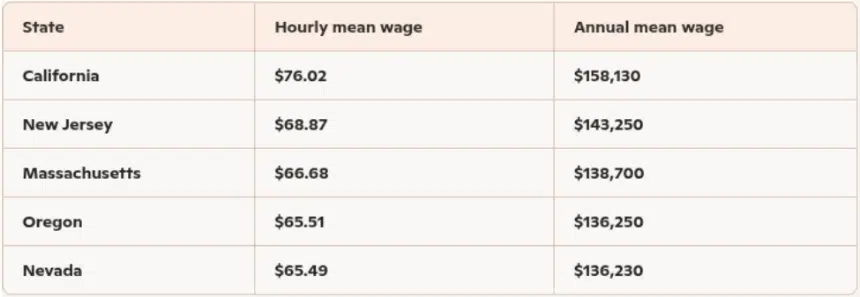
source: www.bls.gov
Hire the right candidate for the facility
The recruiting process in a facility is instrumental in setting employees up for success in their professional lives. Now is the time for you to examine your HR processes and identify and correct gaps or weaknesses.
Even if employees have the right qualifications, this does not mean they are fit for all open positions in the facility.
- Recruiters must be honest about job duties from the beginning of the process.
- Make sure to provide a clear job description and outline daily duties, such as scheduling, and mention the work environment
As a facility owner, hiring the wrong candidate often leads to higher turnover and ongoing staff shortages. This creates instability across teams, increases workload on existing employees, and disrupts daily operations. To hire the right candidate, you also need to know how to address and fix these shortages in the healthcare sector effectively
Invest in smarter and planned methods
Technology is evolving to improve outcomes and keep the workplace safe. In turn, healthcare facilities are updating their strategies to hire and complete the process on time, as required.
Practicing planned healthcare recruitment strategies, such to hire contract or full-time staff based on requirement will help facility owners overcome last-minute needs.
The following are the important strategies to practice to hire better:
- Facilities need to maintain data insights into staff to show where candidates drop off and why.
- Recruiters and facilities must use smarter strategies to maintain shift timings, which helps overcome resignations.
- Healthcare administrators can practice technology-driven planning to strengthen long-term efforts to improve staffing.
Upgrade onboarding and training structure
Facilities and healthcare administrators need to examine your current training and onboarding. This is to look for gaps and weaknesses.
If your training processes do not fully meet your facility’s needs, you may not receive quality services.
To overcome this, recruiters can talk to other employees about where training can be improved and take their feedback, where possible.
After this, if facilities are looking to know how to improve staffing in healthcare, then follow a strong onboarding process. It connects directly to stability and reduces constant rehiring.
Hire professionals from new sources
Recruiters must know that there are many ways to hire for your facility.
If your facility takes longer than required to find qualified candidates, you should consider working with a modern healthcare platform. Using the platform will benefit all roles.
Imagine if your dental office is experiencing staffing shortages.
You must know how to find and hire reliable dental staff fast with modern platforms. Doing so can make recruitment smoother and ensure consistent care.
Additionally, you must check the required skills for each role.
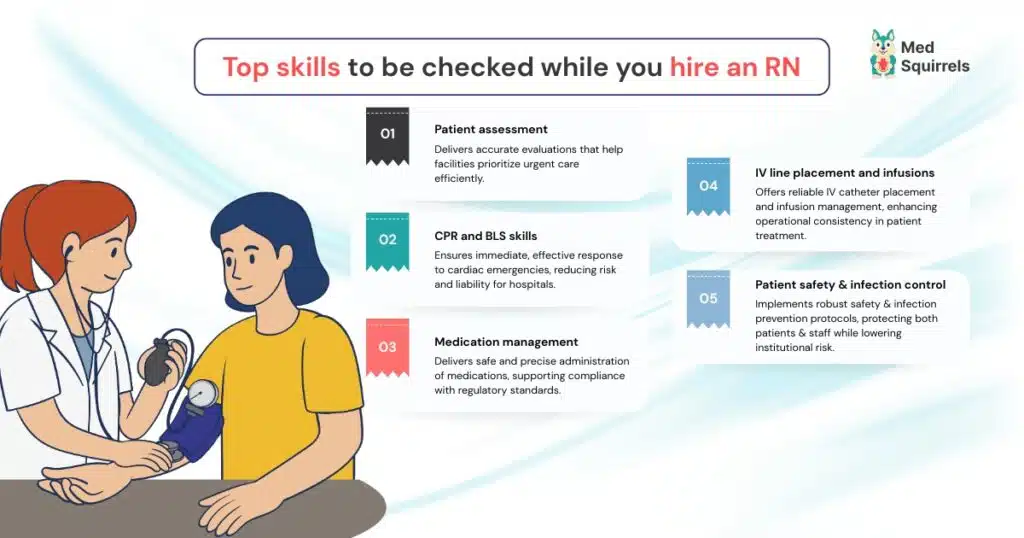
For example, when you hire a registered nurse, role-specific skills are clearly outlined.
These include clinical assessment, patient monitoring, medication administration, and compliance standards. An infographic explains these skills in a simple and visual way.
Key clinical skills to look for when hiring an RN
Completing the recruiting process with the right platform
To improve staffing outcomes, facilities must consistently apply the strategies outlined in this blog. This includes focusing on employee satisfaction, structured onboarding, and broader sourcing methods. When applied together, these efforts reduce the need for repeated recruiting.
However, strategy alone is not enough. Choosing the right platform matters.
Free job boards often attract slow, unqualified applicants, while traditional agencies incur high costs and rigid contracts that do not align with evolving healthcare staffing trends.
A modern platform like MedSquirrels addresses this gap by combining recruitment and payrolling/EOR into one intuitive SaaS dashboard, while delivering AI-matched profiles of qualified clinicians within 2–5 business days.
This makes recruiting faster and easier for healthcare facilities.
To support different needs, MedSquirrels offers three affordable plans without agency markups:
- Purple Plan manages EOR/payroll and handles HR, payroll, and benefits for self-sourced clinicians through an integrated platform.
- Orange Plan delivers full recruitment, including EOR/payroll, combining talent sourcing, hiring, compliance, and payroll into a single solution.
- Blue Plan focuses entirely on permanent staffing, supporting direct recruitment of full-time clinicians and non-clinicians.
By aligning proven strategies with a modern, technology-driven platform, healthcare facilities can build a more stable, cost-effective workforce that supports long-term growth and consistent patient care. Facilities in the USA can book a free demo to explore available plans. At the same time, professionals can visit our open jobs and apply directly, ensuring a smoother experience for everyone involved.
FAQs
Why is healthcare staffing such a persistent challenge for facilities?
It is persistent because it is affected by turnover, burnout, limited talent pools, and fluctuating patient demand. When roles stay unfilled, workloads increase, costs rise, and care quality can suffer. Addressing these requires both short-term coverage planning and long-term workforce strategies.
How can healthcare facilities improve staffing without increasing burnout?
Facilities can reduce burnout by balancing workloads, offering flexible schedules, and investing in better onboarding and training. Retaining existing staff is often more effective and cost-efficient than constantly taking new employees.
What is the most effective way to approach long-term planning?
As a recruiter, you need to understand how to improve staffing in the healthcare sector for long-term needs. You must start focusing on employee retention, analyzing workforce data, and creating proactive hiring plans rather than relying on reactive recruitment.
How does MedSquirrels support healthcare facilities with staffing needs?
MedSquirrels provides a centralized platform that combines recruitment, payrolling/EOR, and compliance management. This helps facilities reduce administrative workload while maintaining control over recruiting timelines and workforce planning
Is MedSquirrels suitable for both contract and full-time models?
Yes, MedSquirrels supports contract and full-time models through its plans. The Purple and Orange Plans provide EOR/payrolling services for contract clinicians or non-clinicians. The Blue Plan offers recruitment for full-time clinicians and non-clinicians, allowing facilities to choose what works best for them.

Suresh writes about healthcare staffing and industry insights for MedSquirrels, helping professionals and facilities navigate hiring needs.